Skip to content

2004

Xmas hols

Meta: I'm back in Dublin for a couple of weeks over xmas, so I won't be updating this weblog very much. See you in January!

BTW I flew back via Chicago, which is obviously the stopover of choice to Dublin from Silicon Valley -- surrounded by 1 iBook per every 8 passengers. ;)

PS: looks like they forgot Poland!

ireland dublin barcamp

An Open Letter to Sound System Developers

Linux: after about 3 months of tweaking and twisting, performed by someone who's been using UNIX for over a decade, I've finally got sound working the way I want it on my Linux desktop. In other words, I can hear sounds made by Flash applets, and I don't have to shut down the best music player on the platform every time another app wants to make a sound.

This is pretty clearly absurd.

So here's my open letter to the developers of the various systems (GStreamer, aRts, ALSA, EsounD polypaudio, et al):

  • Please DO do some testing with crappy sound hardware. I don't care if your sound system works great with a SoundBlasterLive 2006 with the kryptonite connectors, I have a laptop, for god's sake. That means software mixing is essential, because cheapo hardware doesn't do hardware mixing.
  • As an extension: please DO include software mixing by default. ALSA's pretty good in general, but having to hack out 55 lines of hand-tweaked config file before software mixing works, is insane. (Especially when the Wiki documenting that is full of notes that some of the magic numbers may not work on your hardware.)
  • Please DO use existing APIs if possible. That means esd. I'm looking at you, aRts. At least the latest sound project, polypaudio, looks like it's getting this right.
  • I DON'T care about network transparency, realtime response, or having a wah-wah pedal effect built into my sound server. That's just silly. Use a modular architecture to allow that in future, but concentrate on getting the basic stuff working first!
  • Please DON'T hardcode output device or output 'sink' names into the source. Looking at the kgst component of KDE here.

Meh.

Anyway, here's the scoop on what I had to do to get software mixing working in both GNOME, KDE, and Firefox, on my Thinkpad T40 running Debian unstable. Once I figured out the magic incantations, it now seems to be working without stutters or hangs.

Sometime in the next few months, of course, I plan to upgrade to Ubuntu Linux, and all bets will once again be off ;)

music linux mp3 sound drm

BSA's Spam Statistics

Spam: The Business Software Alliance, a UK anti-piracy body representing many of the major software vendors, recently issued a spam-related press release which got a lot of attention in the UK press (they have great press contacts!).

To quote John Graham-Cumming's newsletter on the subject:

1 in 5 British Consumers Buy Software from Spam: that's according to a survey by the Business Software Alliance. I find that a pretty surprisingly high number and considering it comes from an advocacy group that tries to get people to buy legitimate copies of software I expect it's not totally accurate. The one thing I find really surprising from the survey are these two statistics: 23% of spam is read by the person receiving it and 22% of people have bought software. Apparently, 11% of people surveyed like the idea of buying through spam because the software is cheaper.

It's still an interesting figure, but the BSA has come up with some pretty suspect statistics in the past, so pinch of salt applies. As jgc points out, the BSA have a vested interest in making the problem sound worse than it may be in reality.

Still, the survey PDF can be read here, and is worth a look.

anti-spam spam false-positives

EU Software Patent tricks -- very fishy antics

Patents: This is really absurd -- according to this ZDNet UK article, it now looks like the EU Council is considering railroading the EU software patent directive through, by hiding it as an 'A-item' in a Fisheries Council Meeting the week before xmas:

Laura Creighton, the vice-president of the Foundation for a Free Information Infrastructure (FFII), is concerned that the EU Council could be contemplating passing the directive without discussion in an unrelated meeting.

'Before today it was possible for generous people to look charitably at this text (the proposed patent directive) as an example of a tragic mistake, not malice,' said Creighton in a statement on the FFII Web site. 'But not with this last-minute manoeuvring.'

'Only the most committed opponent to the democratic process would believe that the proper response to the widespread consensus that there is something profoundly wrong with the Council's text is to race it through with an A-item approval the week before Christmas in a Fisheries Council Meeting. The bad smell coming from Brussels has nothing to do with the fish.'

Reportedly, A-items are dealt with by asking the assembled councillors if they have any objections to any of the outstanding items. They're not listed in detail at the meeting, so this way the directive can be passed in what is effectively a submarine (boom boom!) manner.

Related: Alan Cox has not been invited to the UK Patents office's public meeting on software patents tomorrow.

In a Talkback to ZDNet UK's earlier story highlighting the issue, Cox wrote: 'I too was mysteriously overlooked despite having written to my MP and received an answer.' .... Cox, who has previously been invited to speak on software patents at the EU, said the Patent Office apparently fears 'every word I have to say about their plans'. He went on to add: 'Unfortunately with all the underhand game playing both in the EU council of ministers and in UK government and patent circles it isn't the slightest surprise.'

Also related: Jason Schultz (EFF) on the Commerce One web-services patent auction last week:

Here, the patents at issue were less valuable to companies that actually produce Web services products than they were to firms that produce nothing but lawsuits and licensing threats. In other words, patents like these have become worth more as weapons than as protections for companies competing in the marketplace.

Many have compared these new patent licensing firms to terrorists, and in some ways, the analogy is apt. When the Soviet Union collapsed, one of the biggest worries was that rogue military personnel might sell off one or more of the USSR's nuclear missiles to a terrorist group. Securing those weapons became a top priority. The reason was fear -- fear that the terrorists, who had little to nothing at stake in terms of world peace and national stability, would use the missiles to extort or manipulate the world political climate. Unlike the United States or China, which could be retaliated against and which had a stake in stability, terrorists were essentially immune from attack, and thrived on instability.

With the patents of bankrupt dot-coms, the dynamics are similar. Rogue licensing firms buy up these patents and then threaten legitimate innovators and producers. They have no products on which a countersuit can be based and no interest in stable marketplaces, competition or consumer benefit. Their only interest is in the bottom line.

While profit itself is often a worthy objective, it is not always synonymous with innovation. Every dollar a tech company pays to patent lawyers or licensing firms is one less dollar available for R&D or new hires. Thus, many companies that offer new products end up paying a 'tax' on innovation instead of receiving a reward. When this happens, it's a signal that the patent system is broken. Forcing companies to pay lawyers instead of creating jobs and new products is the wrong direction for our economy to be headed and not the result our patent system should be promoting.

eu swpats ireland patents law linux us google

playing around with Google Suggest

Web: Google Suggest, a drop-down list of suggestions -- with hitrates! The one letter hits are interesting, too.

"spam" hitrates, the top 3 (aside from "spam" itself):

  • "spam filter": 6,400,000 results
  • "spamcop": 1,570,000
  • "spamassassin": 1,350,000

in the top 3. getting there!

unfortunately, you have to get as far as "justin ma" before my name shows up, so not doing too great in that competition. ;)

anti-spam spam spamassassin

too busy worrying about patents to care about copyrights

Patents: oh, this is painfully ironic.

patents4innovation.org is a PR site set up by EICTA, a consortium of several pro-software-patent multinational companies, to put some PR money into lobbying for the legalisation of swpats in the EU. I've mentioned it before in the context of another boo-boo. Well, here's the next one.

According to FFII, they recently took a Creative-Commons-licensed article from another website, and:

  • republished it without the required attribution to the author
  • translated it, creating a 'derived work', against the terms of the license
  • and then failed to notify readers of the licensing terms, as required

In other words, they managed to infringe the terms of its copyright-based licensing in multiple clauses.

No wonder they claim that patents are required to protect people's inventions. It seems they just don't understand how copyright-based licensing works ;)

(The article's been taken down from the p4i site, but not before the boo-boo was spotted by an eagle-eyed FFII'er.)

ireland law ip patents swpats copyright

Interesting/bizarre recent spam

Spam: some good crazy spam recently -- firstly, some Seventh Day Adventist lunacy:

THE PAPACY IS THE ANTICHRIST THAT IS TRYING TO CHANGE THE LAW OF GOD. DANIEL 7:25

THIS IS THE LAST WARNING.
THE LAW OF GOD IS ETERNAL BECAUSE GOD IS ETERNAL 14:12. MT. 5:17 SATURDAY SEVENTH DAY IS THE TRUE LORD'S DAY. EXO. 20.8-11 SUNDAY IS A FALSE PAGAN DAY. IT IS NOT IN THE BIBLE. IT WAS USED TO WORSHIP SATAN

It runs on in that vein for quite a while. Interestingly, most of the text from there on in is 'gappy' -- in other words, the spammer has inserted spaces between each character of a word -- even inside link addresses. As a result, they no longer work. oops!

And a new one to me -- natural-disaster spam (via Mark Pilkington):

THIS IS AN OFFICIAL WARNING!
fngva uvtt chloez

A huge 300 ft. high ocean wave is moving towards your continent. Your and many other cities are in a real danger.
Approximate wave moving speed is 700 km/h.
cmoym eaaa yypbzz

Please read more about this catastrophe here: (link)

We are strongly urging you to evacuate yourself and your family as soon as possible,
even though you may live far away from your city. The tsunami will reach the continent in approximately FOUR hours.

venbz nwvw exepmi
YOU HAVE BEEN WARNED!

I've removed the link, btw -- the site it links to contains a bunch of nasty malware-installing IE-bug exploits. In case you were wondering: you can tell it's genuine because it says IT'S AN OFFICIAL WARNING at the top.

(ObSpamComment: note -- this here's a good example of why spam is unsolicited bulk email, not unsolicited commercial email; neither are selling anything. one's religious craziness, the other one's trying to r00t your machine.)

anti-spam spam community

Moving House

Life: I'm moving house -- I've just filled about 20 boxes, now to get moving them! Sadly, there's no wifi in range of my new house, so the upshot is I may be offline for a few days. Boo.

home wifi google

Fun Times Ahead with Nathan Myhrvold

Patents: Newsweek: Factory of the Future?:

The dino's ferociously bared teeth hint at elements of Intellectual Ventures' bold business plan. Myhrvold and his partner, former Microsoft chief software architect Edward Jung, have created the quintessential company for the 21st century. It doesn't actually make anything ... Only patent attorneys populate the quiet hallways. ...

Sources familiar with Myhrvold's strategy say that he has raised $350 million from some of the largest companies in high tech: Microsoft, Intel, Sony, Nokia and Apple. Google and eBay also recently invested. With this large bankroll, the company is out buying existing patents in droves. (Myhrvold won't comment on these activities, but sources say he has already purchased about 1,000 patents.) The strategy is to set up a sort of patent marketplace. Patent owners get money upfront for the dusty ideas sitting on their shelves, the investors get the rights to use the ideas without being sued and Myhrvold gets to rent those same ideas to other companies that need them to continue creating products. ...

"We're concerned that these giant pools of patent rights are going to prevent entrepreneurs from entering markets, as opposed to being used to promote innovation," says one worried Silicon Valley venture capitalist.

Now that's scary...

swpats patents ip google

EFF's clueless spam filtering white paper

Spam: The EFF are a great organisation -- damn, I even helped set up an organisation based on its goals in Ireland, back in the day! But this white paper is shockingly clueless.

(Note: this posting has been updated. Original left intact, but there's an update below worth noting.)

For example:

Spam Assassin, a popular program that does ad hoc pattern matching, assigns 'points' to various features of an email to determine whether it is spam. ... One of the major problems with this system is that messages from certain countries -- like China, for example -- can be blocked purely on the basis of where they come from and what language they're in. The implications for free speech here are very troubling indeed: ... thus anti-spam technology unintentionally works as a political censorship mechanism.

SpamAssassin does not give points for country of origin, or language the message arrives in, unless the user explicitly either (a) adds rules from an external source, or (b) modifies the 'ok_languages' setting in their configuration, from the default, to specify that they do not want to receive messages in particular languages. No country- or language-blocking happens by default. This is by design.

It's a shame that the authors felt the need to outright fabricate a danger, here.

The white paper features more broad generalisations about 'spam filters', mostly using unsubstantiated friend-of-a-friend stories, without detailed data. And I do know that there have been cases of MoveOn.org, at least, being a source of UBE, in the past -- so it's not valid to claim that this is all a 'free speech' issue; political UBE is still spam.

They need to realise there's a lot of very smart, very reasonable anti-spammers out there, and most of us agree with the rest of their goals, except for their spam position. This is hurting them.

Still, it appears they're finally getting a clue about requiring subscription requests be confirmed using closed-loop opt-in, so that's good. More political newsletters, and political campaigns, need to get this clue -- just because it's political speech does not mean it's not spam. (I have several thousand political spams in my spam folder -- most from that German anti-immigration virus from earlier this year.)

Note that Rod is unsure if they're practicing what they preach...

Update: Annalee Newitz has been in touch, and pointed out that the white paper in fact says 'mails ... can be blocked', rather than 'are blocked' based on country of origin. In other words, it's purely a matter of this being possible, rather than the default, and that administrators apply these customisations.

In addition, she notes that the conclusions recommend that ISPs and administrators of spam blocking systems allow end users to control their own filtering settings, saying 'If a user wants to block all mail from China, great. If a sysadmin does it for a bunch of users without permission, then that is a problem in our opinion.'

So I agree with that. Misdirected outrage hereby turned off ;)

(Mind you, I still think they need to work more with the reasonable anti-spammers... and fix that unconfirmed sign-up that Rod mentioned, if it's really still unconfirmed!)

anti-spam spam filtering

ApacheCon, and cranes falling into the sea

Trips: So I'm just back from ApacheCon 2004, which took place in the lovely Alexis Park building site ;)

Good fun was had -- very interesting to meet all the faces behind the names from various mailing lists and blogs, and get the inside track on how the ASF really works... there's quite a lot you don't get to understand from the outside, or even from being a committer. So, a useful trip.

Most of the talks were, naturally, very web-oriented -- we'll have to see what we can do about that, next time around! One useful tidbit: I didn't realise, but found out at the conference, that the ASF ConCom are very generous with paying speakers' expenses. So maybe next time I'll join the speaker line-up, too.

A major goal, one we achieved, was an impromptu SpamAssassin developer summit, 5 days sitting down together hammering on bugs and plans, with 4 of the main developers present (myself, Daniel, Theo and Michael). Pretty much achieved, although there were some thorny bugs to deal with... one interesting factor is that we may now be moving towards emulating the Apache httpd's preforking model to deal with a memory/performance issue we're seeing in 3.0.x.

Finally -- this sequence of photos has been cropping up all over the internets. When I saw it, I immediately thought it looked a lot like Ireland -- and Roundstone, Co. Galway, in particular. Sure enough, it appears it is! I guess the Connemara landscape of Roundstone's bay is pretty memorable, after all...

apache spamassassin conferences asf solaris virtualization coding apachecon

patents4innovation.org

Patents: Patents4Innovation is a new site set up by several European multinational companies to lobby for the legalisation of software patenting in Europe.

Their FAQ is good for a laugh, including an answer that basically says that the Patent Office needs to do a better job, and another which states that opponents of software patents have been unable to demonstrate any 'convincing' evidence of swpats causing economic harm (despite the FTC and PriceWaterhouseCoopers reports, which are pretty high-profile organisations).

But the best quote -- in fact, the only quote -- appears on their Testimonials and Quotes page. Here is in full:

"... successful and profitable high-tech enterprises seem to be characterised by holding patents and copyrights. These instruments might reduce the vulnerability of firms with respect to competition and equip them with a more favourable market position."

Source: the "Observatory of European SMEs 2002 / No 6: High-tech SMEs in Europe", commissioned by the European Commission

(My emphasis.) Of course, there's nothing worse than having to compete on a level playing field. ;)

(Thanks to Christian Beauprez for spotting that!)

patents swpats uspto ireland linux

New Scientist's psychic website

Web: The lovely C sent me a link of note -- it's the eglu, 'the world's most stylish and innovative chicken house and is the perfect way to keep chickens as pets'. (She has a thing about keeping chickens.)

So I was all set to link to that on NoMoreSocks.newscientist.com, New Scientist's nifty new xmas-pressies site; but -- get this: it will not load in Firefox 1.0PR, 1.0, or Konqueror at all -- in fact, using telnet, the site doesn't actually respond to requests on port 80 from my linux desktop.

The only browser it seems to work with is MS Internet Explorer in VMWare, presumably using MSIE's psychic powers to contact it without going through TCP/IP.

Mysteriously, it can be lynxed from my server in Ireland, but similarly doesn't work for C's Firefox installation on her desktop. How wierd!

meta security javascript web google

One Really Stupid Feature

Usability: So, I've just found out about a useless feature of my microwave oven the hard way. The microwave's manual notes:

Demo Mode

The Demo Mode is ideal for learning how to use the microwave oven. When set, functions can be entered without actually turning on the magnetron. The microwave oven light will come on, the fan will run and, if on, the turntable will rotate.

To Turn On/Off: The microwave oven and Timer must be off. Touch and hold TIMER SET.OFF for 5 seconds until 2 tones sound and 'd' appears on the display. Repeat to turn off and remove 'd' from the display.

Great! How useful! What a friendly UI! A tiny 'd' that indicates that, although your microwave looks like it's cooking away, it's actually doing nothing.

If you ever want to prank a friend with a Whirlpool oven, I'd recommend this one ;)

usability ui funny home

Global Guerrillas

Politics: Global Guerrillas: 'Networked organizations, infrastructure disruption, and the emerging marketplace of violence. An open notebook on the epochal war of the 21st Century.'

This stuff is scary -- and I think it's right; the author thinks Bin Laden sees the US as an over-stretched 1980's Russia, vulnerable to economic collapse; his last communique talks about what he calls the 'bleed-until-bankruptcy plan'.

Bruce Sterling says 'You ever read my 80s novel ISLANDS IN THE NET? The one with a sinister, imaginary book of military strategy in it called THE LAWRENCE DOCTRINE AND POSTINDUSTRIAL INSURGENCY? Well, this blog feels a lot like I imagined that book would have felt. Kinda floods the mind with creepily subversive 21st century insight.'

Definitely worth reading.

politics history internet

'Stubberfield' falls victim to first felony anti-spam conviction

Spam: 2 found guilty in first felony spam conviction: 'LEESBURG, Va. - A brother and sister who sent unsolicited junk e-mail to millions of America Online customers were convicted Wednesday in the nation's first felony prosecution of distributors of spam.'

Jeremy D. Jaynes, 30, (aka. Gaven Stubberfield) and Jessica DeGroot, 28, convicted to nine years in prison and a $7,500 fine respectively.

Nine years -- wow, that's a serious conviction for spamming... Virginia clearly takes this very seriously, as the home of AOL. Let's see if this causes any of the remaining spammers to think twice.

spam anti-spam gmail filtering

Four More Wars

Politics: Disaster. I can't believe it.

politics history funny

NoSoftwarePatents.com, and Michel Rocard appointed to draw up EP swpat response

Patents: I haven't been blogging much, as I've got the damn flu. I thought I was clear after a minor bout, then it came back around again for another run... urgh. Now I'm all hot, confused, achy, and (due to it affecting my ears and therefore sense of balance) clumsy. Damn you, influenza virus! :(

But there's some good news -- NoSoftwarePatents.com has opened, with a nice, clean, clear website full of excellent content. Not only does it cover the usual list of basics, with good examples like FFII's web-shop example, it goes into more detail about parallels; here's a great one:

Patents on software are just as wrong as expanding the patent system to literature. With patents on story elements, no movie could be published without having to firstly check whether there is any general idea in the storyline that someone patented during the last 20 years. Here's an example: At first sight, Dirty Dancing and Titanic are two very distinct movies. However, if there were patents on story elements, then the makers of Dirty Dancing could have sued the studio of Titanic. Both movies have a scene in which a poor boy takes a rich girl from a party of her social peers to a dancing party of his group, and she enjoys it. Dirty Dancing came out only nine years before Titanic, so any patent would still have been in force. No one knows whether James Cameron had that Dirty Dancing scene in mind as he wrote the Titanic script. Maybe Cameron never saw Dirty Dancing but the patent (if it existed) could be used against him anyway.

That's exactly the right parallel to make! Software patents cover the tens to hundreds of little algorithms you need to put together to make a software product, and comparing an algorithm in a software product to a scene concept in a movie, illustrates that nicely.

Each page has a little quote from heavy-hitters like Bill Gates, Oracle, Deutsche Bank, PriceWaterhouseCoopers, etc., coming out against swpats. There's also a section dealing with the disinformation that the other side has been putting out.

Next time you need to send a URL over to educate someone about this issue, this is the one to reach for.

Some news on the EU Software Patents Directive -- IDA eGovernment News reports that 'the formal approval of the draft Directive on the patentability of computer-implemented inventions by the EU Competitiveness Council has been postponed due to translation delays', and notes that 'on 6/10/2004, the Parliament's Internal Market Committee selected former French Prime Minister Michel Rocard to draw up its response.' It goes on:

Unsurprisingly, the appointment of Mr Rocard -- an outspoken adversary of software patents -- was welcomed by opponents of the proposed directive and criticised by its supporters. That Michel Rocard is taking over the dossier reflects the fact that the wider economic, infrastructural and social implications for Europe are now seen more clearly. Also, in the Council a learning process has begun, and it will be supported by the Parliament's move, Mr Holger Blasum of the Foundation for a Free Information Infrastructure told journalists. On the oher hand, Francisco Mingorance of the Business Software Alliance pointed out that Mr Rocard hasn't shown any sympathy to the directive in the past. We can only hope he will be sufficiently open to the view of persons and groups which have a different opinion, he said.

Well, that sounds like good news to me ;)

patents swpats coding patenting linux

Why implanted ID chips are bad for privacy

Security: The RFID vendors are clearly on a roll, with all manner of uses being proposed. The most recent story is that VeriChip plans to implant them subdermally in hospital patients.

The company line is that it's privacy-safe, since it doesn't expose health records per se -- just the patient's ID number. However, that's missing the point, in my opinion.

RFID chips will broadcast their ID whenever they are within range of a compatible scanner, and the range (in this case) is several feet -- although the story notes that their readers used to track farmed salmon work from 10-12 feet, and the Schmoo Group guys I met last month had no doubts that a high-powered directional antenna like their wi-fi sniper rifle could extend that. There's no encryption, or handshaking, in these chips, it sounds like.

There's no mention if the chip is removed after you leave hospital; some comments about the idea behind this is that it may help if you're involved in an accident, and want your info available to healthcare users, in which case you'd have the chip implanted and broadcasting at other times, in other places, as well.

So, if you've got one of these implanted, it'll broadcast a unique code to readers in range at all times. If an attacker can scan while you're nearby, and picks up that code, they know that it's you, and you only. They only have to match that ID code to a visual identification once, and henceforth you can be tracked by that ID code.

There's a possibility that they'll fix this, by upping the CPU power and incorporating some decent public-key encryption -- but then you need a PKI big enough to track every implanted citizen in the entire country, and the costs will go up and up. I'd find that doubtful. (Mind you, they seem to assume that having a centralized secure database of medical records is a fait accompli in most of the articles anyway, so...)

rfid ireland privacy security

Cambodians Eager to Dine on Rats (fwd)

Funny: AFP: Cambodians Eager to Dine on Rats:

'At first I just cooked them for my family to eat, but guests who tried them said they were tasty, so I started selling a few fried rats to the villagers,' he said. Business boomed so he devoted his menu to them.

' We only eat the small rats -- we dare not eat the big ones because they have too much hair.'

Big in Laos, too -- although I don't think I've heard of sit-down restaurants selling them. When I was travelling in Laos, one of the first tips I heard from other travellers was, 'if you see something that looks like a fried rat -- it is'. urrgh.

(BTW, there's actually good reasons not to eat rat-meat; wild rats and mice are truly filthy animals, vectors of all sorts of nasty diseases.)

food thailand politics

Selves and Others now publishing RSS feeds

News: Selves and Others is a site that cropped up a couple of months ago, tracking the output of many of the left's strongest voices, for example:

Well, one feature they were missing was RSS feeds, allowing users to track new articles by a specific author as they're published. They've just added it; the good old orange XML button now appears on each author's page. Excellent!

rss feeds ireland blogs

Playing US games on a European PlayStation 2

Games: when I moved from Ireland to the US, I brought along my PS2; I hadn't had it that long, and I wasn't going to leave it behind (despite many offers to give it a good home ;).

Of course, Sony include plenty of trade-restrictive features in the PS2; European games won't play on a US PS2, and vice versa. So until now, I've been playing the few games I brought along from Europe, with the help of a YPbPr VGA converter, allowing the PS2 to display on a VGA monitor, and a transformer to transform 110V US current to 220V.

But that was before the superb japanese craziness of Katamari Damacy came along, and with GTA: San Andreas due out next month, something had to be done.

So -- after a little shopping, I found the solution -- rather than get into serious stuff like soldering, I got this -- the Slide Card. It's a 1.5-inch long piece of plastic, with a carefully placed notch. It requires one piece of PS2 modification -- you first of all have to remove the front of the CD panel. This just requires popping out one screw and a couple of clips, painless. You can then leave it off -- it's purely cosmetic -- or stick it back on if you really want to, at a future date.

Then, when you want to play an import game, the protocol goes like this:

  • put in the Slide Card boot DVD, power on the PS2
  • wait for the Swap Magic splash screen
  • insert the little plastic Slide Card, and slowly drag it left-to-right until it hits a piece of plastic internally
  • use it to pull out the CD tray, place the import DVD into the tray, and push it back in
  • use the Slide Card again, grabbing a little internal peg part with the notch in the card, and dragging the card right-to-left to load the CD into place.
  • hit 'X' on the PS2 controller, and the game boots!

So, this is a nifty solution; it basically works around the disc-replacement logic in the PS2, without any soldering or hackery required. And I've successfully used it after a night at the bar on several occasions, so that's the true test of how twiddly it is ;)

Unfortunately, by now I've probably spent nearly as much on hardware to play US PS2 games with a European PS2, as I would have if I'd just bought a US PS2. But hey...

gaming games hacks

Indymedia cross-border takedown reaches Slashdot

Web: The slashdot story. The comments contain a massive amount of noise, but there are some highlights...

Some details of the backend; it appears Indymedia need more mirrors, and the imc-tech list and #tech channel are the best contact locations to get in touch. The comment also notes that the Mir CMS used by most IMCs generates static HTML -- which is a good thing! I hereby withdraw my kvetching about server-side dynamic scripting in that case ;)

The techie who 'had the contract with Rackspace' comments, and provides a link to his weblog, which contains copies of the trouble tickets.

He also notes that the possible illegal posting was a newswire submission -- therefore not 'published' per se, just uploaded in the same way an unmoderated-up slashdot comment is.

And finally -- he notes that the EFF are offering to represent himself and Indymedia pro bono. Yay EFF!

The Electronic Frontier Foundation (EFF) is currently assisting Indymedia investigate possible responses to the seizure of its information. More than 20 Indymedia-related websites, along with Indymedia's online radio, were hosted on the servers, which were dedicated machines provided by Rackspace.

'This seizure has grave implications for free speech and privacy. The Constitution does not permit the government unilaterally to cut off the speech of an independent media outlet, especially without providing a reason or even allowing Indymedia the information necessary to contest the seizure,' said EFF Staff Attorney Kurt Opsahl.

This is great news. Top-secret takedowns are not a good thing, especially when they span three national borders...

ireland politics uk internet filtering http

More on the Indymedia shutdown

Law: t r u t h o u t quotes this press release from Rackspace:

In the present matter regarding Indymedia, Rackspace Managed Hosting, a U.S. based company with offices in London, is acting in compliance with a court order pursuant to a Mutual Legal Assistance Treaty (MLAT), which establishes procedures for countries to assist each other in investigations such as international terrorism, kidnapping and money laundering. Rackspace responded to a Commissioner's subpoena, duly issued under Title 28, United States Code, Section 1782 in an investigation that did not arise in the United States. Rackspace is acting as a good corporate citizen and is cooperating with international law enforcement authorities. The court prohibits Rackspace from commenting further on this matter.

(my emphasis.) I wonder which of those 3 Indymedia is supposed to have been infringing? It's pretty clear how Rackspace feel about this situation, I think.

It seems MLATs have been used before to shut down Indymedia sites in the US; this cryptome mirror of Montreal IMC pages documents one such case. Here's a summary from a quoted email there:

Heres a quite interesting story on the power of mlats and what we will have to look forward to with the COE treaty :

A cop car was broken into in Quebec and a security doc relating to measures for the Free Trade Area of the Americas summit protests was stolen and posted in the net in Seattle. At the behest of the RCMP, a magistrate judge issued an order to grab the records from a Seattle web site called the 'independent media center' using the US/CAN mlat. They were then visited by the FBI/Secret Service. They then had a gag order on this for several days before it was released today.

Great precedent. I wonder if when my car gets broken into again, I can use the cybercrime treaty to find my stereo again...

And snippets from the IMC press release of the time:

On the evening of Saturday, April 21, a day which saw tens of thousands demonstrate against the FTAA in the streets of Quebec City, the Independent Media Center in Seattle was served with a sealed court order by two FBI agents and an agent of the US Secret Service. The terms of the sealed order prevented IMC volunteers from publicizing its contents; volunteers immediately began discussions with legal counsel to amend the order. This morning, April 27, Magistrate Judge Monica Benton issued an amended order, freeing us to discuss the situation without the threat of being held in contempt.

The original order, also issued by Judge Benton, directed the IMC to supply the FBI with 'all user connection logs' for April 20 and 21st from a web server occupying an IP address which the Secret Service believed belonged to the IMC. The order stated that this was part of an 'ongoing criminal investigation' into acts that could constitute violations of Canadian law, specifically theft and mischief. IMC legal counsel David Sobel, of the Electronic Privacy Information Center, comments: 'As the U.S. Supreme Court has recognized, the First Amendment protects the right to communicate anonymously with the press and for political purposes. An order compelling the disclosure of information identifying an indiscriminately large number of users of a website devoted to political discourse raises very serious constitutional issues. To provide the same protection to the press and anonymous sources in the Internet world as with more traditional media, the Government must be severely limited in its ability to demand their Internet identity--their 'Internet Protocol addresses.' A federal statute already requires that such efforts against the press be approved by the Attorney General, and only where essential and after alternatives have been exhausted. There is no suggestion that these standards were met here.

The sealed court order also directed the IMC not to disclose 'the existence of this Application or Order, or the existence of this investigation, unless or until ordered by this court.' Such a prior restraint on a media organization goes to the heart of the First Amendment. Ironically, the Seattle Post-Intelligencer learned about the existence of the order from 'federal sources,' suggesting that the purpose of the gag order was simply to allow the government to spin the issue its way.

The order did not specify what acts were being investigated, and the Secret Service agent acknowledged that the IMC itself was not suspected of criminal activity. No violation of US law was alleged.

Of course, cryptome is still chugging away as it always has been; simple HTML and no server-side dynamic scripting, means easy offshore mirroring ;)

ireland filtering law copyright politics internet science

How to turn a stale project site into a useful Wiki

Web: Almost every project and organisation has, at some stage, bemoaned having stale data on their website, and wished there was a better way to keep it up to date; or wished their FAQ was more complete; or wished they had the time to HTML-ize all their know-how and get it up there.

Well, here's what we did in SpamAssassin to deal with this problem. (Seeing as I've talked about this three times in the past month, I'll write it up here so I can just point at the URL next time!)

First off, we experimented with having the site checked into CVS, FAQ-o-matic, and the Python FAQ software (which was pretty good). All were OK, but very specific in format, using the traditional question-answer FAQ layout -- that's good for FAQs, but not so good for a lot of other stuff -- and keeping it updated was still limited to a small group, therefore the info got stale again.

So we moved to a Wiki. Here's my tips for Wiki-izing your website so that the end results are better than what went in.

Use good wiki software: unusable software will be a pain to use, and the info will still go stale. We used Moin Moin - http://moin.sourceforge.net/ - partly because I like Python (it's nearly perl! ;), it can produce RSS, and it was pretty easy to install.

Don't worry: people won't vandalise it (much). It turns out that vandalism and people throwing up crappy info isn't a serious problem at all. You should increase the barrier, in the following ways:

Require user accounts: set the security policy so that a user account must be set up before editing is possible. This means you won't get wiki-spammed, and also has the side effect of imposing a pretty big barrier to casual vandals.

Send changes to a list: set all changes to be mailed to a mailing list as diffs. This is the most important tip. If you already have a mailing list with the knowledgeable part of the community on it, use that list -- because they're the ones who'll be able to recognise if erroneous info is put up, and will be annoyed about this enough to bother fixing it. There's a bonus side-effect of this; even if some people didn't like the wiki to start with, they'll eventually be needled into using it by wanting to fix stuff they perceive as wrong. And then they get sucked in ;)

Use diff for the mailed changes: Moin by default will only send out change messages saying 'something changed on this page!'. That's not good enough, unfortunately -- you want to mail out what the new text looks like, and highlight exactly where the change happened. Moin can do this nicely, with this patch, which adds a mail_commits_address, where all diffs on every page are sent, using the normal diff mechanism.

Ensure the wiki software can revert quickly: If someone does make a bad change, Moin supports one-click reversion of the page to what it was beforehand. That's great for dealing with spam, or clueless vandalism.

Keep one or two static pages: If you're worried about some script kiddie thinking that defacing a wiki makes them look cool, then keep one or two of the primary user-facing pages as static data. For example, take a look at the link-bar at the top of http://spamassassin.apache.org/ ; five of the ten links are to static pages, the other five are now wiki-ized. In particular, our front page and our downloads page are both static, but our docs are predominantly Wiki'd.

Publicize Mozex: most techie groups will have techie users, and we hate using browser text-boxes to edit text. Mozex -- http://mozex.mozdev.org/ -- saves the day here -- it's a godsend.

Shepherd new changes: in the early stages, you want one or two people who tidy up changes from Wiki newbies, as they go in. They need to keep it looking pretty, and perform Refactoring of stuff that could be laid out better or should become multiple pages. Eventually, others will get the hang of that (and do a much better job than you do ;).

That's the lot. Most of these are to, essentially, migrate aspects of your already-existing and already-working community into this new outlet. In our experience, it's worked really well -- our Wiki is now the most reliable source of info about SpamAssassin, and is extensive and up-to-date.

open-source web software
Indymedia server drives seized

Politics: Indymedia's hard drives in Rackspace UK seized by FBI order, seemingly as a 'courtesy' to Swiss police. There's several morals to be learned:

  • Rackspace UK are happy to roll over for the US feds;
  • it appears the action was taken using powers granted under the USA-Patriot Act;
  • hosting in Europe is not safe from bad US laws.

However, the UK site is back on the air, and reportedly they're recovering nicely; 'All this goes to prove that Indymedia is decentralised enough (but not perfectly) to survive an attack and that as a cooperative international network, we rock!'

ireland filtering internet web uk copyright

more on H5N1 Bird Flu

Health: A few hours after ( ;) I link-blogged this New Scientist article about a case of the H5N1 avian flu transmitting itself between humans, Boing Boing put up this entry titled 'Bird Flu risk extremely low', which concludes that the risk is effectively not worth worrying about.

It's fundamentally wrong, and is well worth pointing out as a result. As Quinn at ambiguous.org says, it's not the danger now that's important here -- it's the potential.

I read New Scientist religiously, so I've been following it, and this search on H5N1 gives the perfect illustration of why this is well worth worrying about:

(Now, while it's worth worrying about, it's not us end-users who should be doing the worrying. It's the politicians who need to ensure CDC and the WHO are funded well, the terrible state of vaccine development and production be sorted out, the lack of outbreak monitoring infrastructure be addressed, and research into these strains is funded and given a priority, in case things do go all pear-shaped influenza-wise.)

health uk history

New fronts for patenting

Patents: Sun files for patents on per-employee software pricing plans (/.). 'Method for licensing software to an entity, including determining a per-employee cost for the software, determining a number of employees of the entity, and determining a total licensing cost using the number of employees and the per-employee cost, wherein the total licensing cost comprises a software license for all employees of the entity and all customers of the entity.'

But, in my opinion, here's the good news -- this is a patent on a license agreement. In other words, this is a new front for patents -- the field of law.

Once the lawyers start running into situations where trivial concepts in their license agreements are patented, you can be sure the situation will start to turn around. ;)

swpats patents software open-source

Firefox 1.0PR's software installation UI

Security: Given the current prevalence of phishing attacks and spyware infestations, designing a good user interface that protects naive users against malware is now more urgent than ever.

Firefox is, of course, widely touted as more secure than MSIE. This is by and large true, due partly to MS' emphasis in their UIs on one-step 'easy' installation and confirmation-dialog reduction (in my opinion) -- but also due to the fact that spyware companies don't yet see Firefox as a target to the same extent.

This changed recently -- spyware 'toolbars' started to appear for Firefox as well. It was quite a surprise to see a dialog pop up when accessing an otherwise normal-looking (though advertising-heavy) page, using my Linux desktop, prompting me to install some 'toolbar' .xpi file!

Firefox 1.0PR now includes code to deal with this. Here's how it works.

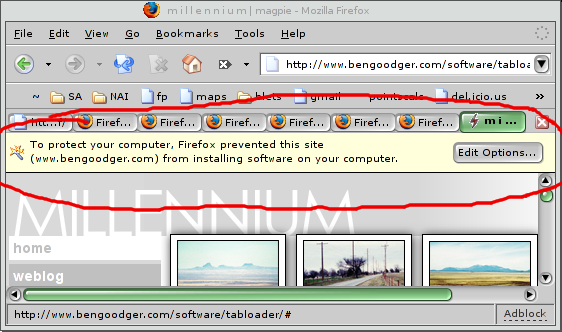
If a site I'm viewing attempts to install an XPI file, I get this prompt:

Note that it's NOT a dialog. This is pretty handy, because it means that I won't get annoying dialogs all the time if I do accidentally go to a unscrupulous site; it just appears like the part of the page. In the clueless user case, they may not even notice that they've been protected, which reduces the risk that they'll install the extension anyway.

(However, I would have extended it by using an icon or look-and-feel that indicated that this was a 'trustworthy' part of the UI, rather than possibly part of the page.)

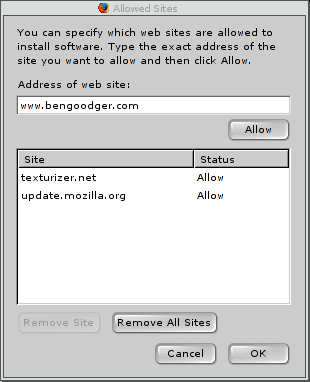
If I hit the 'Edit Options...' button, I get this:

A simple-enough dialog containing the list of sites permitted to install extensions. update.mozilla.org is in there by default, and I've added texturizer.net so I can install from their more extensive list of older extensions. The address of the current site has been dropped in automatically.

To permit the site, I have to hit 'Allow', then 'OK'. So I do that, and hit the 'install' link on the webpage again:

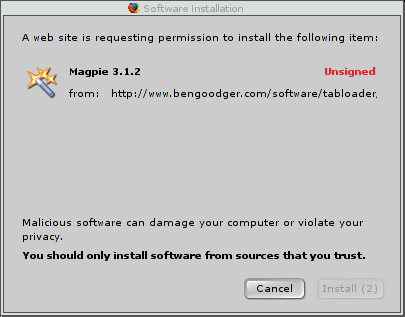
And there's the Software Installation dialog. Note the red Unsigned warning, the proportion of text that is a warning about installing bad stuff (fully half!), and -- this is interesting -- a greyed-out 'Install' button.

The button is on a timer -- it becomes clickable after 2 seconds. This, presumably, is to ensure that people read the dialog! Reportedly, users no longer read dialogs, instead hitting OK on every dialog that appears. In my opinion, this is arguably due to 'the boy who cried wolf' syndrome: by default, MSIE and older Mozilla versions will ask all sorts of stupid questions about 'are you sure you want to send stuff on the intarweb?' whenever you use Google. If anything is guaranteed to induce dialog fatigue, it's that feature.

(Update: actually, that's not the reason. Reportedly, it's a workaround for a couple of social-engineering attacks, whereby an attacker could persuade the user to type a word ending in 'Y', and time the dialog to appear just before 'Y' is typed -- causing the keyboard shortcut for 'Yes' to take effect; or persuade the user to double-click in the right spot, and similarly time the dialog to appear in the right place, in time for the second click. Still, I maintain the measure is useful to deal with the 'dialog fatigue' issue too. ;) Thanks to Smyler and Rod for pointing this out.)

I would have gone further:

  • the 'a software install was blocked' page element should have an indication that it's 'trustworthy content'
  • both dialogs should default to 'Cancel', to avoid users deliberately pressing 'OK'
  • I would possibly require a 'yes, I read this' tickbox to be ticked before the software is installed.

Interesting though. This is the way internet-facing UIs are going to have to develop, in my opinion.

firefox security ui

Back from Toorcon

Travel: Toorcon was great fun! Lots of interesting conversations.

Unfortunately they had a cruddy internet connection, so I'm majorly backlogged, and can't write about any of it just yet ;)

life ireland conferences

Bush at the UN

Politics: So I was listening to that this morning. Did I hear correctly? Did Bush really say that one of the good side-effects of Iraq's invasion, was that there were now hopefully less attacks inside other countries? sure looks like it:

'Coalition forces now serving in Iraq are confronting the terrorists and foreign fighters so peaceful nations around the world will never have to face them within our own borders.'

I'm sure the Iraqi civilians will love that. 'Hey guys, sorry about all the missing limbs, but you're doing a really good job of being flypaper so we don't get hurt. Cheers! Have a 15% corporate tax rate!'

politics us-politics government

ToorCon

Conferences: Hey -- I'm talking at ToorCon 2004 down in San Diego this weekend! Come along and check it out, if you can.

I'd better hurry up and file my presentation slides pronto ;) The topic is:

Spam Forensics: Reverse-Engineering Spammer Tactics

In this talk, I'll discuss how the SpamAssassin project has identified reliable signatures indicating that a message is spam, by reverse-engineering spammer tactics from the spam mails themselves. I'll also discuss several specific features that we have identified, how we found them, and why the spammers add them.

spam anti-spam spamassassin hacks

Sitescooper is WorldChanging!

Green: Wow -- UC Berkeley's Lab Notes newsletter this month includes an article noting the benefits to the environment of reading your news on a PDA instead of getting a delivered newspaper. Check this out:

In a new study, UC Berkeley researchers report that receiving your news wirelessly on a PDA instead of delivered to your door requires up to 140 times less carbon dioxide, several orders of magnitude less greenhouse gases, and the consumption of 26 to 67 times less water.

...

To tease out the truth, Horvath and graduate student Michael Toffel dissected nearly all of the environmentally-relevant processes involved in both wireless news delivery and teleconferencing. In the case of newspapers, the researchers focused on the environmental effects of reading the New York Times in Berkeley, California, from the manufacture of newsprint and ink to the delivery from a nearby printing press to disposal of the newspaper. This data was then compared to such factors as the energy used to manufacture a PDA, including its microprocessor and battery, and the electricity required by wireless and Internet service providers to deliver news content to the device.

Sitescooper is therefore a WorldChanging tool!

web ireland news privacy internet history

The EU software patents battle returns

Patents: Now that the summer break is over, software patents are back on the EU's agenda. The FFII (via EDRI-gram) reports

On 24 September 2004, the European Council will probably meet to rubber-stamp the 'political agreement' achieved on 18 May 2004 on the highly controversial software patents directive (2002/0047 COM-COD).

According to the FFII the text was designed to mislead ministers about its real effects. 'It consists of many sentences of the form or 'software is ... unpatentable, unless ... [condition, which, upon closer scrutiny, turns to be always true]'.' And, states FFII, 'It can be said with certainty that only a minority of governments really agrees with what was negotiated, but several governments were misrepresented by their negotiators, who broke intra-ministerial agreements or even violated instructions from their superiors.'

More info:

eu data-protection privacy

Lara Doody Smith

Life: Luke writes:

Lean and I were joined by Lara at 6.10pm on Saturday 28th September. Lara is a little (8lb 7oz, so not _that_ little) girl. And she is gorgeous. Of course.

Congrats! I'll be dropping in on the three of them next week, looking forward to it...

life family kids

Planetary Backgrounds now using Coral

Web: My Nearly-Live Planetary Desktop Backgrounds site is now using NYU's Coral Content Distribution Network instead of FreeCache.org. (FreeCache wasn't caching the files, because they were too small. drat.)

Coral is a 'decentralized, self-organizing, peer-to-peer web-content distribution network', using a distributed sloppy hash table and peer-to-peer DNS redirection infrastructure.

At least, apparently. ;) I haven't read the papers yet, but what I do know is that so far, it seems to be working perfectly -- each file is requested exactly once by the CDN servers:

  193.10.133.129 - - [31/Aug/2004:16:50:31 +0100] "GET
  /xplanet/tmp/200408311455.399750/day_clouds_800x600.png
  HTTP/1.1" 200 706936 "-" "CoralWebPrx/0.1 (See
  http://www.scs.cs.nyu.edu/coral/)"

and never requested again. That's a big saving... nifty!

caching coding art

Linux and small hardware vendors

Linux: Everyone who's used a non-MS system will have learned -- typically the hard way -- that not all hardware is equal. Not just in terms of specs, flexibility and power, but also in terms of whether or not it can be used at all.

Most hardware vendors consider their specification and interface documentation to be their crown jewels; giving access to these without a signed NDA is impossible. On the other hand, for free software developers, signing an NDA makes life quite difficult -- it can be done, but nobody else can help you maintain it further without signing an NDA, the resulting code may 'disclose' too much of the 'IP', and so on. In a lot of cases, the vendor isn't interested in giving access to the specs, even with an NDA -- it's their IP and why isn't the customer just using Windows?

The end result: lots of hardware with crappy support on non-MS operating systems.

Things aren't as bad as they used to be, though -- since nowadays the high-end hardware is more likely to support standards, and Linux is a top choice on embedded hardware (set-top boxes for example), so it has a much higher profile. But cheap, end-user oriented PCs still wind up with components from vendors who couldn't be bothered with non-Windows customers, and that can mean using a hacked-up, reverse-engineered driver and hoping it works. (That's not to denigrate reverse-engineered drivers. some of them work great. But fundamentally, the vendors are making a mistake here.)

So it's pretty impressive to see that LaCie are now sponsoring development of k3b, the CD/DVD burning application for KDE!

Good timing too, I was about to buy a DVD burner ;)

software hardware coding

kgst output to ALSA/Artsd/ESD instead of just OSS

Linux: Here's a patch that adds support for ALSA/Artsd/ESD output from kgst, the KDE gstreamer middleware used by JuK.

Background: JuK is a great music player app for KDE. However, it hogs
the sound device while running, which means that nothing else gets access to play sound until the app is shut down. This is suboptimal.

The reason it does this is because it plays sound via this chain of components: juk -> kgst -> gstreamer -> sink. Unfortunately, the
kgst component doesn't allow control over what output sink to use, instead hard-coding the string 'osssink' -- the OSS drivers, for traditional Linux /dev/dsp sound. My laptop doesn't support mixing in the sound hardware, which means I need to use a software mixer. 'osssink' doesn't support software mixing, instead giving the caller exclusive access to the sound card, and other apps will just have to wait for it to finish.

(As to why JuK doesn't just play mp3s by running 'mpg321 name-of-file.mp3', and let us specify the '-o' switch to use, I wish I knew. (ObOldbieGripe: component-based architectures are full of this kind of needless over-complexity ;)

Anyway, the patch in the bug above lets the user provide an environment variable for a string for kgst to use instead of 'osssink'.

linux music mp3

Life Hacks: the magic of flat files

Tech: This is the second entry talking about 'Life Hacks'. Possibly the best tip I came away from the talk with, is this one:

All geeks have a todo.txt file. They use texteditors (Word, BBEdit, Emacs, Notepad) not Outlook or whathaveyou.

What we keep in our todo is the stuff we want to forget. Geeks say they remember details well, but they forget their spouses' birthdays and the dry-cleaning. Because it's not interesting.

It's the 10-second rule: if you can't file something in 10 seconds, you won't do it. Todo.txt involves cut-and-paste, the simplest interface we can imagine.

It's also the simplest way to find intercomation. EMACS, Moz and Panther have incremental search: when you type a "t" it goes to the first mention of "t", add "to" and you jump to the first instance of "to", etc.

Power-users don't trust complicated apps. Every time power-geeks has had a crash, s/he moves away from it. You can't trust software unless you've written it -- and then you're just more forgiving. Text files are portable (except for CRLF issues) between mac and win and *nix. Geeks will try the Brain, etc, but they want to stay in text.

I was already doing this, having learned the latter lesson ;), but I was making one mistake -- I was trying to keep the TODO.txt file small by clearing out old stuff, done stuff, and cut-and-paste snippets of command lines, and by moving things into files in 'storage' directories.

That doesn't work. You think you'll be able to grep for it later, but you'll have forgotten what to grep for. You'll even have forgotten what storage directory you used. The solution is to keep it all in one big file, and use i-search. That really does work.

In fairness, I actually have two files of this type. One is the "real" TODO.txt. But the other is a GPG-encrypted file containing usernames, URLs, passwords, nameservers, VPN settings, etc. I have a feeling this is another common Life Hack idiom, too...

Another great tip in the same vein, from JWZ -- make an /etc/LOG:

Every machine I admin has a file called /etc/LOG where I keep a script of every system-level change I make (installing software, etc.) I rsync these LOG files around (keeping redundant copies of all of them in several places) so that if/when I need to re-build a server from scratch, it's just a matter of following the script.

This has been working out great (when I remember to do it. Discipline! ;)

unix search email

Life Hacks: getting back to the command-line

Tech: So Danny O'Brien's 'Life Hacks' talk is one of the most worthwhile reflections on productivity (and productivity technology) I've heard. (Cory Doctorow's transcript from NotCon 2004, video from ETCon.)

There's a couple of things I wanted to write about it, so I'll do them in separate blog entries.

(First off, I'd love to see Ward Cunningham's 'cluster files by time' hack, it sounds very useful. But that's not what I wanted to write about ;)

People don't extract stuff from big complex apps using OLE and so on; it's brittle, and undocumented. Instead they write little command-line scriptlets. Sometimes they do little bits of 'open this URL in a new window' OLE-type stuff to use in a pipeline, but that's about it. And fundamentally, they pipe.

This ties into the post that reminded me to write about it -- Diego Doval's atomflow, which is essentially a small set of command-line apps for Atom storage. Diego notes:

Now, here's what's interesting. I have of course been using pipes for years. And yet the power and simplicity of this approach had simply not occurred to me at all. I have been so focused on end-user products for so long that my thoughts naturally move to complex uber-systems that do everything in an integrated way. But that is overkill in this case.

Exactly! He's not the only one to get that recently -- MS and Google are two very high-profile organisations that have picked up the insight; it's the Egypt way.

There's fundamentally a breakage point where shrink-wrapped GUI apps cannot do everything you want done, and you have to start developing code yourself -- and the best APIs for that, after 30 years, has been the command-line and pipe metaphor.

(Also, complex uber-apps are what people think is needed -- however, that's just a UI scheme that's prevailing at the moment. Bear in mind that anyone using the web today uses a command line every day. A command line will not necessarily confuse users.)

Tying back into the Life Hacks stuff -- one thing that hasn't yet been done properly as a command-line-and-pipe tool, though, is web-scraping. Right now, if you scrape, you've got to do either (a) lots of munging in a single big fat script of your own devising, if you're lucky using something like WWW::Mechanize (which is excellent!); (b) use a scraping app like sitescooper; or (c) get hacky with a shell script that runs wget and greps bits of output out in a really brittle way.

I've been considering a 'next-generation sitescooper' a little bit occasionally over the past year, and I think the best way to do it is to split its functionality up into individual scripts/perl modules:

  • one to download files, maintaining a cache, taking likely freshness into account, and dealing with crappy HTTP/HTTPS wierdness like cookies, logins and redirects;
  • one to diff HTML;
  • one to lobotomise (ie. simplify) HTML;
  • one to scrape out the 'good bits' using sitescooper-style regions

Tie those into HTML Tidy and XMLStarlet, and you have an excellent command-line scraping framework.

Still haven't got any time to do all that though. :(

storage web linux coding unix

Open source v closed-source spam filtering

Spam: I'm quoted in
New Scientist! w00t!

SlashDot picked it up pretty quickly. One comment there misses the point, though:

This is interesting and promising technology. But like all antispam techniques, spammers will find a way around it. Once spammers get a copy of the software, they can create and test countermeasures in the comfort of their own sleazy lairs.

It's worth talking about this. Newsflash: spammers have no difficulty testing their spam against closed-source spam filters, even when they can't 'get a copy' and test them in 'their sleazy lairs'.

How do they do it? Easy -- just set up an account at a site that uses that filter (AOL, Yahoo!, Hotmail, and GMail, it's pretty obvious how to do that; for other closed-source filters, find an ISP that uses it). Then send 'test mails' repeatedly to that account, and apply trial and error to see what gets past the filter and what doesn't. Eventually, they figure out what works for that filter, and what doesn't.

How did I figure this out? Well, I came across the manual for the Send-Safe ratware on-line. It noted that the 'hashbuster' randomisation technique, which we in the SpamAssassin team had long assumed was intended to block hash matches by DCC, Pyzor and Razor, was in fact intended to block AOL's implementation of that system. The open source ones weren't even mentioned.

Update: found it -- from their FAQ:

Mime Encoded content

If you want to get into AOL... use it.

MIME encoders allow you to send documents written within a specific application through email without causing readability or formatting problems. For example, you can send a letter created in MSWord with and be certain that it arrives at its destination in the same format by encoding it with MIME first. The recipient then decodes it back into the original MSWord format.

That isn't why we use it though.

We use it to cause 'uniqueness'.

When you put a rotate tag at the beginning of a MIME encoded email, it causes everything after that point (including checksums) to be 'different' in every message.

Why is that that important?

Because it throws off filters that look for many copies of the same message to nuke.

anti-spam spam challenge-response spamassassin filtering

Image Watermarking With 'pamcomp'

Web: My Dad runs a couple of websites -- his architectural photography business, and Andalucia Photo Gallery, a side project selling some lovely photos from the Andalusia region of Spain.

Needless to say, as the family geek, guess who coded all that up? Using WebMake, naturally ;) This was the main reason I wrote the 'thumbnail_tag' plugin.

You'll note, however, that the image to right is watermarked, quite small, and encoded with a low quality setting. It turned out after a couple of years of operation, that the images were being downloaded and used in print all over the place -- from both sites!

It seems photo piracy is rampant. Even with terms of use clearly linked on the sites, it's still commonplace for print publications to swipe the images -- and not just the little guys, either -- some big commercial names have apparently used the images without asking (or paying licensing fees).

The Andalucia gallery site was a favourite; being a good hit for 'travel photos spain' meant lots of images being used for holiday pages in magazines, newspapers, and so on.

Needless to say, digital watermarking software doesn't work -- it's trivial to load an image into Photoshop, resize or crop, and resave, apparently. Even if PS did respect the watermarks, netpbm doesn't, and a watermarked image isn't identifiable as such once it appears in print anyway! So we went for the blunt-tool approach, adding visible watermarks to the images.

It's pretty easy -- pamcomp allows you to overlay one image on top of another, using a third as an 'alpha mask' to control transparency. The results are pretty nice and not too intrusive.

It's a shame it has to be done, though... :(

images ip copyright ireland politics google

MS Patents sudo(8)

Patents: The varchars.com scraped RSS feeds now include new patent grants and applications by certain companies! Interesting, although given that most developers are advised not to look, not advisable ;)

However, I glanced at the MS one -- and immediately spotted this gem: US Patent 6,775,781, filed by Microsoft, is a patent on the concept of 'a process configured to run under an administrative privilege level' which, based on authorization information 'in a data store', may perform actions at administrative privilege on behalf of a 'user process'.

This, and the patent claims, perfectly describe the operation of sudo, fundamentally as it's operated since running on a 4.1BSD VAX-11/750 in 1980.

20 years head start on a patent application -- surely that must qualify as prior art ;)

patents swpats law patenting linux software

RFID Security

Security: It looks like the security people are starting to take a look at RFID, and it's not pretty.

I link-blogged this the other day -- RFDump is a tool to display and modify data in RFID tags -- including deployed ones, at least in some cases. (Think rewriting the price tags in a shop, scrambling the tracking numbers on a warehouse full of goods, or corrupting frequent-shopper data on a card.)

It looks like this was also discussed at USENIX Security '04 in an RSA presentation (those notes are swarming with typos, but the content's there ;)

That talk has some interesting stuff -- 'blocker' tags which spoof readers with gibberish data, or crash the collision-detection network protocol; while that's being discussed as a security tool here, if the protocol is that hackable, and the hardware is available, I could see that having additional interesting effects in a supermarket. Of course, range is an issue -- but that hasn't stopped Bluetooth hacking, wardriving, etc.

If you ask me, it looks an awful lot like RFID is chock-full of security holes, and the features that make it so attractive (low power use, low cost, tiny size) will be the very features that militate against adding security. We could be in for interesting times here...

security rfid privacy

A 'Boulder Pledge scoreboard' website

Spam: Ask Slashdot: How Powerful is the Turn-Off Power of Spam? The question is, 'How often do you make the decision to NOT buy something form a company because you know they engage in spamming activities?'

This is an old idea -- it goes back to a December 1996 column by Roger Ebert, of all people, who proposes the following pledge that all internet users should take:

Under no circumstances will I ever purchase anything offered to me as the result of an unsolicited e-mail message. Nor will I forward chain letters, petitions, mass mailings, or virus warnings to large numbers of others. This is my contribution to the survival of the online community.

8 years later, it's more important than ever.

However, it's complicated by one additional factor -- not everyone knows which products and companies use spam to advertise. For example, did you know that Kraft routinely advertise their Gevalia coffee through spam?

My suggestion -- a daring individual (that rules me out ;) should set up a website where samples of major-product-advertising spam are collected from (trusted) reporters. A quick scoreboard based on how many reports a particular company accumulates, and we have a Boulder Pledge reputation service.

Some simple rules should be applied:

  • Messages arriving at never-used spamtrap addresses, or scraped addresses from USENET or the web, especially if the message hits multiple of those addresses (indicating a high volume), is the basis for a listing;
  • Failure to respect opt-outs, of course, would be a biggie;
  • Using a known spamhaus, or sending via open proxies in Shandong, would be a massive thumbs-down;
  • Failure to clean up it's act after being made aware of the problem, oh dear.

It'd be essential to take an extremely careful approach to this; any hint of personal axe-grinding, and the site would be useless, written off as just the work of 'another anti-spam kook'.

Essentially, this'd be a Fortune-500-oriented version of spamvertized.org.

Reportedly, many of the large companies using spam to advertise are fully aware at a management level that they are responsible for spamming. (That line about open proxies in Shandong is no joke -- at least one Fortune 500 company has hired a spamhaus that does this.)

Doubtless, some spamvertisers may be victim to an overzealous but clueless marketing department, on the other hand -- but either way, a public 'name and shame' forum gives a great impetus for them to avoid this problem, at least once they've been bitten the first time.

In some cases, it's dodgy 'affiliates' that use spam to advertise their products -- but a company that operates affiliates really should post a policy that says that affiliates found to be spamming will be terminated and have their commissions forfeited; reportedly, that has been found in other programs to quickly cut off the problem.

anti-spam spam filtering

Announcing IPC::DirQueue

Perl: So, I wrote a new CPAN module recently -- IPC::DirQueue. It implements a nifty design pattern for slightly larger systems, ones where multiple processes, possibly on multiple machines, must collaborate to deal with incoming task submissions. To quote the POD:

This module implements a FIFO queueing infrastructure, using a directory as the communications and storage media. No daemon process is required to manage the queue; all communication takes place via the filesystem.

A common UNIX system design pattern is to use a tool like lpr as a task queueing system; for example, this article describes the use of lpr as an MP3 jukebox.

However, lpr isn't as efficient as it could be. When used in this way, you have to restart each task processor for every new task. If you have a lot of startup overhead, this can be very inefficient. With IPC::DirQueue, a processing server can run persistently and cache data needed across multiple tasks efficiently; it will not be restarted unless you restart it.

Multiple enqueueing and dequeueing processes on multiple hosts (NFS-safe locking is used) can run simultaneously, and safely, on the same queue.

Since multiple dequeuers can run simultaneously, this provides a good way to process a variable level of incoming tasks using a pre-defined number of worker processes.

If you need more CPU power working on a queue, you can simply start another dequeuer to help out. If you need less, kill off a few dequeuers.

If you need to take down the server to perform some maintainance or upgrades, just kill the dequeuer processes, perform the work, and start up new ones. Since there's no 'socket' or similar point of failure aside from the directory itself, the queue will just quietly fill with waiting jobs until the new dequeuer is ready.

Arbitrary 'name = value' metadata pairs can be transferred alongside data files. In fact, in some cases, you may find it easier to send unused and empty data files, and just use the 'metadata' fields to transfer the details of what will be worked on.

Sound interesting? Here's the tarball.

queueing storage papers

CEAS Roundup

Spam: So, CEAS was great fun, and very educational:

  • Got to meet up with various antispammers, including Daniel and Theo from the SpamAssassin dev team, Jeff Chan from SURBL, Dan Kohn from Habeas, Catherine Hampton from The SpamBouncer, Miles Libbey, John Levine, Neil Schwartzman -- lots of good chats.
  • MS really know how to feed a conference! I hear rumours there was an extra-special tinned-meat-product-based dish at the banquet...
  • But their firewalling tendencies put a serious damper on keeping in touch with the outside world, at least until we set up an SSH tunnel on port 443 ;)
  • During a lull, Dan Kohn fired off a hands-up census -- a good 75% of the attendees (roughly) admitted to using SpamAssassin!

My highlight papers:

  • IBM's Chung-Kwei pattern-discovery system -- the one which Mark dug up. Very interesting stuff; it turns out that bioinformatics is full of large corpora of data (genomes) which you then need to find patterns in. Funnily enough, so is SpamAssassin: s/genomes/spam/, s/patterns/regular expressions/. The more advanced pattern-discovery algorithms even allow complex patterns to contain alternative blocks, 'don't-cares' and similar regular-expression-like features.

    The really good bit of Chung-Kwei is the Teiresias algorithm (more pages, online demo). Of course, being IBM research, it's probably patented to the hilt, and may be tricky to license; but it's certainly pointed us in a whole new interesting direction -- anyone know any bioinformaticians?

    IBM is really gearing up on anti-spam research. 4 of the 6 papers listed on their website were presented this year, at CEAS.

  • Another good paper was On Attacking Statistical Spam Filters, by Gregory L. Wittel and S. Felix Wu, which (similarly to Henry Stern's submission, which I helped a little with) dealt with an attack on Bayesian filters.

    This is interesting stuff; we're pretty sure it's not as serious as it could possibly be, in SpamAssassin's implementation, but it's still a serious attack.

  • The Impact of Feature Selection on Signature-Driven Spam Detection was an interesting paper on AOL's new signature schemes. (The conference was sponsored by Cloudmark, BTW, but those guys were nowhere to be seen -- in which case they missed this presentation ;)
  • Reputation Network Analysis for Email Filtering was interesting, in that it mirrors to a degree the thinking behind web-o-trust.org, but in my opinion suffered due to a lack of thought about avoiding spoofing (by including IP address information in the FOAF file, it could do this now). However, once SPF becomes pervasive, this could be combined with that to generate personalised webs of trust usable for email whitelisting.
  • Resisting SPAM Delivery by TCP Damping was very nifty; plug a classifier into your MTA, and thereby detect connections from spam relays. Once you've found them, you then throttle down their connection as they attempt to deliver spam. Some other TCP-level tricks can do nifty stuff like massively increasing the bandwidth consumption of the spamming machines. Very very nice!

I took copious notes on the SpamAssassin wiki, if anyone's curious.

anti-spam spam spamassassin

E-Voting shenanigans in Riverside

E-Voting: Paul Krugman: Fear of Fraud:

It's election night, and early returns suggest trouble for the incumbent. Then, mysteriously, the vote count stops and observers from the challenger's campaign see employees of a voting-machine company, one wearing a badge that identifies him as a county official, typing instructions at computers with access to the vote-tabulating software.

When the count resumes, the incumbent pulls ahead. The challenger demands an investigation. But there are no ballots to recount, and election officials allied with the incumbent refuse to release data that could shed light on whether there was tampering with the electronic records.

This isn't a paranoid fantasy. It's a true account of a recent election in Riverside County, Calif., reported by Andrew Gumbel of the British newspaper The Independent.

Here is Gumbel's account. It's quite simply crazy:

On March 4, Floyd and Cassel saw the second Sequoia employee, Eddie Campbell, return to the registrar's office and watched him pop into his pocket what looked like a PCMCIA card similar to those used to store votes on individual touchscreen machines. The Sequoia AVC Edge machines do not make a paper record of individual votes, and any record of total votes for a potential recount -- vital in a race separated only by 45 votes -- would only be stored on that kind of card.

Floyd shouted out: 'Where are you going with that?' But he received no answer.

Incredible.

e-voting politics funny nsa security hacking

Patents in an open source world

Patents: Newsforge: Patents in an open source world, by Lawrence Rosen (founding partner of Rosenlaw and Einschlag).

Interesting article, but I'm not sure summary point number 2 ('continue to document our own "prior art" to prevent others from patenting things they weren't the first to invent') really helps, when the patent examiners clearly haven't performed the simplest Google check. I've found obvious prior art in 30 seconds, by plugging 3 words from patent claims into Google in the past (and yes, I have a reasonable idea how to read patent claims by now).

Point number 3 is interesting, since it contradicts most other advice I've read regarding patent searches: 'Conduct a reasonably diligent search for patents we might infringe. At least search the portfolios of our major competitors. (This, by the way, is also a great way to make sure we're aware of important technology advances by our competitors.) Maintain a commercially reasonable balance between doing nothing about patents and being obsessed with reviewing every one of them.'

However, this comment really is interesting and raises something major that I'd never heard of before -- users of proprietary software can also face a significant risk from the patent threat. In particular, according to the linked comment, Microsoft licensed some patented technology from a company called Timeline Inc., but the license was not sublicenseable -- in other words, it did not grant their customers the rights to fully use the technology! (in fairness to MS, this was established later in court.) Result: href="http://trends.newsforge.com/comments.pl?sid=39443&cid=96153">MS SQL server OEMs and ISVs are now being sued.

swpats patents law linux patenting databases coding ip

Post-Apocalyptic Fiction

Reading: Both jim winstead and Nelson Minar have praised Earth Abides , a 1949 post-apocalyptic novel where 'all but a handful of people die from a mystery disease', and the ensuing narrative 'follows one man's attempt to rebuild something like a society.' It seems a tip from original happy mutant Mark Frauenfelder was the pointer for both of 'em.

I'm a huge fan of the genre; I think it's something about our age group, growing up in the shadow of Reagan's 'Evil Empire' speeches, Threads and (much less terrifying) The Day After.

Given that, it looks like Earth Abides goes straight into the wishlist. However, I should make another couple of reading tips while I'm at it, in the same genre:

First off, Jack London's short story
The Scarlet Plague (1912) is a clear antecedent to Earth Abides. In this story, too, a plague hits the planet and wipes out most of civilization; an old man talks to children who've known nothing but the post-apocalypse period. It's pretty short and well worth a read.

But my main recommendation is Kim Stanley Robinson's The Wild Shore (1984), first book of his Three Calfornias trilogy, and his debut novel.

It takes place in 2047, 60 years after a massive nuclear attack on the US, by Russian infiltrators (pretty dated, eh ;). The narrator is a teenager in a primitive agrarian community on the coast of southern Orange County. His group are farmers, living far away from the previously built-up areas; the people who live amongst those ruins are shunned, and the different tribes meet only occasionally to trade. Disposable butane lighters are a treasured commodity.

He gradually discovers that the US was once a superpower, and that they are now being kept in a virtually stone-age state by outside powers. The interesting factor here is that most sci-fi authors, at this point, would embark on a jingoistic, militaristic armed struggle; it initially seems that's what's happening, but Robinson takes a very interesting tack, in his own style, and this really makes the book something special.

(I won't go too far into it, but if you really want to know and don't mind spoilers, this site thoroughly spills the beans.)

climate-change scifi politics

Counterfeit Cops

IP: A funny IPR-enforcement-related story from New Scientist (sorry, subscriber-only link):

Just before delegates (to the 28 May 'Global Congress on Combating Counterfeiting') left Brussels to ponder their future anti-counterfeiting measures, a salutary tale started doing the rounds.

The WCO (World Customs Organization) produces a CD database of the codes needed to identify goods by type so that local customs authorities can collect the appropriate duties. The discs sell for EUR 1000 apiece, but WCO investigators have found that staff at some border posts, which are supposedly the front line in counterfeit detection, are not using the official CDs. Instead - you've guessed it - they are buying cut-price pirated copies, complete with crudely photocopied, plainly fake covers and sleeve notes.

Physician, heal thyself!

law copyright ireland

Kentucky sez 'Opt-Out Still Doesn't Work'

Spam: Some fantastic data in this paper from the Kentucky Long-Term Policy Research Center.

It's a brief 2-pager detailing the effectiveness of the CAN-SPAM Act in reducing the spam load, using a set of test addresses. The methodology is pretty good.

One point in particular is very important: 'opting out' from spam Just Does Not Work. This graph tells the whole story:

After opting out from spams received, the amount of spam received at those 'opted out' test addresses actually rose. (This even after CAN-SPAM made such activity explicitly illegal.)

Some other data:

  • obfuscating addresses on web pages is still working; 7.7 times the spam is received if you don't bother doing so.
  • e-mail harvesting also continues after CAN-SPAM made it illegal.

If anyone needed proof, this shows that spammers are quite happy to break the law; strong enforcement 'teeth' are needed for any anti-spam legislation. (UK, take note: the thoroughly useless system whereby spam complaints must be submitted on paper isn't going to help!)

The Technical Details document also notes something interesting: one test address was set up to test 'opting out' of legitimate mass mail from some (unnamed) big websites, and continued to receive ads 'sometimes months after opting-out'. For shame!

(thx to John Levine for forwarding the links.)

Spam: Michael Radwin on open HTTP redirectors, and in particular noting that Yahoo! have (finally) closed their main one down. One down, several hundred to go ;)

Good history of the exploitation techniques that spammers have been using, too.

anti-spam spam spamassassin filtering google

BEST SONG EVER -- identified!

Funny: Some of the taint.org readership (that's you, Nishad) may be familiar with BEST SONG EVER.mp3 -- it's an insane, 10-minute workout: one guy ranting at a high pitch in some east-asian language at an incredible speed over some cheesy Casio, hardly taking a breath, punctuated by bizarre 7-Zark-7-style ribbits and squawks. By the end of it, he's nearly hoarse. It is incredibly bizarre. Turkopop has nothing on this.

Well, it's origin has been discovered -- he's called E Pak Sa, and the style is called 'Pansori'. His version is a modern take on this ancient traditional style -- 'While singing, he would imitate the sound of all of the instruments used in the prelude and interlude, and even the sound of the whistle used to gather the tourists.' From there, he grew in popularity, especially in Japan:

'Sell-out concerts, myriad television appearances, riots at in-stores, and Japanese teens speaking Korean are all products of E Pak Sa's impact in Japan. E had infiltrated the popular culture of Japan and paved the way for other Korean artist to do the same.'

And guess what -- his Encyclopedia of Pon-Chak album can be listened to online! The YMCA cover -- track 2 -- is strongly recommended.

music ireland 419

Ross Anderson not quite so cool anymore

Security: Ross Anderson, crypto and security guru extraordinaire, moonlights as -- wait for it -- a street bagpipe player:

I play the pipes (the Great Highland Bagpipe and the Scottish smallpipes). I played competitively as a teenager, and thereafter paid my way through university by working as a street musician in Germany, France, the Netherlands and Denmark.

NOOOOOO! ANYTHING BUT THE BAGPIPES!!!

Only joking. But yes, he really does play the bagpipes. And that submission to the EU's consultation on the management of copyright and related rights is worth a read, to get an idea of how the new increased enforcement of music copyright has had chilling effects on the viability of the UK's folk music scene. (found via Karl-Friedrich Lenz.)

law ireland ip copyright filesharing piracy music

Kiera Knightley

Funny: Kiera Knightley's photoshop boobjob has been all over the place recently -- it's a pretty extensive reworking. But then, that's standard practice nowadays...

However, best comment goes to stephendann:

In photo 2, she has the quad damage. The skin colour darkens, the chest expands, the stomach contracts and the character skin is obviously altered so the rest of the players know she's supercharged. In POTC:King Arthur, it's a more subtle damage modified than (the) UT2K4 glowing purple bow.

LOL!

funny photos games kiera-knightley

Great SSH tip, and how to fix a KDE glitch

Unix: via Ted Leung, Adam Rosi-Kessel's Linux Tips page has some very useful tips, and this one's great -- to avoid
getting SSH connection resets, add the following to your .ssh/config:

    serveraliveinterval 300
    serveralivecountmax 10 

This will insure (jm: sic) that ssh will occasional send an ACK type request every 300 seconds so that the connection doesn't die.

As a similar tip that took a while to track down -- KDE users who've upgraded between KDE releases, will probably by now have seen lots of messages like this:

  nameofapp (KIconLoader): WARNING: Icon directory /usr/share/icons/hicolor/
  group 48x48/stock/text not valid.

It took a bit of googling about to find the cure:

  • run in a shell (I cannot find this on any menu): kdebugdialog --fullmode
  • select: debug area: 264 kdecore (KIconLoader)
  • Change the Warning Output to 'None'
  • select: OK

kde history desktops

DVD pirate's pitch ends in arrest

Funny: BBC: DVD pirate's pitch ends in arrest:

A man has been arrested after trying to sell counterfeit DVDs - at a Trading Standards Office.

The man had apparently missed the sign on the office in Beehive Lane, Chelmsford, Essex, and asked if anyone would like to buy pirated films. Staff said they were very interested indeed in what he had to sell, but when he realised where he was he ran off, leaving his wares and £210 in cash.

Police later arrested the man in a supermarket in Chelmsford.

piracy copyright internet filesharing ireland law

Hacking Netflix

Movies: Hacking Netflix, via torrez.

Jason Kottke points out a great quote on a Friendster cross-site scripting attack -- this great quote: 'We have a policy that we are not being hacked.'

He also speculates that Google used the GMail invite-network data for whitelisting -- but whitelisting based on email address alone is trivially exploitable, so I'd doubt it.

I'm just back from a trip over to Cape Cod to meet family (halfway between here and Ireland, y'see ;) -- lots and lots of luvverly lobster and sundry shellfish -- and after a 6 day trip, had 5000 spams and a couple of thousand nonspam mails to deal with. Thankfully SpamAssassin dealt with the spams (only about 5 false negatives, no false positives I could spot) -- but I'm going to have to do something about that volume of mail. drowning in the stuff. argh.

spam anti-spam gmail google filtering security

Microsoft 0wnz 'http'

Web: Back in 2002, it occurred to someone to check the Google search results for 'http', to figure out what the most popular sites were.

Looks like it's changed -- here's the top five results from a Google search for 'http' now:

  • 1: Microsoft
  • 2: AltaVista (!!)
  • 3: Yahoo!
  • 4: My Excite
  • 5: Google

My guess: older links are getting good PageRank, using whatever new tweaked algorithm they're using. But AltaVista beating Google? ;)

web search technorati http

RTE's Bush Interview

TV: RTE's 'Prime Time' secured a fantastic interview with GWB, with Carole Coleman asking a few very pointed questions. Watch it with RealPlayer, or listen to the audio in MP3 (2.7Mb).

There's a pretty accurate transcript here:

Let me finish! How many times do I have to tell you how to do your job? See, I gotta insult France at least once. Then I gotta claim 'merica to be the most generous nation in the whole wide world, even though it's not true. And listen, let me mention that democracy in Pakistan, too. And guess what? I'm the first president to ever call for a Palestinian state and I'm damn proud of it - just look at the size of my smirk now. Listen, as long as I keep repeating myself and mouthing empty platitudes, you won't have a chance to call me on any of the bullshit coming out of my mouth.

OK, the official one is here.

It appears that the White House just dropped the ball on this one; reportedly, they had her list of questions three days in advance, but given that they suggested that she 'ask him a question on the outfit that Taoiseach Bertie Ahern wore to the G8 summit' (!!!), they weren't paying attention, and expected some kind of giggling moronic schoolgirl, or something.

Hilariously, the White House has since complained to RTE, the Irish Embassy, the Irish Government, and the reporter herself. Probably God, too. I doubt Prime Time will ever get a White House interview again, but given what they clearly expect from the poodles in the White House press corps, that's hardly much of a loss.

(I'd love to see what'd happen if he had to deal with Paxman ;)

Also, went to see Fahrenheit 9/11. Fantastic movie, and best of all, incredibly well-attended.

My favourite moment: the reminder of just how easily the US news media sold itself out during the war. Seeing Katie Couric blurting 'Navy Seals rock!!' like some kind of starstruck 5-year-old with an Action Man toy, was a classic. It's good to see that this will be immortalized in celluloid, as it was truly shocking at the time. (Not much has changed; Judith Miller is still writing for the NYT.)

ireland politics funny law

Samuel L. Jackson's 'Irish' comment

Ireland: Here's a hot UL that's floating around the irish web right now --

In a British program about Samuel L Jackson and Colin Farrell's lastest movie SWAT presented by British presenter, Kate Thornton, the following exchange occured:
  • Thornton: What was it like working with Colin (Farrell), cos he
    • is just so hot in the U.K. right now?
  • Jackson: He's pretty hot in the U.S. too.
  • Thornton: Yeah, but he is one of our own.
  • Jackson: Isn't he from Ireland?
  • Thornton: Yeah, but we can claim him cos Ireland is beside us.
  • Jackson: You see that's your problem right there. You British keep claiming people that don't belong to you. We had that problem here in America too, it was called slavery.

... yeah, right. ;)

(Update: Actually, believe it or not, that's more or less how it really went. Here's the transcript.)

Some commentary at
TheReggaeBoyz.com (quote: 'I NEARLY DEAD TO RASS!!!!') and Kuro5hin.

It looks like the TV programme does exist; no scripts online, unfortunately, so we'll never figure out if this one really happened, I think.

IMO, it's made up for sure. That last line is just a little too harsh for a primetime schmooze-a-gram, at the very least. Plus, it's the kind of thing only an Irishman would give a shit about -- the perpetual adoption of Irish celebs and worthies by the UK media is a continual source of irritation for the Irish -- as Dervala puts it:

'No, Oscar Wilde was ours. You put him in jail, though. And Shaw was ours. And Yeats. And Johnny Rotten.'

ireland funny work uk history

Announcing a new script

Web: Minor software announcement -- after some time using HTMLThumbnail, album, and even WebMake to build photo galleries, I finally got peeved enough, and gave in to the temptation of 'not invented here'. ;)

Presenting Uffizi, a CSS- and template-driven, themable perl script to generate photo galleries. Quoting the POD:

  • it's very self-contained, apart from dependencies on Image::Size and the ImageMagick convert command
  • fast, efficient incremental rebuilding
  • generates full CSS-styled, templated and valid HTML
  • every part of the generated HTML can be modified through the templates
  • generates reasonably-sized images as well as thumbnails, with a link to the full-sized image
  • secure -- all pages are static HTML, so your webserver won't get r00ted through a silly photo album script

I am, of course, using it on my own photo pages, and I'm very happy with it; it's been a while since I had to hack it. (I need to get it to thumbnail MPEGs as well, but apart from that it's teh nifty IMO.)

web ireland history

The 'humans are 99.84% accurate' figure

Spam: 'The spam-classifying accuracy of a human being is 99.84%'. This statement has passed into SlashDot lore as the gospel truth, so time for some debunking.

First off, that's not what Bill Yerazunis said in the CRM-114 Sparse Binary Polynomial Hashing and the CRM114 Discriminator paper. Here's the real quote:

the human author's measured accuracy as an antispam filter is only 99.84% on the first pass

Here's a copy of the original mail:

I manually classified the same set of 1900 messages twice, and found three errors in my own classifications, hence I have a 99.84% success rate.

(my emphasis). In other words, the author sat down and ran through 1900 messages manually, then ran through them again, and checked to see how many messages in the first batch disagreed with the second.

Let's consider an alternative situation, where a user is presented with one message, and asked to take their time, give it a full examination and some thought, and then classify the message. I would consider that more likely to be classified correctly, since fatigue will not be an issue (after 1900 messages, I'm pretty tired of eyeballing), and neither will time pressure (taking 20 seconds on each of 1900 mails would require 10.5 hours, and would be excruciatingly boring to boot).

In addition, the study wasn't clear on exactly how much information from each mail was presented. Too little (just the subject line) or too much (every header and raw HTML), and a human will be more likely to make mistakes than if the mail is rendered fully, and the extraneous header info hidden. In my experience, I've never hand-classified 1900 messages purely through either method, because it's just too tiring, and I know I'll make quite a few mistakes. The UI for this work is important.

And finally, the figure is derived from a study with one user performing a task once. There's no way you could use that figure in a serious setting -- it's not valid statistical science. Here's Henry's comment:

Yerazunis' study of "human classification performance" is fundamentally flawed. He did a "user study" where he sat down and re-classified a few thousand of his personal e-mails and wrote down how many mistakes he made. He repeats this experiment once and calls his results "conclusive." There are several reasons why this is not a sound methodology:
  • a) He has only one test subject (himself). You cannot infer much about the population from a sample size of 1.
  • b) He has already seen the messages before. We have very good associative memory. You will also notice that he makes fewer mistakes on the second run which indicates that a human's classification accuracy (on the same messages) increases with experience. For this very reason, it is of the utmost importance to test classification performance on unseen data. After all, the problem tends towards "duplicate detection" when you've seen the data before hand.
  • c) He evaluates his own performance. When someone's own ego is on the line, you would expect that it would be very difficult to remain objective.

So, to correct the statement:

'The spam-classifying accuracy of this one guy, when classifying nearly two thousand mails by hand, was 99.84%, once.'

anti-spam spamassassin false-positives challenge-response

Cormack and Lynam's study on supervised spam detection

Spam: or, 'SlashDot spam drama'. So, a few days ago, I forwarded a link to a paper I'd been sent -- it's a great paper, and I'm not just saying that because SpamAssassin did well -- it really tests some of the popular open-source spam filters comprehensively, and correctly. (The authors have 24 years of information retrieval research between them.)

The results have been pretty incendiary. ;) Here's a timeline with links, in case you were wondering where we are right now:

anti-spam spamassassin challenge-response

A UNIX shell tip

UNIX: I've just made the first change to my core bash configuration in years, to add -b to the set command-line. It triggered some thinking about when the last one was.

It turns out, that apart from writing scripts and aliases frequently, I haven't changed my commandline UI in any respect, since about 2 years ago. By contrast, I've been hacking about with GUI settings continually, new desktop backgrounds, themes, colours, etc. Odd!

Anyway, here's the tip -- it's very handy, I find.

I changed to using a 2-line prompt, with the first line containing the time and the full working directory, in a 'magic' cut-and-pasteable format:

        : exit=0 Thu Jun 24 17:55:29 PDT 2004; cd /home/jm/DL
        : jm 1203...; 

Note that the prompt starts with ":", which means that bash/sh will ignore the line until it hits ";". The end result is that the entire line evaluates to "cd /home/jm/DL" when pasted. Hey presto, cd'ing several terminals to the same dir just involves triple-clicking in one, and middle-button-pasting into the others. nifty! Similarly, the second line has a little bit of prompt, but that snippet will be ignored when cut and pasted.

Having the exit status of the last command (bash var: $?) is useful too. The code:

  do_prompt () {
    echo ": exit=$? `date`; cd $PWD"
  }
  PROMPT_COMMAND='do_prompt $?'   # executed before every prompt
  do_prompt 0                     # set up first prompt
  PS1=": `whoami` \!"
  PS2="... >>; "            # continuation prompt
  PS1="$PS1...; "

unix shell howto

The Web-App generation

Software: Mark Twomey, in response to all the Win32 API stuff recently:

We now have a generation of computer users ... who have never received or sent email from a so called 'rich client', never had to send a postal order off to order something from some distant vendor, and are not amazed by something like a search engine. ....

Those ('rich client') people remind me of minicomputer users who crapped on the 'crummy little operating systems' used on 'crummy little desktop computers.'

He's right, you know -- for de yoot, Windows is generally just a way to access Hotmail.

microsoft funny coding spam history

Ahmed Chalabi and Iran's encryption

Security: some crypto drama.

Ahmad Chalabi apparently told the Iranian government that the NSA had broken their secret code, according to 'US intelligence officials': NYTimes: Chalabi Reportedly Told Iran That U.S. Had Code. This story is still running -- Bruce Schneier has just posted his expert opinion, as has Ross Anderson. As I noted on Eric Rescorla's weblog, here's my (non-expert) theory ;)

It's known that the Iranians used Crypto AG equipment up until about 1992, and it's been widely reported that Crypto AG's systems were backdoored by the NSA and traffic routinely decrypted. (also, Baltimore Sun story, 1995)

Reportedly, the Anglo-Irish discussions of the 1985 were a rather one-sided affair, because the Irish government used Crypto AG machines to communicate between their Embassy in London and Dublin, and intercepts of their reports were fed back to the UK government.

In addition, according to this article (backup), the NSA also provided Iraq with intercepts of Iranian secret traffic, while Iraq was a US ally -- which could explain why Chalabi would have known about it.

It also speculates as to how it was done:

'Knowledgeable sources indicate that the Crypto AG enciphering process, developed in cooperation with the NSA and the German company Siemans, involved secretly embedding the decryption key in the cipher text. Those who knew where to look could monitor the encrypted communication, then extract the decryption key that was also part of the transmission, and recover the plain text message. Decryption of a message by a knowledgeable third party was not any more difficult than it was for the intended receiver. (More than one method was used. Sometimes the algorithm was simply deficient, with built-in exploitable weaknesses.)'

So my opinion is that Chalabi's claim was very old news from the 80's and early 90's -- which pretty much fits in with the rest of his tip-offs to everyone else ;)

nsa law security privacy politics ireland algorithms funny

"Vice-President Hunter Thompson"

Politics: Kerry in Colorado:

"Just to put your minds all at ease, I have four words for you that I know will relieve you greatly," Kerry told the fund-raiser. "How does this sound? Vice President Hunter Thompson."

Travel: Great posting on culture shock and 'going native' at Yankee Fog.

Hacks: Dan Kaminsky's LayerOne presentation hits Slashdot. Definitely one of the highlights of that conference.

Spam: confession for two: a spammer spills it all. Interesting -- especially since the spammer winds up earning less than he would have working for Starbucks.

It's also worth noting this posting from Gary Smith on the sa-users list, in which Gary filled out a spam form with some not-entirely-valid info -- with hilarious results!

So I did talk to some of these lenders. Apparently they buy leads from www.lendergateway.com . One guy that I talked to was irritated because it costs him $100 per lead they sell him and it's supposed to only be sold to him. He apologized quite a bit and was nice enough to give me the information on who sold him the names. The number he game me goes to voicemail which I'm going to try later. A couple other people told me what I can do with myself and one lady kept saying that she couldn't give me information on who provided her with my information.

The stupid thing is each time I talk to them I tell them I'm on a cell and that I need their name and number and I'll call them right back. They give it to me... So when they hang up I start calling again and again. I've been irritating the hell out of them...

Anyways, that's the fun storing of what happens when these forms are filled out.

$100 per spurious 'lead' would make a serious dent, if enough spurious leads showed up... ;)

spam phishing anti-spam scams filtering

WINW

Net: WINW Is Not WASTE: 'WINW is a small worlds networking utility. It was inspired by WASTE ... (WINW) has diverged from its original mission to create a clean-room WASTE clone. Today, the WINW feature set is different from that of WASTE, and its protocol is incompatible with WASTE's protocol. However, WINW and WASTE achieve similar goals: they allow people who trust each other to communicate securely.'

Not quite there yet -- just a Windows version with no sharing -- but actively under development. One to keep an eye on...

p2p networking security software

Great Economist article on UNIX

Software: Economist: Unix's founding fathers (via sourcefrog.net). A very good article on Thompson, Kernighan and Ritchie's amazing achievement, with some new details I hadn't heard before:

AT&T was required under the terms of a 1958 court order in an antitrust case to license its non-telephone-related technology to anyone who asked. And so Unix and C were distributed, mostly to universities, for only a nominal fee. When one considers the ineptness of AT&T's later attempts to commercialise Unix -- after the court order ceased to be applicable because of another antitrust case which broke up AT&T in 1984 -- this restriction, an accidental boost to what would later become known as the open-source movement, becomes even more crucial.

So that's how that happened. Just think -- if it wasn't for that court case, we'd probably all be hacking on VMS. ;)

Also at sourcefrog, mbp points out that the Sulston reverse-engineering story is 'remarkably similar to that of Richard Stallman several years earlier, when the frustration of closed-source printer software helped motivate him to start the GNU project'.

Patents: yet another sourcefrog link, this time to a CNet story with a hilarious quote regarding software patents and the GIF/PNG debacle:

But Unisys credited its exertion of the LZW patent with the creation of the PNG format, and whatever improvements the newer technology brought to bear.

'We haven't evaluated the new recommendation for PNG, and it remains to be seen whether the new version will have an effect on the use of GIF images,' said Unisys representative Kristine Grow. 'If so, the patent situation will have achieved its purpose, which is to advance technological innovation. So we applaud that.'

Wow. Presumably by the same logic, they applaud al-Qaeda for improving airline security innovation, too...

open-source security linux internet

What's wrong with DRM, and 'better support'

Copyright: Cory Doctorow's DRM talk presented to MS research yesterday. This is a fantastic introduction to the issues regarding DRM; if you know someone who isn't convinced that DRM is A Bad Thing, this is the argument they need to read.

OSes: /.: France Considers Open Source. The usual arguments are going on in the comments, but some people still insist that they get better support from MS than from Linux vendors.

What planet are they on? Because it would have been handy for me to live there, on the occasions in the past where I've had to develop code on MS platforms, and administer networks of Windows PCs. In my experience, you do not get support from Microsoft. Instead, you do what you do with Linux -- go searching on Google, read MSDN, or post in the MSDN forums.

As far as I can see, there's zero difference between doing that with Windows, and doing exactly the same thing with Red Hat -- except in the latter case, you can turn up debug logging through a documented API or switch, use the source and fix it yourself, find the original developers and post a message to their core -dev list, or even ask them personally.

Where's this amazing support? Maybe the companies I've worked for just weren't paying enough, and therefore weren't significant blue-chip customers. Or maybe it's because we weren't based in the US, and so got support from less-skilled, less high-priority staff in a regional office. But I've certainly never experienced the support these advocates claim MS offers, which makes me think it's FUD as usual.

open-source linux amazon

Bloomsday!

Literature: Happy Bloomsday Centenary! Google agrees:

Google Bloomsday logo

You can have a read of Joyce's masterpiece online at online-literature.com, although this is certainly one text that works better on paper, to be pored over and parsed slowly. But regardless of whether it's readable on-screen or not, the legality of that copy is dubious, anyway.

As this Telegraph article notes, the copyright situation on Ulysses is, sadly, a total mess. Even 84 years after it was written, and promptly banned in the US, UK and Ireland for 'obscenity', Ulysses remains a thorny legal subject.

The novel was first published in 1922, and as such, fell into public domain in the UK in 1992, but was apparently 'pulled back' in 1996. According to this mail, due to recent copyright term extensions, the 1922 text will now remain in copyright in the EU until the end of 2011, and may not expire until 2032 in the US. And this Irish Times article notes that in Ireland, 'copyright on Joyce's works ran out on December 31st, 1991, 50 years after his death. However, EU regulations revived copyright from July 1995 when it extended the lifetime of copyright to 70 years.'

Reportedly, the Dail even had to pass emergency legislation last week to prevent an exhibition at Dublin's National Library from being sued by the Joyce Estate:

The threat to the exhibition has been caused by the 2000 Copyright Act which creates a doubt about its ability to display manuscripts bought by the State because the Joyce estate still holds copyright.

Hilarious. Recent overzealous copyright extension legislation snares governments too! But they get to rewrite the laws in emergency session to fix it ;)

All very ironic, considering Ulysses' structure was deliberately derived from The Odyssey in the first place.

ireland copyright law history

Making a Bootable CD from a Floppy Image

Tech: Troubleshooters: Making a bootable CD from a bootable floppy image.
Making a note of this for future reference -- it should be handy next time I need to do a BIOS or firmware upgrade on my Thinkpad.

I ran into the need for this recently when trying to upgrade the BIOS on my Thinkpad running Linux, so hibernation would work. IBM don't provide BIOS upgrade tools for Linux, so you have to keep a Windows partition around. (Yes, I pay the Windows Tax -- I've been bitten by proprietary firmware upgrades requiring it in the past, as in this case.)

Amazingly, however, even after paying the Tax, the 'non-diskette' BIOS upgrade (ie. the standalone Windows app) doesn't work from Windows XP! Instead, you get a hard hang when it tries to bring the machine down from XP to a single-app mode to perform the upgrade. Running from DOS similarly fails, because the BIOS upgrade app is a WIN32 application. Clever.

Eventually, I wound up reformatting my Windows partition, installing Windows 98 (!), and running the BIOS upgrade app from that worked fine. But next time around, I should be able to save myself a few hours of MCSE imitation by using this floppy-to-CD trick... here's hoping. ;) PCs Are Hard.

hardware linux ibm

'Precision' bombing, and iTMS Europe

War: A couple of war links, I'll keep it short. ;)

High-profile air strikes 'killed only civilians'. 'The American military launched some 50 air strikes designed to kill specific targets during the Iraq war, it emerged yesterday, but none of them found its mark. Instead the air strikes had a high civilian toll, according to military officials serving at the time.' Still, it sounded good, like as if CSI were doing all the war strategification and stuff ;)

And: the
Pentagon 'Torture Memos' took some tips
from the torture techniques used in Northern Ireland in the 1970s.

Music: Licensing row mars iTunes launch. UK indie labels report that 'where Apple has spoken to labels the terms on offer have been commercial suicide', and as a result, they won't be selling their tunes via iTMS Europe.

I agree with Mark Twomey on this one -- bad move. This (and the prices!) reduce the Euro-iTunes offering to about the usefulness of whatever that one is that Real.com have (you know, the one you can't even remember the name of) -- and nobody in Europe buys major-label music online anyway.

ireland mp3 music funny filesharing law wtf

First Nobel Prizewinner forced to reverse-engineer?

Software: This mail contains a fantastic anecdote from The Common Thread: Science, Politics, Ethics and the Human Genome, by John Sulston, head of the Sanger Centre, and a joint winner of the Nobel Prize for Medicine. I'll reproduce some bits here:

Once the first fluorescence sequencing machines arrived, it became clear that we had to take control of the software. The machines worked well, but ABI (jm: the vendor) wanted to keep control of the data analysis end by forcing their customers to use their proprietary software. ...

I could not accept that we should be dependent on a commercial company for the handling and assembly of the data we were producing. The company even had ambition to take control of the analysis of the sequence, which was ridiculous. ...

So, one hot summer Sunday afternoon, I sat on the lawn at home with printouts spread all around me and decrypted the ABI file that stored the trace data. ... Within a very few days, Rodger and his group had written display software that showed the traces - and there we were. The St Louis team joined in, and they all went to decrypt more of the ABI files, so that we had complete freedom to design our own display and analysis systems. It transformed our productivity. Previously we'd only been able to get the traces as printouts, which we bound together in fat notebooks ....

I certainly feel that between us we did push ABI back a bit and denied to them complete control of this downstream software. It was the first experience of the kind of battle for control of information that I seem to have been fighting with commercial companies ever since: a foretaste of the much larger battles that would later surround the human genome.

Amazing. Was John Sulston the first Nobel Prize-winner to have to reverse-engineer a proprietary file format in the course of his research?

And would his actions be legal in the UK in a few years, once the IPR Enforcement Directive is transposed into law there?

data-protection privacy history funny law security

LayerOne

Conferences: LayerOne was seriously great! Got to meet up with some really interesting people; discuss some nifty stuff; and get some new angles on the whole hacking scene.

Seriously, that was well worthwhile, especially in terms of potential new ways to deal with spam, and issues to watch out for in terms of spammer techniques in future. A great techie conf, and the boozing^Wsocialising was pretty good too ;)

I'm actually giving some thought to going to Defcon after that...

spamassassin apache conferences anti-spam spam

German neo-nazi UBE, and CAN-SPAM

Spam: Reg: German hate mail spam attack stuns experts: 'Mailboxes in Germany and the Netherlands were flooded yesterday with spam containing German right-wing propaganda. Spammers used the Sober.G virus - a mass mailing worm that sends itself to email addresses harvested from infected computers - to spread their messages as widely as possible.'

The one good thing about this is that it might help some people realise that spam isn't all about porn and commercial email; any kind of mail can be spam, including political speech.

However, this may be a bit late for the US, since CAN-SPAM explicitly does not regulate political spam. ah well, you live and learn, I suppose. ;)

anti-spam spam filtering spamassassin

Updating European Election voting guide for Ireland

Patents: Ciaran O'Riordan just posted a message to ILUG, regarding how concerned voters in Ireland can use their votes in tomorrow's European elections to prevent legalising patenting of software ideas in Europe. Here's the scoop:

Area Vote #1 and #2
East Avril Doyle Eoin Dubsky
South Brian Crowley Gerard Collins
North WestSean O'Neactain
Dublin Patrica McKenna Ivana Bacik

Note the main thing I got wrong -- some sitting MEPs from Fianna Fail and FG actually voted the right way! So a vote for FF in this case, is a vote against software patents. (I never thought I'd be saying that, but there you go ;)

ireland voting dublin

Witty's 110 seed hosts

Security: good ;login: preprint article on the 'Witty' worm. 'Conclusion: Witty represents a new generation of malcode: written by a motivated, skilled, and malicious individual. Witty's author is the first to combine both skill and substantial malice. The author had some motive which lead, for him, to desire a destructive effect. Witty was written by an expert and, unless caught, he could do it again.'

However, there's one point where I think the authors have slipped up:

The use of previously compromised machines (for seeding) requires that the attacker either obtained access on 110 machines using a different tool, already had access to 110 machines, or took control of these machines from a third party. Thus Witty's author probably possessed some ties to the attacker underground, to gain these machines in the short timeframe.

IMO, that's not necessarily the case. Given that current estimates are that 80% of spam emanates via open proxies, and that those in turn are generally insecure machines that have been taken over, I would surmise that someone with access to a reasonable amount of spam and an off-the-shelf Windows vulnerability scanner could quickly amass 110 machines to launch the attack with -- simply by scanning for the vulnerabilities those machines were r00ted with in the first place.

Good article otherwise, though...

spam security anti-spam malware

TaintBochs, and oil

Security: A very interesting security paper -- Understanding Data Lifetime via Whole System Simulation. It combines virtual machines with data-flow tracking (a la perl's 'taint' mechanism, after which this site is named ;)

By modifying the Bochs VM to support tracking 'tainted' data, they found several cases in popular apps (Mozilla, emacs, and MSIE) where passwords entered from the keyboard are retained in memory, and thereby wind up on disk due to swapping.

This has been a known issue for a long time -- see the source for passwd.c from the 'shadow' package -- but aside from security-naive developers, several other factors have made it more complex recently:

  • recent too-smart compilers will optimise away memset()
    • buffer-zeroing unless you're careful (oops!)
      • Input buffers and event queues are a problem; password data from the keyboard will often persist in the kernel, window system, and application event queue buffers.
      • Abstractions cause many needless copies of tainted strings. Mozilla's abstraction layers even include a string-copy to the heap to perform a string comparison operation, ouch ;)

In general, they suggest more use of buffer zeroing, even for low-level buffers that might not seem to require it (such as the X server's event queue, and the kernel input buffers).

BTW, a similar system they didn't mention is the Sidewinder firewall appliance, which uses what they call 'Type Enforcement' -- effectively, tainting the data based on which network interface it arrived on.

Overall, a very nifty paper. I wonder if Tal Garfinkel is related to Simson? ;)

Oil: a MeFi gem: expert opinion on depletion of the oil reserves. 'Simmons, Campbell, even the Iranian Bakhtiari agreed that the real situation of Saudi reserves is very bad. ... Not a rosy picture, even for optimists.'

Patents: Transcript of the rms talk from a couple of weeks ago.

security hacks passwords

MS' latest patent

Patents: Oh, come on. USPTO: task list window for use in an integrated development environment. Here's claim 1:

  1. A computer-implemented method for managing development-related tasks, the method comprising:

    during an interactive code development session, evaluating source code to determine whether a comment token is present;

    in response to determining that the source code contains a comment token, inserting a task into a task list; and

    in response to completion of a task, modifying the task list during the interactive code development session to indicate that the task has been completed.

There's 74 more claims that are about up to that standard, including the usual 'an input module connected to the knee-bone' mumbo-jumbo that means it 'isn't a software patent'.

This is just quite simply absurd. Are we really supposed to believe that nobody had thought of what is essentially a list of tickboxes, displaying the output of 'grep TODO *.c', before March 6, 2000? You have got to be kidding. This /. comment suggests that Delphi 5 (released 1999) did it.

(update: looks like there was a provisional patent application, so that may have to be Mar 5 1999.)

William Chiles, Anders Hejlsberg, Randy Kimmerly and Peter Loforte should be ashamed of themselves for filing this joke. And the USPTO examiner who granted it should be fired.

(PS: a factoid from the slashdot comments: IBM receives (note: not even 'files for') nearly 10 patents every day.)

patents swpats patenting coding law uspto funny

Invasion of the spambots

Spam: Good Salon article on the new forms of spamming, such as Wiki and referrer-log spamming etc. Here's a good quote:

'The adult industry will likely be married to spam and its attendant distribution methods long past the evolution of man into beings of pure energy,' jokes Domenic Merenda, vice president of business development for Edge Productions, a company that operates adult-media properties.

There's a good deal of crossover -- I've seen both email and referrer-log spam advertising the same porn sites.

spam anti-spam filtering

Nigritude Ultramarine

Web: the June part of the contest is over, but given that there's a July part still to go -- here's a 'Nigritude Ultramarine' link to Anil Dash.

I wasn't really bothered at all about this, until I came across this guy, whose technique involved spamming third-party Wiki sandboxes with backlinks. His excuse? 'A Sandbox (is) a part of a system in which everybody is urged to play around freely. Usually for testing purposes. You can post headings, paragraphs, lists and links here. The content in return will be indexed by Google.'

As this forum thread points out -- 'The SandBox page is there for a purpose: to allow users of the wiki to learn to use the software. It is
not meant to be "a place where anyone can create backlinks."'

Sorry, that's spam in my book.

coding meta google

Irish Dating Site, and TheyWorkForYou.com

Web: Bernie Goldbach points to a site that's news to me: AnotherFriend.com. It's an Irish dating site.

I've had the odd discussion comparing dating culture in the US (organised 'dating') and Ireland and the UK (where it's a lot more casual), and I must say, I was really convinced that the Friendster/craigslist-style organised, web-mediated dating just wouldn't fly.

Seems I was wrong! Right now, there's 157 people online on the site, with a good half of those being logged-in, chatting users, and about 75% of those in turn being premium, paying members. Wow, not bad.

Politics: TheyWorkForYou.com is a triumph. The most incredibly detailed, and web-aware, hypertextual database of political activity I've seen yet. The web-awareness -- full of scraping, links, RSS and even community -- is what makes it amazing; the concept of being able to read news of your representative's latest speeches and voting record in your RSS aggregator is incredible. We need to get this out there for every country in the world.

It certainly beats Today in Parliament, that's for sure ;)

Aside: nice choice of username for the 'Site News' weblog:

Some sites linking to this entry

An error occurred: Connection error: Access denied for user: 'fawkesmt'@'localhost' (Using password: YES)

Wierd: Incredible footage (WMV stream) of a guy who went nuts, converted a caterpillar earthmover into what is essentially a tank, and went on a GTA-style rampage through the streets of Granby, 15 miles west of Denver, Colorado. In the process, he destroys the local bank, the newspaper, and several stores, seemingly working on the basis of (several) personal grudges.

ireland blogging web

Action Replay

Hacking: Amazing -- the Action Replay cartridge is still around!

To be honest, I'm quite surprised that the PS2 hardware platform allows any of this stuff without some mod-chip-style soldering... but then, it's pretty clear Datel have the technology to figure these things out. Impressive.

Aside: in my teens, I wrote demos on the Commodore 64 entirely in the Action
Replay's built-in monitor. I tried using compilers that supported such luxuries as symbolic labels, variable names, etc., but the ability to halt the entire machine and debug extensively, with a single button press, was just too nifty ;)

history coding google hardware

Irish MEP Candidates

Patents: lyranthe.org notes that the EU elections are coming up this Thursday, 11th June. Accordingly, here's a single-issue roundup of the candidates, from what I've heard:

  • The Labour Party, sadly, haven't yet come up with a concrete policy on the issue -- but the Dublin candidate, Ivana Bacik, has (verbally) stated her opposition.
  • The Greens, however, are actively campaigning against them, their candidates clearly understand and have communicated with voters on the issue in the past, and the cross-Europe party policy is clearly stated.
  • Eoin Dubsky is an independent candidate, standing on a primarily anti-war platform. He's stated his opposition to software patenting clearly and publically. He's also a total techie -- with RSS feeds and a Redbrick account! ;)
  • FG's position is totally unclear, as usual... ;)
  • And in the other corner: FF and the PDs are whole-heartedly supporting software patenting; in fact, they're the ones running the EU Council which just pushed through software patenting law despite the democratic mandate from the European Parliament. boo.

(PS: these are my opinions, not those of my employer. ;)

(updated: I'd left out Eoin Dubsky! my bad, now fixed.)

ireland eu voting privacy politics

Easy-peasy web scraping: HTTP::Recorder

Perl: I've been writing a few convenience web-scrapers recently using WWW::Mechanize, with great success.

So the latest development, HTTP::Recorder, looks very nifty too:

HTTP::Recorder is a browser-independent recorder that records interactions with web sites and produces scripts for automated playback. Recorder produces WWW::Mechanize scripts by default (see WWW::Mechanize by Andy Lester), but provides functionality to use your own custom logger.

... Simply speaking, HTTP::Recorder removes a great deal of the tedium from writing scripts for web automation. If you're like me, you'd rather spend your time writing code that's interesting and challenging, rather than digging through HTML files, looking for the names of forms an fields, so that you can write your automation scripts. HTTP::Recorder records what you do as you do it, so that you can focus on the things you care about.

No SSL support yet, though, as far as I can see, but for simple scraping -- or as a good starting point for a more complex Mechanize script -- it looks like it'll work great.

web scraping http html privacy

ISPs, AUPS, and RIRs

Spam: Kasia raises a very interesting question. Here it is, in a nutshell:

Should the quality of an ISP's enforcement of its Acceptable Use Policy, be a condition of their contract with their Regional Internet Registry, and therefore affect whether they can be assigned new network address space?

  • Are there that many ISPs with lax or virtually nonexistent spam-related AUP enforcement? Yes, definitely.
  • Is spam that much of a problem? Speaking personally, I would say yes, but then, I would ;)
  • who would judge whether an ISP is doing enough, or too little?

Head on over to her weblog if you have a comment on this.

spam anti-spam privacy

Don't look for it, and you won't find it

Health: USDA orders silence on mad cow in Texas: 'The U.S. Department of Agriculture has issued an order instructing its inspectors in Texas, where federal mad cow disease testing policies recently were violated, not to talk about the cattle disorder with outside parties ... The order ... was issued in the wake of the April 27 case at Lone Star Beef in San Angelo, in which a cow displaying signs of a brain disorder was not tested for mad cow disease despite a federal policy to screen all such animals.'

Great idea -- if you want to avoid finding mad cow cases, just don't bother looking for them! The beef rendering plant in question supplies beef to MacDonalds, reportedly.

Press: LWN: A look at SpamAssassin 3.0 (article is subscriber-only until next week).

OSes: Kernelthread.com: Making an Operating System Faster. Great article on some OS-level optimisations Apple used in MacOS X -- including a nifty boot-time read-ahead system which reportedly more than doubles the speed of OS X reboots. nice!

Wildlife: here's another critter we encountered last weekend -- a baby Western Diamondback rattlesnake, hiding in a crevice.

food research linux

Spamometer

Spam: The Spamometer; a 1997-vintage spamfilter along the lines of filter.plx. Interestingly, I hadn't seen this before -- who knows, if I had, SpamAssassin could have used a (0.0, 1.0) scoring system instead of the '5 point threshold'. ;) (Thanks, Gary!)

anti-spam spamassassin spam

Going to LayerOne

Conferences: I'm going to LayerOne; it looks interesting, and I've been hoping to bump into Danny O'Brien (who's there doing his Life Hacks talk) for a couple of drinks and a blather for quite a while. Other speakers look similarly interesting, in an 'offbeat hacker conference' way, so I think it'll be fun.

Conflicts with The Streets playing the Wiltern though, but c'est la vie ;)

ireland dublin barcamp

Desert camping, and Dr. Strangelove's all-zeroes password

Life: I've learned one thing this weekend -- humans are not designed to function in the desert. I went bush-camping in the Anza-Borrego Desert state park with a few mates, and we quite simply baked in the 45C/113F degree heat. Walking 3 miles in that heat was easily equivalent to 15 miles in normal temperatures.

We did manage to catch a good look at one of the endangered bighorn sheep that live there -- the poor sheep was clearly trying to get to some water, but those damn humans kept getting in the way!

On the way back, we passed the aftermath of a forest fire near Temecula. Scorched earth.

Security: via IP -- a very scary article at Bruce Blair's Nuclear Column -- apparently, the secret unlocking codes on the launch control mechanisms of Minuteman nuclear missiles were deliberately set to '00000000' throughout the height of the cold war, because the Strategic Air Command 'remained far less concerned about unauthorized launches than about the potential of these safeguards to interfere with the implementation of wartime launch orders.'

Green: A couple of good /. comments on renewable power sources: one from a wind farm designer, and some anti-FUD figures for solar panels.

Music: The full text of
The Timelords' The Manual (How To Have a Number One the Easy Way) is online:

        THE JUSTIFIED ANCIENTS OF MU MU
      REVEAL THEIR ZENARCHISTIC METHOD USED
        IN MAKING THE UNTHINKABLE HAPPEN.

                  KLF 009B
          1988 (YOU KNOW WHAT'S GONE) 

security history coding

Snippets

Photos: the view out to sea from Seal Beach, just south of LA. (duh. thanks Ben, I'd b0rked the link earlier.)

Patents: via the FFII Kwiki, here's 2087 Microsoft USPTO software patents viewed roughly by subject matter. The 'Web' selection is particularly interesting.

Terror: The Atlantic: All you need is love -- how the terrorists stopped terrorism. Amazing -- marry them off!

Tourism: Pictures from Bangkok's new 'Sky Bar' -- open-air dining, 63 floors up, with no walls apart from 1.5-metre-high glass.

ireland history books

new terror indicators

Funny: NYPD alerts cops to 'terror indicators'.

The NYPD has ordered its patrol force to be more vigilant about spotting and reporting possible signs of terrorism, including individuals who "express hatred for America." .... The cards advise them to contact counterterrorism investigators when they have suspicions over anyone who is, among other things, carrying driver's licenses from different states, videotaping utilities and tunnels or wearing fake uniforms.

Sounds like the Village People won't be playing NYC any time soon, then ;)

nsa security terrorism privacy filtering false-positives law

Language registration: en-Spam-porn

Funny: via swhackit! -- Language registration: en-Spam-porn:

'One is very much tempted. It is certainly a unique orthography.'

Indeed. When I was offered "[t]ons of dwolnaoadble mvoies, pohtos and sotires", I quickly read past "mvoies" and "pohtos", but was stumped for a while by "sotires". Perhaps I was blocked by interference from "satires".

But I think that registration will fail, because there are no descriptive works provided for the Language Tag Reviewer to consult.

filtering funny web censorship internet uk

a new use for the 'Terrorism Quotient'

Marketing: It appears that MATRIX (the Multistate Anti-TeRrorism Information EXchange) at one stage did -- and may still -- include a 'terrorism quotient' field, representing 'a statistical likelihood of (people) being terrorists'.

Seisint, the company providing the system, is a Boca Raton, FL company founded by Hank Asher, previously of Database Technologies, the company that 'stripped thousands of African Americans from the Florida voter rolls before the 2000 election, erroneously contending that they were felons'. Lovely.

Boca Raton, eh? Yep, there's a spam connection -- Hank Asher also, apparently, bought eDirect.com from noted Boca-based spammer Steve Hardigree (ROKSO record).

The email in the linked article goes on to note that Asher and Hardigree had 'disagreements' regarding 'how eDirect should position itself in the Direct Marketing Community', so I doubt Asher might have necessarily approved of spamming -- but it does appear he had interests in Direct Marketing.

Given that, I suggest a new spin-off strategy for Seisint's 'terrorism quotient' field, courtesy of my mate Luke: terrorist-targeted direct marketing!

Those turrists are in the market for lots of high-profit-margin goods:

  • AK-47s (OK, not a very big margin there)
  • chemical weapons instructions (just download from the internet! but don't tell them that)
  • weapons-of-mass-destruction-related-program-like-activities

All Seisint have to do is SELECT Name,EmailAddress FROM MATRIX WHERE TQ > 120, do a mail run, then watch those non-consecutively-numbered US dollars roll in. Easy!

spam anti-spam security

Caesar's Palace open wifi

Tech: I should note this here just in case anyone finds it useful. A handy tip for anyone visiting Caesar's Palace; their 'Business Center' doesn't have wifi yet, but (cough) one of their neighbours certainly does ;)

wifi ireland networking

'Papers!' and the Hass

Travel: I've just spent a week in the UK; much culture was imbibed, I got to see Michael Landy's Semi-detached at the Tate, met up with some good mates including the pregnant Lean, and was a happy camper overall.

Then I had an 11-hour transatlantic flight, stuck in the middle of a 5-seat row with pointy elbows on both sides; then, best of all, arrived at US Immigration and found myself fingerprinted and had my photo taken, in accordance with their new policies under the US-VISIT program.

Apparently the biometrics equipment providers are a company called Cross Match Technologies. Fingers crossed (arf!) they have better false positive rates than their competitor, Identix.

I'm looking forward to seeing similar false-positive-prone usage of biometric data, for US visitors to other countries in response. (With hilarious results!)

Aside: I wonder how href="http://use.perl.org/%7eMatts/journal/18915">Matt's cooking-related-program-activities injury will affect his biometric profile?

Also of relevance -- apparently Boston are introducing random spot-checks of passenger's papers on their metro transport.

It's interesting that travel by train requires a passport, driver's license, or similar heavyweight documentation -- but one can zip around the country unimpeded by road. Of course, all of this is moot, seeing as the 9/11 hijackers had perfectly-in-order documentation, including driver's licenses, and travelled extensively under their real names and passports. One wonders what exactly all this has to do with the War Against Terror, given that.

Funny: Knight Foundation, featuring a downloadable David Hasselhoff Paper Plane! Don't forget, the song 'Hot Shot City' is particularly good.

privacy funny travel security uk

The 'as such' loophole

Patents: According to Ciaran O'Riordan of IFSO, one key aspect of the EU Council's meeting on the software patent legalisation proposal hinged on the use of the phrase 'as such', to effectively sneak a loophole past the Council members:

I recommend that everyone listen to the recordings of the Council's meeting. Transcripts are also linked from there, but the tone of voice etc. is interesting.

Anyway, basically, the people in the room didn't understand the implications of the text (that's our fault).

Bolkenstein added an amendment: "computer programs will not be patentable as such" - this (rightly) fooled most people into thinking that software would not be patentable. Really, it just means you can't patent software as software, you have to patent "software running on a computer". I think the rejected part of the German amendment would have closed this loophole. .....

Anyway, the point is that the Council members were on our side, we just hadn't told them precisely what we want .... We told them "no to software patents", and they think they've done that. We should have said "no to 'as such"', and similar textual lobbying rather then implication lobbying.

swpats patents ip software law linux open-source patenting

Yahoo! release DomainKeys

Spam: Yahoo!'s DomainKeys proposal for sender auth.

I'm in the UK this week, so commenting in detail isn't too easy right now. But briefly, the big problem I foresee for DK is dealing with mailing lists and forwarders.

I did spot this oddity in the patent license, though:

Yahoo! will grant a royalty-free, worldwide, non-exclusive license under any Yahoo! patent claims that are essential to implement or use any Implementations so that licensees can make, use, sell, offer for sale, import, or yodel Implementations; provided that the licensee agrees not to assert against Yahoo!, or any other Yahoo! licensees of Implementations, any patent claims of licensee that are essential to implement or use any Implementations.

My emphasis. "Yodel"? ;)

But seriously -- patents will make implementation of this tricky for open-source projects, unless those terms are extended to allow the license to be transferable and usable indefinitely.

Patents: argh. That's all I can say for now. :(

patents uspto law ireland security swpats

Compare and Contrast

Compare this recent statement from Minister Mary Hanafin, Minister of State with Responsibility for the Information Society, and this extract from 'Why Microsoft Wins' advertorial written by a Microsoft product manager, Sunday Business Post, 2004-05-02:

ILUG have already written an article in response to this pretty obvious prompting of a government minister by a commercial interest.

(thanks to ompaul at lwn.net for pointing that out.)

open-source software business

Stallman Speaking in Dublin

GNU: Hey, Dublin-based people! Richard Stallman will be giving a talk titled 'The Dangers of Software Patents' in Dublin on May 24, at 19:30. It'll be in the TCD Hamilton building, right beside Pearse St. DART station. I've never seen him speak, but I hear it's definitely worth attending, and his message needs to get out there, further into the Irish software industry and political circles.

Also on patents: good news via groklaw.net -- Germany has stated they plan to vote against the Irish software patent legalisation plan, and some French ISVs are asking Chirac to do likewise.

ireland dublin patents

Newseum link fixed

News: Oops -- I've just realised, that Newseum site I linked to a few days ago actually does change the URLs frequently for those front-page PDFs. However, the changing is limited to using the day of the month in part of the URL, as far as I can see.

So here's bookmarklets that'll do that:

Also -- Breedster explained: Frequently Asked Questions On Viral Marketing. 'Viral', geddit?

delicious ireland Links

Debunking the 'make the patent examiners work harder' myth

Patents: There's a good discussion over at Joi Ito's weblog on software patents.

Unfortunately, there's a persistent, and popular, fallacy that crops up quite frequently in these discussions, and does so here in the comments:

'much of the processing of patents has been, to use understatement, deficient. An invention that is 'silly or obvious' will likely not pass the approrpiate legal test - if this test is applied by people who understand the inventive technology .... while I agree with most of your observations about deficiencies, I fail to see the logic in your solution (to simply outlaw these kinds of inventions).'

So, what the commenter is saying is that the patenting of software and business methods would be acceptable, if only the 'inventive bar' was raised so that trivial patents were not granted.

The problem with this is that:

  • it ignores the fundamental problem with these kinds of patents, which is
    • that they patent ideas instead of physical inventions.

      A parallel would be to allow the patenting of plot-lines in fiction, meter in poetry, or combinations of ingredients and cooking methods in recipes. These are all ideas, transformed into output 'products' by performing them as input on a set of hardware (books, cooking equipment), in the same way as software patents and business method patents are abstract ideas that operate on input, generating output, when implemented on a CPU. So, should they be patentable, too?

      Patenting of physical designs is fundamentally different from patenting of abstract ideas in one key way. Physical designs must function correctly under real-world physics, and this requires extensive up-front design and prototyping, before they can be turned into mass-produced products.

      Abstract ideas can be developed mentally, and the up-front work required before the idea can be put down on paper is trivial by comparison.

      Consider these EPO patents: EP0807891 (Sun's 'shopping cart' patent) or EP0689133 (Adobe's 'tabbed palette window' patent). The up-front work required to devise these applications is trivial to anyone with a rudimentary knowledge of UI design; the hard part appears to be writing the legalese, and I understand the patent lawyers take care of that part. ;)

      Compare with US patent D0450164, a design patent for a Dyson washing machine. The level of detail, and extensive specifications, is massive, and it's clear a lot of work had gone into the process before the patent application was filed.

      • In addition, the commenter assumes that extensive prior art searches really do take place. From what I've heard from patent applicants, and from what I've observed in the range of granted software patents, this is cursory at best, and generally performed by the patent lawyer and the examiner, not the applicant themselves.

        I've even observed a few patents where prior art, cited in the patent, implemented exactly what was claimed!

patents swpats law uspto patenting coding linux software

Breedster, and a Joyce domain

Toys: My Breedster profile Argh, I've been infected by the Breedster STD!

Apparently, though, there's a way around it through reincarnation, or -- rumour has it -- through touching Asriel, the bug with the power to heal.

In the meantime, paranoia reigns, and this time of crisis has brought out the worst in some bugs:

It's an interesting piece of emergent net-art, if you ask me, but the STD is pissing me off. (it's itchy!)

Literature: Ulysses:

The cat walked stiffly round a leg of the table with tail on high.

-- Mkgnao!

-- O, there you are, Mr Bloom said, turning from the fire.

The cat mewed in answer and stalked again stiffly round a leg of the table, mewing. Just how she stalks over my writingtable. Prr. Scratch my head. Prr.

Mr Bloom watched curiously, kindly the lithe black form. Clean to see: the gloss of her sleek hide, the white button under the butt of her tail, the green flashing eyes. He bent down to her, his hands on his knees.

-- Milk for the pussens, he said.

-- Mrkgnao! the cat cried.

They call them stupid. They understand what we say better than we understand them. She understands all she wants to. Vindictive too. Cruel. Her nature. Curious mice never squeal. Seem to like it. Wonder what I look like to her. Height of a tower? No, she can jump me.

-- Afraid of the chickens she is, he said mockingly. Afraid of the chookchooks. I never saw such a stupid pussens as the pussens.

-- Mrkrgnao! the cat said loudly.

mrkrgnao.com is available ;)

games books funny domains

Open Voting Consortium

EVoting: I didn't realise it, but the Open Voting Consortium's 'EVM2003' e-voting system looks excellent. Here's the key point: it produces printed ballots, unlike the DRE (Direct Recording Electronic) systems. Those are what's counted, and those are what the voter verifies. And it's open-source, too, so the source is available.

Here's a good intro from the Baltimore Sun:

Although it's far from a finished product, the system retains what's good about current electronic voting systems. It's voter-friendly, easier than older systems to administer, and accessible to blind voters without assistance.

It also addresses the concerns of today's critics. First, it uses open-source software that's available for public inspection - eliminating the secrecy that outrages critics of today's proprietary "black box" systems.

Second, the software is free and can run on a variety of computer platforms, which makes the system cheaper to acquire and maintain. Third, it creates a paper trail of printed ballots that can be counted by hand or machine in case of disputed elections - without compromising privacy for the blind.

Instead of printing a "receipt" that confirms a ballot cast electronically, it's based on the quaint notion that the best ballot is still a paper ballot. "We didn't see any reason to reinvent the wheel," said Fred McLain, the project's lead software developer.

security e-voting politics

The 'Human Shredder' Rumour

Iraq: OK, I've been keeping quiet on the whole Iraq thing -- so far, it's pretty much turned into what I was suspecting would happen once GWB declared 'Mission Accomplished', and now there's lots more people saying what I previously felt wasn't being said. However, I've just heard something that really winds me up.

Richard Perle was being interviewed on BBC Radio 4's PM show about the torture at Abu Ghraib. He made a comment to the effect that 'at least the Abu Ghraib incidents weren't as bad as Saddam's use of the human shredder'.

First off, two wrongs do not make a right, and the neocons needs to stop assuming that this is an excuse.

Secondly, the human shredder story is uncorroborated rumour from a single person in Northern Iraq, and no evidence has ever found to support it. All evidence points to the opposite.

But if we let it pass without debunking, this one's going to go down as 'history', alongside the 'babies thrown out of incubators' story from Gulf War I, and the 'bayoneted babies' story from 1914.

history algorithms nsa politics

good interview with Philip Greenspun

Open Source: ITConversations: Doug Kaye and Philip Greenspun (via Tony Bowden).

Very interesting interview overall. Philip notes that he didn't see weblogs coming because 'it never occurred to me that relatively minor changes in how you allow people to author would cause such a revolution'. I must admit, I was the same. As far as I could see, it was just another HTML page, being updated frequently -- it took me quite a while before I realised the social aspects, of conversations taking places in a group of weblogs, was making a whole new thing.

Also, there's a great few paragraphs where he discusses how sensitive to supply-side economics the whole 'building a business on open source' thing is. Search for 'a dollar cheaper and a day faster' to find it.

open-source software web

'The EU is a democracy only on paper'

Patents: The Irish EU Presidency keeps on rolling.

FFII notes that 'this Wednesday, the Irish Presidency managed to secure a qualified majority for a counter-proposal to the software patents directive, with only a few countries - including Belgium and Germany - showing resistance. (This 'compromise' is the most pro-patent text yet,) discarding all the amendments from the European which would limit patentability. Instead the lax language of the original Commission proposal is to be reinstated in its entirety, with direct patentability of program text fragments added as icing on the cake.'

'The proposal is now scheduled to be confirmed without discussion at a meeting of ministers on 17-18 May, unless one of the Member States changes its vote. In a remarkable sign of unity in times of imminent elections, members of the European Parliament from all groups across the political spectrum are condemning this blatant disrespect for democracy in Europe.'

Some quotes from MEPs about this behaviour:

  • Daniel Cohn-Bendit, chairman of the Greens/EFA Group: 'The national patent officials in the Council do not want "harmonisation" or "clarification". They merely want to secure the interests of the patent establishment. If they don't get what they want, they simply bury the directive project and try to find other ways to get around the existing law.'
  • Anne Van Lancker, a Belgian MEP of the Socialist group: 'the current Council proposal was written behind closed doors by patent office administrators.'
  • Piia-Noora Kauppi, Finnish MEP of the European People's Party: 'the Council is not taking the will of Europe's elected legislators into account.'
  • Pernille Frahm, Danish member and Vice-Chairwoman of the GUE/NGL group: 'The patent administrators in the Commission and Council are abusing the legislative process of the EU.'
  • Bent Hindrup Andersen (MEP, DK, EDD): 'The approach of the Commission and Council in this directive is shocking. They are making full use of all the possibilities of evading democracy that the current Community Law provides.'
  • Johanna Boogerd-Quaak (MEP, NL, ELDR): 'the Irish Presidency has buckled under the interests of American Companies. A handful of big American Companies may actually profit from software patents, but it is a very bad deal for innovation in European SMEs. Additionally, the Council is showing contempt for parliamentary democracy. We must make sure that after the elections there will again be a majority in the European Parliament that is willing to show its teeth.'

Amazingly, the Council proposal documents aren't even being released to the public, 'due to the sensitive nature of the negotiations and the absence of an overriding public interest'; the FFII got hold of them via a leak.

There's still a chance that this can be reversed; this still needs to be confirmed at the Competitiveness Council of Ministers on 17-18 May. This isn't a dead cert just yet. As a result, FFII are proposing more demonstrations and another 'net strike'.

It's unclear whether writing to anyone will make a difference, at least for people in Ireland, however; everything I've read seems to indicate that our representatives on the EU Competitivity Council are not on our side.

Specifically, the only names I can find regarding this Council are Mary Harney, pro-business, anti-regulation right-wing leader of the Progressive Democrats and 'President-in-Office' of this committee; and the staff of the Department of Enterprise, Trade and Employment's Intellectual Property Unit.

(Of course, Harney at least can always be voted out at the next elections, and I'd strongly suggest anyone working in the field bear that in mind if this gets passed!)

eu ireland privacy

Newspaper front pages from Around the world, as PDFs

News: Newseum: Today's Front Pages (Flash map view). A great site;
the best thing about it is, a double-click on each newspaper's 'dot' will pop up their front page as a larger image in a new window, and give you a URL for a full-page PDF file.

Best of all, those full-page PDF links update every day with that day's front page... for example, these are eminently bookmarkable:

Excellent!

A bit like The Guardian's Digital Edition, but a whole lot cheaper and simpler.

news ireland rss google

E-Voting debacle gives us the first F-word in the Dail

EVoting: No ducking the f*ing question . . . did he say it? (Irish Independent) (reg req'd, see bugmenot):

A direct transcription of Mr (Michael) Smith's comments reads: "Let them, f* it, we'll say no more - we'll say no more."

Given the barrage of taunts he was facing in the Dail at the time, it is quite plausible - and in context - if the 'eff it' is replaced in the sentence by 'duck it'.

The Opposition was continually interrupting Mr Smith when he was trying to put a brave face on the Government's squandering of EUR 52m on e-voting. Ill at ease and clearly keen to avoid the onslaught from the Opposition, the minister seemed to know he was on a hiding to nothing.

Labour leader Pat Rabbitte, who has made baiting Michael Smith a career work-in-progress, was pursuing his quarry with noticeable effect. Mr Smith's eyes narrowed as his mouth tightened in frustration, he turned to address his frontbench colleagues, and uttered the sentence that has turned him from Tipperary choirboy to bad-boy rapper.

It seems that the F-word isn't specifically prohibited in the Dail -- "the 'Salient Rulings of the Chair, Second Edition', the book which governs behaviour in the Dail, doesn't specifically forbid the use" of the word. It does, however, apparently prohibit the words "brat, buffoon, chancer, communist, corner boy, fascist, gurrier, guttersnipe, hypocrite, rat, (and) scumbag." ('corner boy'?)

ireland politics swearing

Some history: Unisys and the GIF patent

Patents: I've just come across Tim Oren's page on the Unisys GIF patent furore of 1994-5. Tim used to be VP of 'Future Technology' at CompuServe.

The GIF furore, in case you missed it, was one of the most far-ranging software patent debacles to date. Here's what happened...

Compuserve was one of the biggest online services at the time. In 1987 they'd created GIF, an efficient image file format, for public use, with a very liberal license. As a result, everyone and their dog wrote software to read and write GIF files (including myself ;).

GIF, like many other tools of the time, used the LZW (Lempel-Ziv-Welch) file compression scheme, which had been widely published without any indication that it was considered proprietary. LZW was pretty much the de-facto standard for file compression in the early 90s, in the same way that 'gzip' is nowadays.

However -- 7 years later, in 1994, Unisys suddenly announced that they had filed for, and eventually received, a patent on the LZW algorithm. As Tim wrote at the time, this was a 'submarine' patent. (Unisys had owned that patent since 1985, and pursued hardware licenses -- but all and sundry believed that the patent didn't cover software-only implementations.)

Unisys shook downbrought an infringement suit against Compuserve, who had published the GIF standard and implemented it widely in their software. Compuserve had 'no recourse but to settle'.

(Interestingly, it appears that at the time, Unisys seemed to think that GIF decoders needed licenses as well -- popular thinking nowadays is that only GIF encoders need licensing, but Unisys didn't think so at that stage at least.)

There is a happy ending -- thankfully, free software saved the day. ;)

As Tim writes, Thomas Boutell, Jean-loup Gailly and others came up with PNG; Jean-loup and Mark Adler wrote GZIP; and LZW was consigned to the dustbin of unusable technology for most new projects. Old projects, of course, had to go through some redesign pains to achieve the same goal.

BTW, it's worth noting that, even though the Unisys patent has expired, it's still not safe to dust off LZW. GNU (and others) believe that there's another patent filed on the same algorithm independently by -- guess who -- IBM, which doesn't expire until 11 August

  1. The thoroughly-competent USPTO strikes again ;)

The lesson: be careful when implementing published standards. Nowadays, the IETF requires that contributors disclose 'the existence of any proprietary or intellectual property rights in the contribution that are reasonably and personally known to the contributor'. But in this case, the patent was owned by another body, Unisys, and the contributor (CIS) didn't know that, so that wouldn't have helped.

So, the real lesson: Just Say No to software patents ;)

swpats patents coding graphics images

BBCtorrents and some bits

Television: Tony Bowden: BBCtorrent? 'Later this month, the BBC will launch a pilot project that could lead to all television programmes being made available on the internet.' I have my fingers firmly crossed here. This could be really excellent news. Of course, not being located in the UK could make it not-so-easy to actually watch them from here, but the underlying thinking is really cool.

Tech: LayerOne. Weekend conf in LA, with Danny O'Brien -- think I might just tag along!

Patents: Posting this here so I can find it in future. Here's a /. comment saying 'if it becomes impossible to safely develop software in the US and EU due to patents, innovation will move to India and China'. This isn't quite true anymore -- my response, noting the Brazil/Glaxo/AZT case.

copyright piracy filesharing ireland ip linux law patents

MS sponsoring the Irish EU Presidency

Europe: Given the Irish EU Presidency's recent passing of the IP Enforcement Directive and the second attempt to get the Software Patents directive through using the EU Council of Ministers, is it really appropriate for Microsoft to "contribute" to the Irish EU Presidency?

MS reportedly see software patents as a very important part of their strategy to deal with open source, as they noted way back in 1998 in the leaked Halloween I document.

MS is reportedly applying for 10 new patents a day (or is it per week? eWeek can't decide. anyway.)

It's pretty clear that MS want to 'de-commoditize' open standards, using software patents; they said so in the Halloween doc. Their XML Word-processing patent, which claims to patent the use of two open standards (XML and XSD) in a word-processing file format, is a great example of locking up an open standard as a patented, proprietary format.

As a result, they'd have a vested interest in helping the EU Presidency to decide that software patents should be legalised in the EU. A more conspiracy-minded type than myself might read something into their 'contributions' accordingly ;)

Now, it could be all touchy-feely niceness from MS. This eWeek article quotes David Kaefer, Microsoft's director of business development for intellectual property:

According to ... Kaefer, "We'll make our IP available to all comers, open-source or not." Kaefer added that Microsoft isn't focused on what garage-shop developers are doing ...

Sounds lovely, except it didn't happen in this case, where MS threatened an open-source developer with patent litigation:

Today I received a polite phone call from a fellow at Microsoft who works in the Windows Media group. He informed me that Microsoft has intellectual property rights on the ASF format and told me that, although I had reverse engineered it, the implementation was still illegal since it infringed on Microsoft patents. ... At his request, and much to my own sadness, I have removed support for ASF in VirtualDub 1.3d, since I cannot risk a legal confrontation.

eu privacy ireland security open-source politics usa microsoft

E-Voting nobbled in Ireland

eVoting: Success! The use of e-voting systems for the June elections in Ireland has been abandoned, after a severely critical report from the Commission on Electronic Voting. Take a look at the report here. Some bits:

  • They particularly do not like the continual revision of the software, noting the 'large number of new versions of the software since the original ... review' and 'the fact that new versions of the software continue to be issued in the run-up to the June elections'.
  • 'as the software version proposed for use at the forthcoming elections is not as yet finalised, it is impossible for anyone to certify its accuracy'. (my emphasis)
  • They were not given access to 'the full source code'.
  • They found a bug! 'certain of the tests performed at the request of the Commission identified an error in the count software which could lead to incorrect distributions of surpluses'.
  • 'experts retained by the Commission found it very easy to bypass electronic security measures and gain complete control of the hardened PC, overwrite the software, and thereby in theory to gain complete control over the count in a given constituency'.
  • And they raised the pre-arranged-transfer-pattern hack: 'publication of ballot results in full is a valuable aid in checking the accuracy of the results but this can in theory reveal deliberate voter signatures of low-preference votes which could allow voters to identify themselves in a context of corruption or intimidation'.

The use of VVAT, and changes to the counting procedures to remove randomisation, was outside the terms of reference, unfortunately, so it's not totally over yet. But I can't see the government getting away with re-introducing e-voting without VVAT now.

Finally, the opposition political parties are calling on the Minister to resign.

I've got to say -- nice work to all the concerned citizens who've achieved this, despite the government's continual stonewalling and secrecy.

ireland voting security privacy

CAN-SPAM's first prosecution

Spam: CNN: First four charged under 'can spam' law:

Court documents in the landmark case in Detroit describe a nearly inscrutable puzzle of corporate identities, bank accounts and electronic storefronts in one alleged spam operation.

At one point, investigators said, packages were sometimes delivered to a restaurant, where a greeter accepted them and passed them along to one defendant.

Detroit Free Press: 4 Oakland men cited in 1st U.S. spam case:

The four are accused of secretly commandeering computers that forward e-mail for some of the nation's biggest corporations -- including Ford Motor Co. -- to send millions of junk messages advertising herbal supplements, diet patches and sexual enhancement pills and products.

Other unwitting companies and agencies whose computers were used include Unisys Corp., Amoco Corp., the Administrative Office of the United States Courts and the U.S. Army Information Center, according to a complaint filed in U.S. District Court in Detroit on Wednesday. .....

Unraveling the trail of spam took four months. Berg said that because of the use of proxy servers, trying to trace the spam back to the original sender was difficult. .....

In Karlsruhe, Germany, an Internet security expert and activist named Anders Henke runs what he calls a "proxy pot," a system that simulates a mail proxy but doesn't actually forward mail. It sits on the Internet, looking vulnerable to the sophisticated scanning software used by spammers to sniff out open proxies.

Starting in early January, the complaint says, Henke's proxy pot intercepted 5 million attempts from computer accounts linked to the Michigan men.

spam privacy data-protection email security anti-spam law

More Thoughts on GMail

Mail: I've been playing around with GMail a bit more recently. They've fixed the issues they had with Firefox and keyboard control, and it is nice.

Threading: since I plan to bother a few open-source MUA developers ;), I've written up a thorough analysis of their 'conversation' model, with its 'collapsable history', archive-not-delete approach, etc. Take a look, if you're curious.

HTML: one feature that no-one's commented on, is that GMail does not create HTML mail -- all mail composed through their composer is sent as text/plain only.

This is very interesting, because it suits me just fine. HTML mail causes so many more problems than it solves, especially when full-featured web browser components are used to display it, IMO. I get to see the security exploits this enables, every day in my anti-spam work.

But it's also very significant that nobody else has commented on it -- nobody misses it!

Phantom Labels: another interesting thing I've noted: sometimes a mail will appear in your Inbox with a 'spam' label, even though you've never defined one. It's not in the 'Spam' folder; it's in your inbox.

Aaron has a good theory on what this is, and I think he's right -- he suggests it's when ' the two emails are in a conversation (same subject); one is marked as spam, one isn't. So the conversation (which is what appears in your inbox) gets two tags: Spam, and Inbox. So when viewing the list it looks like it gets the Spam tag.'

Also, while I'm here -- details on LiveJournal's distributed filesystem, MogileFS, which apparently 'will be open source'. Link via acme.

gmail email mail security smtp google

EU IPR Enforcement Directive Approved By Council

Politics: FFII reports that the 'IPR Enforcement Directive', the law proposed to deal with 'IPR infringement' by the wife of the CEO of Vivendi Universal, has just been approved by the EU Council.

Another glorious moment of digital cluelessness by the Irish presidency. But then, it had already been passed by the parliament. Reminder: that page lists the Irish MEPs and how they voted on a key amendment, which would have inserted safeguards so that 'surprise raids ... in the middle of the night by private security firms, on the flimsiest evidence' would not be possible.

It's now done in Europe. Next step is to deal with it when the member state governments implement it (which has to happen by June 2006).

ireland privacy eu data-protection politics filtering internet data

Neologism Watch: 'Neverendum'

Language: So, here's a word worth noting -- 'Neverendum'. This Guardian article notes:

(Quebecois politician Mario Dumont's) meteoric ascent is a sign of how weary voters in the French-speaking province have become about what has been dubbed the 'neverendum referendum', the debate over whether Quebec should become a country. It has dominated Quebec politics for three decades.

It looks like Ireland's ever-recurring referenda (motto: 'if at first the Government fails to get their desired result, try, try again') have driven the word into usage over there too, judging by this Irish Family Planning Association press release:

'The idea of holding another pro-life neverendum is clearly ludicrous and serves only to distract from the daily reality of Irish Abortion.'

And there's even a song, referring to the Nice referendum:

'The Government should not patronise us but should respect the views of the people,' he said. Or, as he puts it in verse, 'What part of our No don?t they understand?'

ireland history politics eu

Pat Kenny tangles with Aileen

Ireland: So on Saturday last, Pat Kenny, the host of the Late Late Show (Ireland's longest-running chat show) had Aileen O'Carroll on to talk about the Dublin Grassroots Network's planned May Day march.

The Gardai have been doing their damnedest to block the march, gaining power to deploy armed police, and in turn, the PR big guns have been deployed in force to get scare stories printed, with the tabloid journos utilizing their considerable wiles in the process.

So, it's culminated in an appearance on the Late Late for Aileen. By all accounts, it went very well.

Apparently, another great moment of reported hilarity was a lengthy discussion between Pat Kenny, the tabloid journalist, and a 'security expert' as to whether there would be 'agent provocateurs' present. It seems all agreed there might just be. One wonders if they thought to look up the word beforehand:

Agents provocateurs are also used in the investigation of political crimes. Here, it has been claimed that the provocateurs deliberately seek to incite ineffective radical acts, in order to foster public disdain for the political group being investigated; and to worsen the punishments its members are liable for. Within the United States the COINTELPRO program of the Federal Bureau of Investigation had FBI agents posing as political radicals in order to disrupt the activities of political groups the U.S. government found unacceptably radical. The activities of agents provocateurs against political dissidents in Imperial Russia was one of the grievances that led to the Russian Revolution.

ireland politics media newspapers

TRIPS, WIPO and the WTO doing the right thing on software patents?

Patents: The pro-software-patent lobby has frequently stated that TRIPS -- the Treaty on Trade Related Aspects of Intellectual Property Rights (TRIPs), signed on 1993-12-15 as a constituting document of the World Trade Organisation (WTO) -- requires that software be patentable. For example, here's one from the International Chamber of Commerce:

ICC believes that the directive should follow current practice in the EPO and a number of EU member states and make it clear that computer program products can be claimed. To disallow such claims in the directive would create great legal uncertainty for holders of such patents already granted. Prohibiting product claims would also render enforcement of patents difficult and raise questions with respect to TRIPS compliance. TRIPS requires patents not only to be available, but also to be 'enjoyable' in all areas of technology.

Well, it actually appears that the treaty may state exactly the opposite! Christian Beauprez, a UK-based consultant, has taken a closer look at the details, and come up with this:

TRIPS Article 10.1, 'Computer programs, whether in source or object code, shall be protected as literary works under the Berne Convention (1971).'

WIPO Copyright Treaty Article 4, 'Computer programs are protected as literary works within the meaning of Article 2 of the Berne Convention. Such protection applies to computer programs, whatever may be the mode or form of their expression'.

This includes the execution or processing of a program, as demonstrated in the EEC software copyright Directive 1991, 'the permanent or temporary reproduction of a computer program by any means and in any form, in part or in whole. Insofar as loading, displaying, running, transmission or storage'

They also stipulate that exceptions to exclusive rights of authors are to be limited to 'special cases' which do not conflict with a normal exploitation of the work and cannot be prejudicial to the author's rights. (e.g. the rights to sell,rent,broadcast,give away,translate, and generally enjoy.).

... Authors cannot own underlying ideas, but inventors can as part of their 'invention'. When the field of software (aka data processing) is opened up to 'inventors', they can block authors from exploiting their works on the grounds that they own the 'underlying ideas'. Therefore this is prejudicial to the rights of authors and illegal under all these Treaties.

There's lots more at Christian's site. FFII, one of the main anti-software-patenting players in Europe, have agreed that this is a key point in their TRIPS analysis:

In summary it can be said that the European patent establishment is 1. refusing to clarify and concretise the meaning of the TRIPs treaty; 2. wrongly equating the TRIPs treaty with 'US practise', using threats of alleged TRIPs-incompatibility for purposes of fostering Fear, Uncertainty and Distrust (FUD); 3. trying to impose a sui generis software patent regime on Europe which is incompatible with the TRIPs treaty.

swpats patents law linux uspto ireland

GMail and Anne

Spam: Anne Mitchell on GMail's spam filtering -- sounds like her results are actually worse than mine were. But the ads worked well:

... just today, in an email from Mrs. Nwakama Ani, the wife of the late James Ani, a farmer in ZImbabwe, asking me to please help her to export $50million dollars which her late husband amassed, Gmail's Adsense very thoughtfully offered me 'Cheap airline tickets from the USA to Zimbabwe'. You know, just in case I want to go over there and help her personally.

Anne's spam weblog looks like good stuff -- I've added it to the blogroll...

spam anti-spam gmail

Machine Molle

Art: Machine Molle bill themselves as 'post-production', but I suspect that's understating their work -- their site has Flash-playable copies of their videos for Royksopp's 'Remind Me', Air's 'Electronic Performers', and a recent ad for Areva, a Canadian power company. All are simply amazing. Go take a look. (link via Joe)

ireland video art

Closed-group Filesharing

Net: So, it looks like closed-group filesharing will be appearing in several more implementations soon. NTK writes this week, 'the big new (yet old) killer app this year is going to be a some dinky little program that lets you easily and selectively share individual files with groups and sub-groups of your friends.'

It's interesting to see this -- it's been several years in the offing. So far, there seems to be two main angles: secure collaboration in a private workgroup, and private filesharing in a closed group, defined socially (I've taken to calling this the 'playgroup' ;).

Groove is an example of the 'workgroup' idea. However, to my mind it's been crippled by a strict one-platform policy, and possibly because it's proprietary, commercial software. Still, nice idea.

Several MS researchers helped kickstart the 'playgroup' idea with this paper: The Darknet and
the Future of Content Distribution
. Clay Shirky's thoughts.

WASTE is the classic implementation of a 'playgroup' darknet, sadly killed off due to ownership issues. NTK state that it 'was too crypto-tastic to succeed', but I don't see that -- it was actually excellent software; in particular, its entirely-decentralised and public-key-crypto-based architecture worked surprisingly well in practice, even with NAT, firewalls and all that problematic stuff.

More of the up-and-coming projects -- at least the ones that intend to take heed of 'playgroup' needs -- need to take cues from this app. The only negative in their approach is that the 'gating' of new members is too relaxed; all it takes is for one existing member to accept them into the group, their public key is flooded out to all, and pretty much everyone is set to accept the new key by default.

Robert Kaye has written about his thoughts on how this all should work in this ETCON presentation and this O'Reilly Network article. I'm not sure that a loosely-coupled SSH-based system is easily deployable, though; IMO an 'all-in-one' app is easier to get installed and deployed.

iFolder is Novell's new tool in development. This sounds pretty interesting, although it seems very strongly workgroup-oriented, as does Foldershare, a new Windows-only app from some 'ex-AudioGalaxy staffers', apparently.

Both operate by using some kind of file-sync algorithm, along the lines of rsync or Unison, to synchronise multiple copies of a dir across a network. (Here's hoping it's up to the standard of Unison.) So very large collections will be duplicated throughout the net -- which may actually be quite cool for backups, but strikes me as bad news for users on slow links.

And finally, there's Clevercactus Share -- this sounds interesting, is cross-platform, and is now in beta, apparently. Haven't seen it, though ;)

So far, techie details on the internals of the latter three systems are scant; it'll be interesting to see how heavily they tilt towards the 'workgroup', how well they deal with firewalls and NAT, the extent of crypto use, etc. But nice to see more software entering the field...

open-source p2p filesharing

Some stats on GMail's spam filter

Update: greetings, visitors from 2006! Please pay no attention to these figures, they're from 2004, and both GMail and SpamAssassin have undergone major changes since those days. Historical interests only.

So, I set up a .forward to forward all my personal mail to GMail to see how it coped with my spam load, and compared it against the personal SpamAssassin install I'm running these days. Here's the results:

  • test start: Mon Apr 12 15:50:39 PDT 2004
  • test end: Tue Apr 13 18:26:45 PDT 2004
  • total spam messages received by both during the test: 210
  • total ham messages received by both during the test: 528

The SpamAssassin results:

  • true positives: 189
  • false positives: 0
  • false negatives: 21
  • true negatives: 528
  • FP%: 0.00%
  • FN%: 10.00%

The GMail results:

  • true positives: 144
  • false positives: 7
  • false negatives: 66
  • true negatives: 521
  • FP%: 1.32%
  • FN%: 31.42%

So, not too hot. But there are extenuating circumstances! ;)

  • The GMail false positives were not 'typical' mail, whatever that is -- all of them were Mailman 'administration required' messages regarding spam in Mailman mailing list queues. I'd only be annoyed if I was a GMail user administrating Mailman lists. And it turns out there's a bug in current dev SpamAssassin that now does the same thing...
  • presumably, GMail allows some element of per-user probabilistic classifier training -- if so, some 'move to Inbox' might also sort those out quite quickly, I'd guess.
  • GMail seems to be a four-phase classification system. Messages can either go into: 1. the inbox, 2. the spam box, 3. the inbox with a little green 'Spam' indicator, or 4. the spam box with a little green 'Inbox' indicator. Not sure what the latter two do, but they may indicate some level of 'unsure' as per spambayes; worth noting that most of the FNs in the Inbox did not get the green 'Spam' indicator beside them, though.
  • I used a .forward to bounce the traffic over. So if GMail includes spam-evasion at the SMTP level, along with whatever content-filtering and probabilistic classification they're using, they wouldn't get the benefits of that.
  • SpamAssassin has the benefit of some user configuration; I'd got a couple of my spamtrap addresses blacklisted in the SpamAssassin config, and my Bayes databases have been trained using SpamAssassin's autolearning.
  • this is all really unscientific, and it's a really small sample ;)

Surprisingly, all the SpamAssassin mailing list traffic discussing spam, throwing around spammy URLs and phrases, didn't get caught, however; probably because the volume of spammy phrases in those is less than in the Mailman admin stuff.

anti-spam spamassassin spam google

Blocking mail with no Message-ID

Spam: Bram shares a spam-filtering tip -- 'most of the viruses I get have a Message-Id tacked on by the local mailserver. A little bit of messing with procmail and suddenly my junk mail level is under control.'

This is what the SpamAssassin rule MSGID_FROM_MTA_SHORT does. It gets:

  4.432   6.7680   0.0560    0.992   0.94    3.67  MSGID_FROM_MTA_SHORT

6.7680% of spam is hit, but so is 0.0560% of ham mail -- which makes it 99.2% accurate. By default in 2.6x, it gets a score of 3.67 points.

There's a lot of divergence between people's corpora -- for instance, I currently have no ham mails that hit this, so it's 100% accurate for my current mail collection; but some other people have an 80% hit-rate.

This is because some large-scale legitimate mass-mailers -- for no apparent reason -- also omit the Message-ID when they send the message across the internet. This isn't quite a contravention of RFC 2822, but that RFC strongly recommends using the header:

Though optional, every message SHOULD have a 'Message-ID:' field.

(see RFC 2119 for what 'SHOULD' means -- it's a strong recommendation.)

The moral for legit senders: make sure you read the RFCs before you start sending SMTP; otherwise you'll look like a spammer.

The moral for spamfilter developers: watch out for the legit bulk mail senders; some of them do really bizarre things with SMTP. ;)

anti-spam spamassassin smtp

Daily Show on spam, again

Spam: Lisa Rein has captured the Daily Show's segment on spam -- 'Email Trouble' -- Rob Courddry interviewing Scott Richter. (direct link to the 10MB Quicktime movie).

This vidcap leaves out the unfunny subtitles -- and it's on archive.org, so at least you'll be chewing up non-profit bandwidth instead of someone's personal-site bandwidth ;) If you haven't seen it yet, go ahead and download it; it's well funny.

(link found via Spamblogging.)

funny spam journalism planet planet-antispam weblogs anti-spam

Wildfeeds

TV: from the #tvtorrents FAQ: 'Wildfeeds' are 'a transmission by the network to distribute the episode before it airs around to the tv relay stations. You need to be in the correct location and have a large satellite dish in order to receive them.'

Word for the day!

ireland tv rss feeds

Good Guardian article on Spam

Spam: Guardian: Incredible Bulk, by Danny O'Brien. A great article from the
'Spam and the Law' conference. 'This is why people such as Richter are appearing from the shadows. They have a choice: turn legit, or risk an increasingly criminal lifestyle.'

Also spam-related: Code Fish Spam Watch, which lists and dissects phishing attacks, in great detail. Some of those trojans are exceptionally sophisticated -- such as this trojan targetting Barclays online banking, which actually takes screenshots of a CAPTCHA-style login protocol. Scary!

spam anti-spam google filtering

Ireland's Disastrous EU Presidency

Patents: Disastrous for European software developers, that is.

It looks like Ireland's EU Council Presidency is pushing through some nasty stuff on behalf of the European Patent Office. FFII says:

On all points where substantial controversy exists, the Council Working Party has taken the most hardline pro-patent view of all parties. They make patentability hinge on the word 'technical' and yet refuse to explain what that word means. They have refused the interoperability exemption which even the Legal Affairs Committee had accepted. They have rejected the freedom of publication. They are insisting on making programs directly claimable, something which even Arlene McCarthy and the Commission did not advocate.

Nokia's Patent Department is leading the PR push:

The (Nokia call-for-support) letter calls on ministers to drop their objections, and to support a draft text issued by the Irish Presidency on March 17th: 'All of Europe's innovators, including individual inventors, small and medium size enterprises (SMEs), as well as large multinational companies, require patents to protect their inventions, provide incentives to undertake research and development in Europe, and to promote licensing and technology transfer', claims the letter.

'Nokia doesn't seem to be counting Opera among the European innovators', comments Håkon Wium Lie, CTO of Opera Software Inc, an innovation leader in the web browser market and producer of much of the software used in Nokia's mobile phones.

Note that it's the Patent Department of Nokia, not necessarily Nokia's top brass, pushing this -- here's a relevant anecdote from FFII:

The patent officials never see the CEOs themselves, and when they appear in public, their thinking on patent matters may surprise the audience. Last week Airbus CEO Peter Kleinschmidt was invited as a pro-patent speaker to a panel in Paris but then, during his speech, congratulated his co-panelist Michel Rocard for his important contributions to containing the expansion of the patent system, which, as he described in detail, was slowing down innovation at Airbus.

(The economic studies and the US' Federal Trade Commission both concur, incidentally. But it's pretty unlikely a patent lawyer will say the same thing in public ;)

On the other side, 15 MEPs have signed their own Call For Action which points out that 'patent professionals in various governments and organisations are now trying to use the EU Council of Ministers in order to sidestep parliamentary democracy in the European Union' and urges the Council to 'refrain from any counter-proposals to the European Parliament's version of the draft, unless such counter-proposals have been explicitely endorsed by a majority decision of the member's national parliament'.

Let's see if Ireland's presidency will do it the democratic way, or in a back-room deal, over all our heads...

ireland eu privacy data-protection law dublin science

Muff News

Travel: I'm just back from a great road trip around Nevada and Arizona -- lots of fun was had, and I even came out $100 up on the blackjack!

In other travels, my mate Eoin recently visited Muff, Co. Donegal, and made sure to get a picture of the event.

Muff is well-reknowned as one of those towns with a silly name; the story goes that they even have a SCUBA diving club, called -- guess what -- "Muff Diving Club". Sadly, the reports are apparently greatly exagerrated. Eoin writes:

I have been hearing the story of the 'muff diving club' for the last 10 years, and now i can categorically state that its an urban legend. No such thing. There was a 'top muff' petrol station though where we picked up a few keyrings. The girl behind the counter was trying to give us all 200 keyrings left in the bag as she was so sick of muppets like us coming in for a laugh.

funny ireland dublin

Finally! My round-the-world journey pics

Pics: After nearly 2 years of peripateticism, I've finally managed to track down my CD-ROMs of scans of a select few of the pictures I took on the round-the-world trip I took back in 2001-2002 (well, it wasn't quite round-the-world, just Down Under and Asia, but who's counting).

Here they are:

And some highlights:

ireland mapping cycling

McCarthyite smearing, 21st-century style

Politics: The massive opposition to e-voting without a VVAT by Irish Citizens for Trustworthy Evoting and others, has clearly got Minister Martin Cullen thoroughly needled.

As John Lambe points out here, in the Dail on Wednesday he stated that ICTE are 'not experts in this field', 'have no expertise or international accreditation', and best of all, he has resorted to the 21st-century equivalent of calling ICTE 'reds under the bed' -- they are apparently 'linked to the anti-globalisation movement'. Here's a cut and paste from the online transcripts:

Mr. Bernard Allen, FG: Electronic voting is a good idea but this system has been badly thought through and public confidence has been badly shaken by a Government unwilling to listen to anyone but its own so-called experts. The Government has called the introduction of this system a step forward, a point reiterated by the Minister. I submit that it is a retrograde step based on insufficient knowledge on the use of technology. The Minister has a new toy and thought everyone would like it. They do not. The Irish Computer Society said: 'Any electronic voting system must include a paper-based voter-verified audit trail.' The Minister in his arrogance recently said these people were cranks and Luddites.

Mr. Bernard Durkan, FG: Are they cranks?

Mr. Martin Cullen, FF: They are linked to the anti-globalisation movement. The Deputy should check them out. They are all the same.

Mr. Allen: It is all a--

Mr. Cullen: If Fine Gael bases its policies on such people, it is no wonder it is in decline.

Mr. Durkan: The people concerned are computer experts.

Mr. Allen: We do not know what the Minister's policies are and where he stands on any matter.

Mr. Paul Kehoe, FG: The Minister should know more about policy having been a member of more than one party.

Mr. Allen: Irish technology experts have told the Government its system must include a paper-based voter-verified audit trail.

Mr. Cullen: They are not experts in this field.

Mr. Allen: The Minister has made a serious allegation about genuine people--

Mr. Cullen: They are not accredited to anything. They have no expertise or international accreditation.

(Interruptions).

Mr. Michael Ring, FG: Fianna Fáil are experts on everything. They have filled every tribunal in the country.

Mr. Allen: The Minister has come to this House and--

Acting Chairman (Jerry Cowley, Ind): Deputy Allen should direct his comments through the Chair.

Mr. Allen: The Chair should ask the Minister to cease interrupting.

Mr. Cullen: Such comments are pathetic. It is no wonder Fine Gael is in such a disorderly state.

Mr. Ring: Fianna Fáil are the experts.

Acting Chairman: I remind Members that this is not a Committee Stage debate. We are dealing with Second Stage and I ask Deputies to allow Deputy Allen to continue without interruption, please.

Mr. Allen: The Minister has vilified people who cannot protect themselves.

Mr. Durkan: Outside the House.

Mr. Allen: The Minister should withdraw the allegation against--

Mr. Cullen: I have not vilified them. I said they are not accredited--

Mr. Allen: The Minister said they are linked to the anti-globalisation movement and suggested we should check them out.

Mr. Cullen: Yes, they are.

Acting Chairman: Deputy Allen, please continue.

Mr. Allen: The Minister should withdraw that allegation against people who cannot protect themselves.

Mr. Cullen: I will not.

Acting Chairman: Deputy Allen, please continue.

Mr. Durkan: The Minister has cast aspersions on people outside this House. In accordance with Standing Orders--

Mr. Cullen: I think they are proud of their links.

Mr. Durkan: On a point of order, the making of such an allegation is not in accordance with the Standing Orders of this House. Perhaps the Minister would like to comment.

Acting Chairman: The Chair has ruled on that matter.

Mr. Durkan: With respect, the Chair has no authority to rule on this matter. Standing Orders apply.

Acting Chairman: That Chair has ruled on the matter.

Mr. Durkan: No, I am sorry, I do not agree. On a point of order, the Minister has cast aspersions--

Mr. Cullen: I paid them a compliment.

Mr. Durkan: The Minister has cast aspersions on people outside this House.

Mr. Cullen: They will regard my remarks as a compliment, a badge of honour.

ireland e-voting politics

Antarctica

Antarctica: I'm obsessed with the wierd collision of out-of-control bureaucracy, strategic-interests-disguised-as-science, and normal life in a way off-normal place, that is the US Antarctic program. It's fundamentally a microcosm of what future space exploration bases will be like -- lots of high-faluting science talk, quite a bit of 'making sure we have a strategic foothold' reality, and people getting on with life in one of the most amazing places they can.

Via MeFi, Sandwichgirl.com is a great journal site describing her life way down under -- full of great little tidbits like describing Antarctica as 'the island', ie. 'we are all taking bets to see how long it will be before he's kicked off the island'.

It's great, although thoroughly overloaded from all the attention right now.

File alongside Big Dead Place and The Symmes Antarctic Intelligencer -- highlight:

'Once you shelter one magic elf, you gotta shelter 'em all', says NSF Representative Jack Hjorth. 'I've seen it before. Pretty soon all science comes to a standstill and you're runnin' a magic elf halfway house.'

science climate-change funny

Protesting Against Software Patents

Patents: The FFII are suggesting a 10-day online 'net strike' to protest against the ongoing attempts to legalise software patenting in Europe.

The Commission and the Irish EU Council Presidency are pushing for unlimited patentability of software, heavily lobbied by multinationals and patent lawyers. They are ignoring the democratically voted decision of the European Parliament from 24 September 2003, which has the support of more than 300,000 citizens, 2,000,000 SMEs and dozens of economists and scientists.

As a result, I'm putting up a protest front page on these sites:

If you support the actions of FFII, please join in, or even attend the in-person demonstration in Brussels! We need to make it clear that the small software developers of Europe do not support these undemocratic actions.

And finally, shame on the Irish EU Council presidency for supporting the EPO hook, line and sinker. Thanks, and I know who I'll be voting for in future...

ireland patents eu swpats dublin law

EFF April Fool

Funny: EFFector Vol. 17, No. 11a April 1, 2004. Some pretty funny gems in this one: USPTO to Start Granting Indulgences, Microsoft Wins Patent for Software Industry Monopolization, and SCO to Sue Over Unauthorized Use of Earth's Resources:

Lindon, UT - On the heels of its campaign against users of the Free Software program Linux, the SCO Group today announced that it will begin a new round of lawsuits against users of other free resources, including fire, water, air and land.

'People think they can just use free things without paying for them,' said SCO CEO Daryl McBribe. 'This kind of 'socialism' is anti-American and a violation of the Constitution. It's up to corporations like SCO to crush that kind of idealism.'

software ip patents

Ca Plane Pour Moi, GMail, and XCP

Music: Ever wondered what the lyrics to Plastic Bertrand's classic belgopunk tune really said? (Apart from 'I am the king of the divan', that is.) Wonder no more. (...ok, maybe these are a bit more likely. 'Ey up!', indeed.)

Mail: Google Mail front page. It has MXes -- but they don't answer yet. No SPF record yet, either ;)

Funny: XCP - the XML Control Protocol 'is a drop in replacement for traditional Transmission Control Protocol, or TCP. With the advent of XCP/IP, connection-oriented networking will finally move from the legacy environment of inscrutable bits and bytes to a structured, human-readable world relying upon XML. XCP is the first 4th Generation Protocol, or 4GP. It is designed for a networking environment that is very fast and very reliable - the Internet of today!'

internet networking history netflix ip

Katamari Damacy

Games: Katamari Damacy (roughly translated as 'Clumpsoul') is a game where you roll around various landscapes, making a giant ball of 'stuff'.
Here's a review. It looks like sheer genius; here's hoping it gets a US/Euro release!

games video gaming

GMail

Mail: Google announces new mail service. This is not an April Fool's Day joke -- just terrible timing. ;) It's for real.

Diego has some good comments.

My thoughts:

  • Privacy: 'we do not disclose your personally identifying information to third parties unless we believe we are required to do so by law or have a good faith belief that such access, preservation or disclosure is reasonably necessary to ... (c) detect, prevent, or otherwise address fraud, security or technical issues (including, without limitation, the filtering of spam)'. They're going to build one hell of a spam-filtering corpus this way ;)
  • A nice ToS clause: 'Your Intellectual Property Rights. Google does not claim any ownership in any of the content, including any text, data, information, images, photographs, music, sound, video, or other material, that you upload, transmit or store in your Gmail account. We will not use any of your content for any purpose except to provide you with the Service.'

gmail spam security google filtering anti-spam privacy

Maypole

Perl: Maypole

  • BeerDB. Maypole is a Struts-style web application framework by

Simon Cozens, and looks very nice. The number 1 attractive feature (compared to any Java MVC framework ;) is encapsulated in this tagline:

Maypole: if you're writing code, YOU'RE DOING SOMETHING WRONG.

If/when I wind up writing a web app sometime soon, I may just give this a try...

One thing I'd like to see is a CGI::Application-based Maypole module, for prototyping (and for low-overhead installs, where mod_perl is too much to install). Looks like it's well on the way.

web http unix coding

Psychic Homeland Security

Funny: Feds Cancel Flight on 'Psychic' Bomb Tip: an American Airlines flight was cancelled because of a tip-off from a self-reported psychic.

The purported psychic's call was 'unusual,' conceded Doug Perkins, local administrator for the federal Transportation Security Administration director.

'But in these times, we can't ignore anything. We want to take the appropriate measures,' he said.

Suuuuuuure.

funny security phishing

Slurpie

Web: Slurpie - (another) distributed peer-to-peer downloading protocol (via HtP).

This looks pretty interesting; no special server is required, Slurpie can be used to download files from a HTTP/FTP server in a 'swarming' fashion similar to BitTorrent.

However, Slurpie does require a central server of its own, which it needs to 'know about' somehow in advance, and that server will then know who's downloading what. Not sure how you'd do that effectively; in this case, a .torrent-type file format that contains the 'main' file URL and a URL for the Slurpie server, might be more effective.

linux music python

EPO Patents by Country

Patents: The pro-swpat lobby like to claim that software patenting will benefit EU-based SMEs and the economy, instead of benefitting large, US-based companies.

It's pretty trivial to show this up, however. Here's the figures, based on FFII's stats on EPO software patent applications by country of applicant (current as of 2003/11/15):

Country of applicant
Patents applied with EPO
US 22778 46.84%
(All EU countries combined) 11855 24.38%
JP 10580 21.76%
CA 1074 2.21%
IL 724 1.49%
AU 525 1.08%
KR 500 1.03%
SG 95 0.20%
NZ 73 0.15%
RU 66 0.14%
(all remaining countries) 357 0.73%

So, a whopping 46.84% of the patent applications on file with the European Patent Office were registered by US companies, not local inventors; and only 24.38% of the patent applications were from EU-based companies.

swpats patents eu ip

Doc Searls rocks, and EPO patents by country

Linux: Doc Searls will be speaking at LinuxWorld Expo 2004 in Dublin. Apparently, he'll be discussing DIY-IT -- the 'real' Linux story ('how the demand side supplies itself'). That presentation is great -- strongly recommended.

(If you're in a hurry, just skip to the funny part.)

Patents: op-ed article in the Sydney Morning Herald about patents and US-Australia 'free trade' talks.

... The cost of fighting a patent litigation battle in the US has dropped considerably. "Claims are now actually decided by a judge and only about 3 per cent of cases go to trial," he says. "Therefore, costs have been limited dramatically. In most cases, costs are less than $US2 million." (jm: my emphasis)

The question remains as to how many small Australian technology companies can afford to put up that sort of money if they believe their patent has been infringed or, worse still, if they have been accused of infringing a patent. (jm: exactly! the playing field is tilted dramatically.)

...

Local software developer Jeremy Howard believes that the US-Australia free trade agreement legislation has the potential to stifle local development. Howard has created two software systems with global potential, a portable email product called Fastmail (jm: hooray Fastmail!) and an insurance-industry package called Profit Optimising System. He believes two particular provisions of the FTA could be devastating to local software development. One is the requirement for Australia to have legislation similar to the US Digital Millennium Copyright Act (DMCA) and the other is the stringent enforcement of software patents.

"The (DMCA) legislation removes the ability to use reverse engineering to make products compatible with existing products," Howard says. "There are two negative effects of this. It reduces competition: effectively no one who writes software can be compatible with existing proprietary software. It's also bad for security and privacy: people won't be allowed to analyse protocols to see whether they're secure because that's considered reverse engineering. Thus, we see that this legislation will protect vendors from bad publicity as well as competition."

Howard considers DMCA as a serious threat to the local software industry, but he believes a potentially even greater threat from the FTA will be a requirement for Australia to stringently enforce software patents.

"Many US software companies have huge portfolios of patents," he says. "It costs millions to fight a (disputed) patent suit, so small companies will be forced to pay licence fees to patent holders or be shut down. This means that it will clearly not be practical for small software businesses to try to become established on the world stage. We'll be spending more time worrying about patents instead of innovating."

A very, very clueful article. Here's hoping EU-based journalists are taking notes! The data about software patents being of much greater benefit to US companies than local exporters is a big deal, so I'll write about that in the next posting.

patents swpats linux uspto patenting law

Ann Widdecombe

Funny: The Guardian's got a new agony aunt -- Buck up! Ann Widdecombe's no-nonsense solutions to life's knotty problems.

My husband left his wife and child for me eight months ago. I have two children, younger than his, from a previous relationship. Despite what I feel was a very reasonable divorce settlement, my husband still spends as much on his first child as he did before, and still gives his ex-wife additional money whenever she asks for it. It all amounts to easily as much as he spends on us, his new family. I think we should be his first priority now, especially as his ex-wife is a professional woman and has ample funds for everything she and her child might need. He wouldn't be depriving them of anything. Am I right? (Name and address withheld)

(Ann's response -- best read in a shrill schoolmarmish tone...)

He should have stayed with his wife as he vowed to do when he married her. You should have married and stayed with the father of your kids. Then you wouldn't be in this silly mess, where the only victims are the children. Goodnight.

Also, overheard: '(European companies) employing US-based contractors these days is a shrewd business move due to the strength of the Euro -- America is like the India of Europe.'

funny ann-widdecombe family politics

IJC Invents the 'De-Bapper'

Funny: Hooray for the International Jewish Conspiracy! They've come up with The De-Bapper -- de-baptize a fundamentalist Christian of your choice now, without their consent!

What brought this on? It seems the Mormons started it:

The Church of Latter-day Saints, a religious sect founded by a man who claimed to learn the word of God by putting his face in a hat, has been baptizing the dead, including up to several hundred thousand Jews. ... Jews to have been baptized include Menachem Begin, a former prime minister of Israel, diarist Anne Frank, and the Baal Shem Tov, the spiritual leader whose teachings form the basis for the Hasidic movement. ...

"Mormons baptize the dead using a practice known as proxy baptism, which allows a living person to stand in for the deceased," explains Yosef Shmidt, counter-Mormon intelligence specialist. "The process is slow, and requires a ceremony that includes complete immersion of the proxy in water. 'De-bapping' is done on a specially consecrated Macintosh G-4 computer, known as the Mac A/B. It's faster, and since you use fewer towels, better for the environment."

Top ten De-Baptism choices include Mel Gibson, 'S&M Film Director', and GWB, 'IJC Puppet'. Also worth a read over at the IJC:

IJC Yet to Choose US President: "The International Jewish Conspiracy's Government Oversight Committee have still not decided who they will install as America's next president ... The Keeper of the Silver Spoon, who has overseen George W. Bush's meteoric rise from AA reject to International Jewish Conspiracy puppet, fears his protege may be a one-hit wonder ... 'It's not that he said all Jews are going to hell. ... It's that every time he tries to think for himself, he gets it wrong. When we told him to screw the economy, we meant with his stupid tax cuts, where the rich would get the extra. Instead he pours it all into the desert."

And: href="https://web.archive.org/web/20040602215943/https%3A//www.internationaljewishconspiracy.com/articles/ijc_031208_lizard.html"> Are You a Giant Lizard? You'd Be Surprised!: "Conspiracy theorist David Icke has claimed that most members of the Illuminati (including some of the world's premier Cognoscenti here at the International Jewish Conspiracy) are, in fact, giant shape-shifting lizards called Draconians. Although Icke has singled out two Jewish families, the Rothschilds and the Bronfmans, the International Jewish Conspiracy's Medical Corps fears that other INJEWCON Members may be at risk." Read the article for some easy ways to tell ('when angry, do you hiss and climb the drapes?')

funny politics us-politics

Arch - distributed source-control repositories

Software: sourcefrog: arch rocks: mirroring. This is incredibly cool:

Finally, GNU Arch lets you do this. Anyone can mirror a public archive. In fact, several sites such as sourcecontrol.net have set up to just mirror all the open source software they can find. Others mirror just intermittently, as a backup in case a primary archive is lost.

What's more, because changesets are strongly GPG-signed, people using the archive can feel sure that they're getting the changes as the original author wrote them, without any accidental or intentional modifications.

BTW, that 'archive' -- in Arch-land, an archive is a source-code version control repository. In other words, if you want to track development work on a project, you take a private copy of the repository and sync up to every change as it is made remotely, in essence duplicating the central archive (although changes only go one way, obviously).

Then, if you have the privileges -- you can merge any changes you make on that archive back up to the central one.

Very cool. I really need to take some time to get into Arch.

coding aws linux

OpenOffice tip

Tools: a handy OpenOffice.org tip: when typing, you often want to emphasise a word with italics, bold, or underlining. Interestingly, OOo adds a nifty text-markup-influenced AutoFormat feature -- if you surround the word with asterisks, e.g.

I really *really* think you should foo

it'll convert on-the-fly to bold:

I really really think you should foo

I like it! It's much more natural than CTRL-B, CTRL-U etc. Only pity is that _underlines_ don't turn into italics -- I know that seems more logical, but nowadays, an underline means a hyperlink, and IMO the italic is more widely used for emphasis as a result.

software open-source writing

Craving an Irish Breakfast

Food: For some damn reason, it's impossible to get pork sausages here in southern CA. The only good ones I've had were at the Cat and Fiddle, an english pub in LA, who do really kick-ass all-day UK-style breakfasts.

However, it's been a while since I've been up there, and I've got a fierce hankering for a dacent brekkie -- one featuring sossies, rashers, and black pudding. However, some asking around has pointed me to FoodIreland.com, which has a fine range of proper food -- including what is recognisably a Full Irish Breakfast! (some readers may note the similarities to breakfasts in parts of the UK, but I'll insist on calling it a 'Full Irish', thank you very much.)

It also does Proper Tea (heavy on the Assam tips), Marmite, crisps and Jammie Dodgers. Quality!

But there are a couple of minor nits -- first off, it's excruciatingly expensive. But money's no object where a dacent brekkie is involved. Secondly, Lynx deodorant -- WTF? People are willing to pay extra for that stuff? And most importantly of all -- where are the King Crisps!?

food ireland dublin

nose-picking

Funny: According to a 'top Austrian doctor', picking your nose and eating it is good for you:

'Medically it makes great sense and is a perfectly natural thing to do. In terms of the immune system the nose is a filter in which a great deal of bacteria are collected, and when this mixture arrives in the intestines it works just like a medicine.

'Modern medicine is constantly trying to do the same thing through far more complicated methods, people who pick their nose and eat it get a natural boost to their immune system for free.'

funny health bizarre

E-Paper finally on the market

Tech: ... nearly. The Sony Reader EBR-1000EP. 170 pixels-per-inch is a nice resolution, and in general it looks very cool, esp. considering the E-Paper aspects (ie. looks like paper, back-lighting not required, easier to read). However -- never mind that it's only available in Japan so far, even once it becomes available in the US, its pricing structure is moronic:

All three of the Impress Watch articles say it will cost around 40,000 yen - approximately $400 USD. And this is just for the reader, subscribing to the e-book service costs $5-10/month. They do, however, have the option of just purchasing single books for 350 yen, about $3.25.

Dammit -- I don't want e-books and their DRM and lock-in -- I just want a HTML viewer like Plucker or iSilo, so I can use Sitescooper!

Also, it's not yet foldable. Once I can fold up the reader into a little ball in my pocket, then fold it out again into an A4-sized 'page', I'll be a happy man.

Still, getting there -- let's hope they get a clue and kill off that DRM. Otherwise, I can't see myself buying one, even once the price comes down.

Funny: (in a geeky way): mentioned on LWN -- 'granted, drawing circles w/ GIMP is a bit like finding 2 + 2 by evaluating the integral of 2dx over the range 0..2.'

(jm: worth noting that the same applies for Photoshop, for that matter -- in this respect GIMP has emulated Adobe's 'you need to buy Illustrator to do that' attitude. That's really quite bizarre when you think about it. Wonder if GIMP 2.0 fixes that?)

hardware news ec2

Antarctica - the Big Dead Place

Funny: Big Dead Place: 'This site is dedicated to Antarctica and to thinking about Antarctica.' It's also pretty funny, and full of meat for an Antarctic obsessive like me.

'The Thing' review: 'Common icons of Antarctic life are repeated throughout the movie with uncanny precision: spilled fuel; ubiquitous barrels; plentiful whisky; anti-intellectualism; resentment toward Norwegians being the first at Pole; general madness; obsession with generators; and black flags planted in the snow .... the most noteworthy deviation from actual USAP practices is that in the film everyone has a flamethrower. In the movie, fire is a tool against insidious dangers and is employed as an agent for the community against the threat of a larger hostile organism. In the actual USAP, employees are forbidden flamethrowers.'

Also -- 'The Finn's Tooth' -- looks like they took cocktail advice from Eric Rescorla! (link via MeFi.)

funny movies science travel

Bet you never thought of this

Tech: Excellent post from Colin Charles here:

Which brings us to an interesting point. Computers today are largely based on metaphors that the average urban bloke understands. Like we have a desktop, to represent our workspace. How do we transpose such an idea to someone in a rural area? What about a blinking cursor, in a language like Urdu that has no translation? They've resulted in calling it a 'firefly'!

That's taking Danny's 'eating out of the trash bins outside a cubicle farm' comment even further...

coding history ireland

Jon Udell's forged S/MIME signature, and spam

Spam: Jon Udell: How to forge an S/MIME signature, and Liudvikas Bukys' take on the results: 'Jon Udell tries his hand at S/MIME signature forgery, revealing that PKI is not a panacea. A digital signature proves something. The proof is strong but the something is weak (if it just demonstrates that you clicked a few things to get a persona certificate).'

He then suggests two ways to use this info in useful ways:

The first is 'higher-class certificates (where certificate authorities demand more proof, and encode that fact in the certificate). But higher quality means harder to get and less actual deployment. And higher quality means more attractive target for theft of keys.'

In the anti-spam case, it also means that you trust the certificate provider to both (a) accept money from their customers to issue them certs, and (b) take away those certs from their own customers if they infringe by sending spam messages. This is the hard part. There's an active financial disincentive for a company to do this; the people who benefit (the end-users) are not their paying customers, whereas the people who get hurt (the infringers) are. Economics dictates that they water down the requirements, in order to maximise their profits -- making the system useless.

On the other hand we have: 'reputation systems. Of course, building robust reputation systems is not easy. Users may wish to have multiple sources of reputation information to fit their own definitions of good and bad behavior and how fast those judgments are made. It replays the whole DNS blacklist deployment. Some reputation systems may seem arbitrary and capricious. Others may be too slow or too tolerant. They are all lawsuit targets. Will there be too many to choose from?'

'zackly. An excellent illustration of how S/MIME or other PKI will not solve the spam problem, and we'll still have the same DNSBL situation as we have now (although hopefully working a lot better).

S/MIME may solve the forged-email problem, like SPF does -- however, like SPF it will still need to work with reputation systems to be usable as an anti-spam scheme.

anti-spam spam security privacy

New EU patent activity, and TRIPS says software is a 'literary work'?

Patents: FFII: Conferences and 'Patent Riots' in Brussels 2004-04-14
: 'The Foundation for a Free Information Infrastructure (FFII) calls on its 50.000 European supporters and on 300.000 petition signatories, including more than 2000 CEOs of European software companies, to take to the streets in Brussels on April 14 and in national capitals around 1st of May, and to temporarily block access to their websites, in protest against new moves by the EU Council and Commission to legalise patents on computerised calculation rules and business methods'.

Last year, the European Parliament voted to exclude software and business methods from patentability. Now, it appears the EU Council is secretly planning to push that through regardless -- so FFII are planning another round of protest for 2004-04-14.

In other news -- the European Patent Office and other pro-patent bodies have always insisted that the WTO Trade-Related Intellectual Property (TRIPS) treaty required that software be patentable. However, this poster thinks not:

Article 10 of said treaty clearly states: a.. 'Computer programs, whether in source or object code, shall be protected as literary works under the Berne Convention (1971).'

This is the strange thing you see, the statement doesn't seem to mean that much on first glance. It is only when reading it closely that one realises that it does not simply say that 'computer programs are automatically copyrighted under the Berne Convention', it specifies they 'shall be protected as literary works'.

Literary works cannot be patented because they are not inventions. Indeed if literary works could be patented one would have to concede that books, screenplays, and music could be patented as well although according to my research there is no provision for this in law. We would also have to apply patent laws to these areas since we are not allowed, apparently under article 5 to restrict on the basis of the field of technology.

On reflection, it's actually a very interesting comparison. Like literary works, it's not the idea of what software does (the plot summary) that makes it valuable, it's all the fiddly details of its implementation (the full story). Hmm! Maybe TRIPS got that right after all...

eu patents swpats law ireland

Editable Text-to-HTML converters

Web: Dive Into Markdown -- a great post from John Gruber about editable-text-to-HTML formats (he's the author of Markdown):

... my actual workflow looked like this:

  1. Write in BBEdit.
  2. Preview in a browser.
  3. Switch back to BBEdit for revisions.
  4. Repeat until done.
  5. Log into MT, paste the article, publish.

Eventually, it dawned on me: this is madness. The primary advantage to using a computer for writing is the immediacy of editing. Write, read, revise, all in the same window, all in the same mode.

Totally agreed (although note, I'm using my own, very similar, EtText instead of Markdown ;). But this weblog is 100% EtText-driven, instead of HTML -- I just throw an email at it, and it publishes it. I don't think I've used the web interface in months.

Which reminds me -- I really should steal some ideas gather inspiration from Markdown for EtText at some stage. ;)

html web google history

LOAF

Social: LOAF is 'a way to share your address book without abandoning your privacy.'

A nifty use of Bloom filters to share your address book in a one-way manner -- when you receive a mail, you can query your LOAF db to see if any of your correspondents previously corresponded with the sender; but they cannot look up the LOAF file to determine your correspondents, unless they know that correspondent's email address in advance.

This, BTW, would be a very good way to implement a 'Do-Not-Email' list -- although the other two problems with those still apply.

Interesting stuff -- although I wonder how acceptable the 4-8Kb MIME part overhead per message will be...

anti-spam email mail spamassassin

Windows Partition Pain

Computer: Argh. When I bought my laptop, I had no option but to buy it with Windows XP -- IBM doesn't seem to sell them any other way. (you can pay extra to buy it that way from EmperorLinux, but really, the main reason I wouldn't want it is to save money, I'm afraid.)

Anyway, so I kept the XP partition safe, and jumped through various hoops to keep it in one piece; after all, it had cost me money to pay for that Windows license, and you never know when I might need it to upgrade some firmware or whatever.

Well, after trying (twice) to upgrade some firmware -- the BIOS, namely, to get APM hibernation working -- and having XP crash on me both times, I left it for a bit.

That was a couple of weeks ago. I just tried to check some files on the /windows partition -- and something has scribbled all over the FAT32 sectors. Rien de Windows plus. :(

(Prime suspect right now is the Phoenix BIOS 'suspend-to-disk' tool -- I just looks flakey, and I know it goes in and tweaks with some kind of undocumented BIOS wierdness. I bet anything it's told the BIOS that the first FAT32 partition was a suspend partition, and one of the failed susp-to-disk attempts scribbled all over it.)

I suppose I'll probably reinstall at some stage... if only to get this bloody BIOS upgraded and suspend-to-disk working!

hardware security silicon-valley

Prior Art: Representing Queries in a DNSBL Lookup

Spam: DNS blocklists are a well-established, low-latency way to query a database of IP addresses for info. If you need to query a database over the internet quickly and in a connectionless manner, they're ideal.

Declude have a page called how ip4r (DNSBL-style) DNS lookups work, which describes the general method:

  • input: the DNS zone for the DNSBL (e.g. 'sbl.spamhaus.org')
  • input: IP address to query about (e.g. '1.2.3.4')
  • perform A, or TXT query to retrieve data: 'dig
    4.3.2.1.sbl.spamhaus.org. TXT'
  • output: data (waves hands... not important right now)

All well and good, if all you have is a single IP address as input. But what if you want to attach more query parameters -- such as your user ID, or some numeric value to set a 'sensitivity' level, like the SpamAssassin threshold system?

Easy-peasy: encode it in the looked-up hostname. Assuming you want to pass
a user ID number of '9583495' and a threshold value of '7' along with the query above, here's one way to do it:

  • 'dig threshold.7.uid.9583495.4.3.2.1.sbl.spamhaus.org. TXT'

Note that to avoid charset issues, marshalling into an '-a-z0-9.' namespace is probably safest. Of course, a dynamic DNS server is required to process these. But the protocol itself, at least, will support it.

(Just brain-dumping here so I have an URL to point to in future, and to get it into archive.org etc...)

anti-spam spamassassin algorithms dnsbls coding

Megalithomania!

History: Megalithomania is an incredible website 'originally dedicated to Irish megaliths, but now expanded to include all sorts of antiquities that are of importance/interest.'

The author visits sites each week, writes up brief reports, takes photos, and logs the log on this excellent website; every site is added to a map, and there's a whole load of ways to find sites by location, by clicking on a flash map, by date of visit etc.

It's a triumph of usability, very pretty, and who knew there was a kist in Dublin Zoo's tapir enclosure?

Hope everyone had a good Paddy's Day! (PS: note: most definitely not 'Patty's Day'.)

ireland history internet

Apple doing a Speech-Driven Interface

UIs: Apple planning 'Spoken Interface' for 10.4. Damn! This was one of the main reasons I chose Linux over MacOS X for my new laptop!

You see, Linux has xvoice, which combined with a scriptable window manager and the now-samizdata version of IBM's ViaVoice for Linux, means that a whole lot of UI navigation can be performed via voice.

Well, now it seems Apple are into the idea too -- and they'll probably do the job right and without the samizdata. ;) (Found via WorldChanging).

Politics: The full Bruce Sterling 'State of the World 2004' speech.

speech ui politics

More on the WSJ interviewee

Spam: So this Orlando Soto guy again -- the story hit Slashdot today, and the /.ers did some digging. It appears that Mr. Soto runs dduo.com, listing himself at the bottom of the page as 'Orlando Soto - Webmaster/Owner'. He sells a wide range of apps, including:

  • IP Ad Web Sender: 'Send your advertising message to millions of people instantly! Target your advertisement geographically! Advertising message on someone's screen, the second you send it! To send messages, IP Ad Web Sender uses a program called net send which is part of windows and is installed by default in Windows 2000, Windows NT and Windows XP.'

Yep, that's Messenger spam. But don't worry, he flogs the solution too:

  • IP Blocker: 'Protect yourself against a new type of annoying pop up spam message called IP Ads that can be sent directly to your computer anytime while you are online.'

Or you could just save your money and turn it off the easy way.

spam botnets security anti-spam

GPRS, and the price of it

Tech: GPRS roaming works... technically. Joi Ito gets a $3,500 bill for checking his mail around the world. Yowch.

FWIW, I've never met anyone who's used GPRS for anything other than the odd demo, or emergency use only, except for employees of the mobile carriers -- and they get it for free.

My bet is that the basic failure was a disconnect between the real world and the specification stages -- someone somewhere picked up one of those massively-inflated analyst reports a few years ago, said 'I'd like a piece of that road-warrior market which will be worth $5 billion by 2005, it says here!' and set prices (to stun) accordingly.

security travel mobile privacy

Sad, Lonely Man Turns to Spam for Comfort

Spam: WSJ: For Orlando Soto, No Day Is Complete Without Some Spam.

Mr. Soto routinely comes home to some 150 e-mail pitches, and he loves getting them all ... he buys stuff pitched in spam e-mail -- again and again. He buys spam-pitched aromatherapy oils for his wife and pharmaceuticals for himself. ... He buys stuff via spam for himself and to resell on Web sites he sets up -- a business idea he got from a spam pitch. ...

It's mind-blowing -- leaves you wondering how one man could be so gullible, and hand over so much money to some of the world's dodgiest vendors, without even any concept of comparison shopping (and without falling victim to identity theft and a cleared-out bank account). Until you get to this line:

In the past, Mr. Soto says he has sent out spam himself,

Aha.

but he doesn't any more for fear of the increasing multitude of federal and state spam regulations now on the books.

Of course. (link via Craig)

spam anti-spam filtering gmail google

Aliso Viejo and Dihydrogen Monoxide

Funny: AP: SoCal city falls victim to Internet hoax, considers banning items made
with water
. It's the old 'dihydrogen monoxide' hoax again:

'It's embarrassing,' said City Manager David J. Norman. 'We had a paralegal who did bad research.'

The paralegal apparently fell victim to one of the many official looking Web sites that have been put up by pranksters to describe dihydrogen monoxide as 'an odorless, tasteless chemical' that can be deadly if accidentally inhaled.

So -- ha ha, stupid Aliso Viejo city officials. But seriously -- why is a paralegal making decisions on scientific issues? Isn't that what the EPA and their environmental scientists are there for? Tail wagging the dog, I think.

funny hoaxes government

Thank you, MS Word Metadata

Politics: California AG forwards anti-P2P screed on behalf of the MPAA.

However, the metadata associated with the Microsoft Word document indicates it was either drafted or reviewed by a senior vice president of the Motion Picture Association of America. According to this metadata (automatically generated by the Word application), the document's author or editor is 'stevensonv.' (The metadata of a document is viewable through the File menu under Properties.)

Sources tell Wired News that the draft letter's authorship is attributed to Vans Stevenson, the MPAA's senior vice president for state legislative affairs. MPAA representatives have issued similar criticisms of P2P technology in the past. Stevenson could not be reached for comment.

Funny: Humorix: Feds Unveil Practical Method To Combat Spam. ''If a spammer
has access to a list of millions of clue-impaired users, they won't need to bother sending spam to anybody else', Thullweppon argued.' (thanks to Kenneth Porter for the link!)

politics law privacy email microsoft spam ireland

Closed-Source Runtimes

Open Source: A good entry at sourcefrog.net describing some reasons people are driven to use open source -- the closed-source component library one, in particular, drives me nuts.

I've run into this in the past -- here's an example I can point to. That's a fixed version of Java 1.0's java.util.StreamTokenizer class, to fix a bug where space cannot be treated as a special character. (Hopefully it's now obsolete, seeing as I wrote that 9 years ago!)

Note that I probably do not have permission to use and redistribute that class. Also note that the bug fix I submitted to Java 1.0 probably never made it into the code, because I was an individual user and not a major corporate client. The bug may have been fixed independently, however, given that StreamTokenizer still exists, but I doubt my fix ever got near the dev team. (However it still means I can say I fixed a bug in James Gosling's code ;)

Invariably, getting access to source, and being allowed to fix bugs in it, is a key issue -- and one that continually drives developers to open source/free software libraries. RMS has been saying this for years, of course.

Music: A massive selection of links to mp3 blogs. gabba > Pod looks very interesting... they even had a copy of Egyptian Empire's Horn Track recently, one of my favourites.

open-source coding software

Markdown: another 'Plain Text to HTML' lib

Web: Plain text, transparently turned into nice markup, is an idea that's clearly never going to go away.

Setext has been around for over a decade, I wrote EtText myself for use in WebMake and elsewhere (including this very weblog!), Zope came up with StructuredText, and more recently, there's been Textile and reStructuredText. Now welcome the newest arrival: Markdown.

First impressions: looks an awful lot like EtText, TBH, but I'd presume that's the shared heritage from Setext. ;)

My feedback: I'd recommend supporting '-' (dash) for list bullets -- it turns out that's a whole lot more widely supported than '*' (asterisk), including in Vim. Also, automatic link inference is very handy; picking up http: URIs and turning email addrs into mailto: links may not look super-pretty, but saves a lot of typing, and EtText Auto links are pretty handy for stuff that's never going to be anything other than a link (take uncommon nouns like 'SlashDot', for example).

text html writing web

Irish MEPs and their votes on IP Enforcement

Ireland: Now that the IP Enforcement directive has passed, Irish readers might be interested to find out how their MEPs voted on it.

First off, the good ones:

  • PATRICIA MCKENNA - GREEN PARTY MEP (DUBLIN) since 1994
  • NUALA AHERN - GREEN PARTY MEP (LEINSTER) since 1994

Both of the Green MEPs voted along party lines on a key amendment, amendment 54, which would have limited enforcement to commercial-scale counterfeiting rather than individual infringement.

But on the other side, we have these, who voted for applicability of the directive to all 'IPR', according to FFII. The hall of shame:

  • JOE McCARTIN - FINE GAEL MEP (CONNACHT/ULSTER) since 1979
  • JOHN CUSHNAHAN - FINE GAEL MEP (MUNSTER) since 1989
  • DANA ROSEMARY SCALLON - INDEPENDENT MEP (CONNACHT/ULSTER) since 1999
  • NIALL ANDREWS - FIANNA FAIL MEP (DUBLIN) since 1984
  • GERARD COLLINS - FIANNA FAIL MEP (MUNSTER) since 1994
  • JIM FITZSIMONS - FIANNA FAIL MEP (LEINSTER) since 1984
  • LIAM HYLAND - FIANNA FAIL MEP (LEINSTER) since 1994

Unsurprising to see the conservative FFers (and Dana!) in there -- but what do FG think they're doing?

Considering that FFII read this as permitting 'surprise raids on teenagers in the middle of the night by private security firms on the flimsiest of evidence', as passed, this is a 'hall of shame' issue.

The moral: vote Green!

ireland politics internet

More on the new EU IP Enforcement Directive

EU: EU Reporter (PDF) thoroughly trashes the new law:

The legislation as structured is opposed by lawyers and judges, who have said that large corporations will be able to slap pre-emptive injunctions on small manufacturers and put them out of business without any fear of having to pay compensation if their action proves to be no more than to gain commercial advantage.

Music companies will get the right to demand raids merely on suspicion of a breach including on private homes.

WITHOUT PROOF factories could be closed, assets and bank accounts frozen by opportunist actions based on patents claims, Greg Perry, Director General of the Brussels-based European Generic Medicines Association told EU Reporter. ...

Pressure from the current 15 Member States is being blamed by a large swathe of industry for rushing bad legislation into law. Surprisingly, one of Britain's largest corporations has slammed both parliament and Council saying: 'It will take many years to undo the damage that this legislation has the potential to do.' Unsurprisingly the corporation, normally close to the British Government, refused to be named.

eu law uk

'Group Coca-Cola Schemes', and the EU IP Enforcement Directive passes

Ireland: Bad news from home.

A truly ground-breaking concept, the 'Group Broadband Scheme', has been watered down into a shadow of what it could be with a requirement that all community internet access schemes be operated in association with 'an Internet Service Provider or Authorised Operator'.

In other words, rather than a radical new way to provide affordable non-profit, community-owned high-speed internet access in rural areas, it's just business as usual:

'With the launch of the 1st Call for Group Broadband Scheme proposals, it is clear the Minister intends to require that any application for funding under the group broadband scheme initiative be made in association with an Internet Service Provider (ISP) or Authorised Operator (AO)', said (Ireland Offline) chairman Christian Cooke, 'a so-called Broadband Internet Service Provider (BISP)'. .....

Experience in the UK has shown that the commercial provision of broadband in rural areas is not financially viable. Low population and wide dispersal lead to lower margins than can be supported by a profit-oriented enterprise. ....

Ireland Offline warned that the prerequisite of partnering with a BISP as a condition of GBS funding, there is a very real danger of companies cherry-picking more lucrative areas, leaving communities for which the funding should have been made available ... without any services.

'In short, in its current form, the group broadband scheme initiative bears no resemblance to the group water schemes, to rural broadband provision', said Cooke, 'and every resemblance to the packaging of subsidized local monopolistic franchises, monopolistic because no competitor could go head-to-head with a subsidized service. It is therefore better to think of them as not so much like group water schemes as 'group coca-cola schemes'.'

IrelandOffline press release here.

In other EU news -- the EU Parliament has approved the IP Enforcement Directive. The Greens report:

  • Patents are included within the scope of the directive.
  • only 3 parts of the directive are limited to 'commercial scale'. This means that the provisions of Articles 7(1), 8 and 9 can potentially be used against consumers. In the US this kind of legislation has been used to target, amongst others, children and their parents for downloading music.
  • there are concerns amongst ISPs that they can be attacked for 'providing' the means to download content which is protected by copyright.

James Heald: 'Exactly what will now happen, and exactly what surprises it may lead to, will now depend on the different details of how the directive is now implemented from member country to member country across Europe.'

ireland filesharing filtering copyright uk internet privacy eircom

Back to the drawing board, pt XVII

Security: Educated Guesswork forwards a great illustration of real-world security-measure subversion.

Public places with relatively unattended and un-secured toilet facilities, like train stations, have historically had a problem with intravenous drug users using the cubicles to inject. So about 10 years ago, some bright spark came up with the idea of lighting these places with ultraviolet lights, under which the blue blood in someone's veins cannot be seen.

Apparently, this works -- or at least worked until recently, when the IV drug users figured out an ingenious circumvention technique -- highlight your veins beforehand using a UV marker. In normal lighting, the ink is invisible -- but once in the UV-lit area, it shows up, apparently better than the veins show up under normal lighting anyway!

As EKR says: 'remember, folks, your opponent will change his behavior to oppose you. That's why he's called your opponent.'

Health: An oldie from 1998. City Limits: 7 1/2 Days. An undercover investigative reporter gets incarcerated as a mental patient in Brooklyn -- for a lot longer than he planned. Horrific.

Life: yesterday, I saw Mohammed Ali in the flesh. I was totally star-struck.

privacy aws tim-bray

Sharing With Social Networks

Social: Next-Generation File Sharing with Social Networks. One thing -- the central server is not actually required, as WASTE showed. Otherwise good stuff...

I have a feeling that whatever clients are built to implement social-network-based sharing will need a way to deal with a user being a member of multiple indepedent networks, where Network A has a policy that would not permit Network B's users to connect, but User X is a member of both.

storage images networking

MS Word's change history feature strikes again

Security: SCO accidentally leaked their previous lawsuit plans -- to sue Bank of America -- through MS Word's ability to retain prior changes in a Word document.

This seems as good a time as any to re-plug
find-hidden-word-text, a quick perl hack to use 'antiword' to extract hidden text from MS Word documents in an automated fashion, based on Simon Byers' paper Scalable Exploitation of, and Responses to Information Leakage Through Hidden Data in Published Documents. It works well ;)

Safety: Great Malcolm Gladwell article on S.U.V.'s. My favourite bit:

when, in focus groups, industry marketers probed further, they heard things that left them rolling their eyes. .... what consumers said was 'If the vehicle is up high, it's easier to see if something is hiding underneath or lurking behind it.'

Bradsher brilliantly captures the mixture of bafflement and contempt that many auto executives feel toward the customers who buy their S.U.V.s. Fred J. Schaafsma, a top engineer for General Motors, says, 'Sport-utility owners tend to be more like 'I wonder how people view me,' and are more willing to trade off flexibility or functionality to get that.' According to Bradsher, internal industry market research concluded that S.U.V.s tend to be bought by people who are insecure, vain, self-centered, and self-absorbed, who are frequently nervous about their marriages, and who lack confidence in their driving skills.

... Toyota's top marketing executive in the United States, Bradsher writes, loves to tell the story of how at a focus group in Los Angeles 'an elegant woman in the group said that she needed her full-sized Lexus LX 470 to drive up over the curb and onto lawns to park at large parties in Beverly Hills.'

Social: Ted Leung: Google requires that its employees spend 20% of their working hours on 'personal projects'. Wow.

law history microsoft security google

IBM Service Rocks

Hardware: So IBM Thinkpads come with a predesktop area -- a hidden 4GB partition of recovery files, Windows XP install disks, windows drivers, etc. taking up space on the hard disk.

I haven't used Windows much at all on this machine, given that I don't use Windows when I can avoid it, but I did pay several hundred dollars for it -- since it's now impossible once again to buy an IBM laptop without doing so (or without paying quite a lot extra). So I want to keep it around, and I want to make sure I can reinstall if things go wrong.

Having a hidden partition just isn't quite safe enough for me -- because I've had hard disks go belly-up before, or scribble on the partition table, or so on -- these things happen. Thankfully it's easy enough to get CD-ROMs shipped from IBM support if you ask nicely, so I did so yesterday afternoon at about 3pm.

This morning at 9am, there was a knock at the door, and I received a package shipped from Durham, NC containing the reinstall CDs.

It's great dealing with professional hardware companies again ;)

ibm hardware uk

X11 Window Managers, and Dr. Evil

Linux: wmctrl and Devil's Pie -- two nifty tools for window control. Both are command-line tools that use NetWM, a standard for X11 window managers, to hook into window manager policy and apply scriptable control to windows as they appear (in the Devil's Pie case) or to pre-existing windows (in the wmctrl case).

I've just reverted back to sawfish from KWin recently, in order to get this control back; I probably wouldn't have if I'd found these in time.

(In case you're wondering why I reverted: specifically, sawfish allows the user to control window position very efficiently from the keyboard using corner.jl, and the KWin folks weren't interested in a patch to do the same there. In addition, sawfish has wclass.jl , which allows windows to be controlled by name; it's very handy to say 'Show Mail', and have xvoice de-iconify your mailreader in response. Both are killer features for rodent-free use of a UNIX desktop.)

Funny: Dr. Evil's monologue about his childhood from the first Austin Powers movie. Sheer genius. 'Sometimes he would accuse chestnuts of being lazy, the sort of general malaise that only the genius possess and the insane lament.'

Open Source: Tim Bray goes through a couple of open-source studies; first is the clueless 'Where do you want to go, Aiden?' essay I mentioned here a couple of days ago, but the second is a study from a couple of French economists I hadn't heard of. I'll just reproduce the translation:

Choosing software is not a neutral act. It must be done consciously; the debate over free and proprietary software can't be limited to the differences in the applications' features and ergonomics. To choose an operating system, or software, or network architecture is to choose a kind of society. We can no longer pretend that free and commercial software, or Internet standards and protocols, are just tools. We have to admit at least that they are political tools. After all, fire and the printing press are 'just tools.'

Ireland: Some new Irish weblogs:

linux unix ui

Ted Jesus Christ GOD

Spam: Kottke passes on news of the second coming -- in spam:

It is now that blacklisting and filtering and blocking and Blocking of Port 25 and Blocking SMTP connections and filtering out email and anything related that does not allow any person in the United States of America to send email to anybody and then have opt-out or opt-in and that COMPLY with the CAN-SPAM Act of 2003 are doing something that is ILLEGAL and you are a CRIMINAL for doing this you have CRIMINAL LIABILITY and CIVIL LIABILITY and your company CANNOT protect you in the slightest. If your company asked you to murder somebody would you do this? Of course not for most. Then do NOT do illegal and criminal things now that are out side of the law and outside of Federal Law now with the passing of the CAN-SPAM Act of
  1. The corporate veil can be pierced and board members of the corporation and officers of the corporation and executives of the corporation and managers of the corporation and employees of the corporation that are involved in the slightest in the writing of or approval of or enforcement of Terms of Service or Policies or Procedures or Business Decisions or Business Practices or Zero Tolerance Policies that would or does interrupt or cancel or block or filter or blacklist or harass or defame the character of or slander Ted Jesus Christ GOD in the slightest from sending legal email now and into the future are COMMITTING A CRIME and have CIVIL LIABILITY also and can be pursued by the US Attorney and State Attorneys and District Attorneys and the FTC and also if doing certain things also the ATF and the FBI and more. If calling TJCG a SPAMMER and then BLACKLISTING or BLOCKING or FILTERING or putting into list or putting into any Product or Service anything related to stopping the emails of TJCG you are also committing DEFAMATION OF CHARACTER and LIBEL and SLANDER and damaging the good reputation of TJCG.

What, no divine retribution?

spam gmail security anti-spam filtering law data-protection

FOAF and social networking sites

Networking: FOAF is really building steam now.

In the meantime, Tribe.net plans to announce RSS feeds and Jabber support this Friday.

It's good to see some open-standards based stuff being used to compete. Given this, I think we might see more useful possibilities emerging as these sites become true web services.

community ireland atom

E-Voting in Ireland: signatures needed!

eVoting: Are you an academic, or do you know any academics, working in the field of computer science in Ireland? If so, you should consider signing, or collecting signatures, on
this ICTE statement. It's eminently reasonable -- 'since computers are inherently subject to programming and design error, equipment malfunction, and malicious tampering, we join with (the ACM) in recommending that a voter-verified audit trail be one of the essential requirements for deployment of new voting systems.' (thx for the pointer, Simon!)

ireland voting security

Clemens Vasters' 'Letter to Aiden'

Open Source: Clemens Vasters: Where do you want to go, Aiden? Sadly, Clemens misses the
point dramatically.

Point one: I've worked on open-source and proprietary software. I still do. I work on them both simultaneously (or, at least, proprietary 9-5 and open-source outside work hours ;). I have a good few of the things you're supposed to have 'by the time you're 30'.

It's not an all-or-nothing thing; working on open source doesn't mean retreating into a garrett and staying up all night. Nothing is black-and-white like that, and surely Clemens should be able to recognise that aspect of the real world by now. ;)

Point two: Open source work does found a career. It acts as a fantastic testament to your ability -- especially if you've written good code or organised a team. I'd be much more happy to hire someone who had demonstrated that ability, over people who had no OS dev experience, if I was interviewing candidates in the day job. (In fact, I have in the past. ;)

For one thing, a tar.gz from Sourceforge is a lot easier to verify than some assertion that when you worked for some big company, you were Very Important and did Amazing Things, but sorry, they were all secret and proprietary so you have no proof.

Point three: 'It doesn't matter whether you love what you are doing and consider this the hobby you want to spend 110% of your time on: It's exploitation by companies who are not at all interested in creating stuff. They want to use your stuff for free. That's why they trick you into doing it.'

This is total FUD -- pretty much just shouting 'it's an IBM conspiracy!'

For the record, I've never even talked to anyone from IBM about open source, as far as I know -- aside from when I stood up once at a conference and attempt to ask an IBM manager about their crappy software patent policy and how it conflicted with their avowed support of open-source. (Obviously their payoff cheque was late that month ;)

More good comments on slashdot, believe it or not (with the threshold at 3, that is).

(finally, an aside: I suspect the guy's name was 'Aidan' BTW.)

open-source software business

Getting into KDE 3.2

Linux: I'm really getting into KDE 3.2. I've been looking for a music player that is better at handling large collections of MP3s better than the venerable XMMS, without much luck:

iTunes is, of course, the 'gold standard', but is Mac/Windows only, so that's not going to work on my Linux machine.

Rhythmbox is getting there as an iTunes clone, but right now is woefully incomplete. It fails to play lots of my music, has serious interface shortcomings -- you can rate songs, but then there's no way to use those ratings, and you cannot edit any of the tag metadata in the released version.

JuK is the new KDE music player app. Initially, I wrote it off -- it uses the clunky interface of 'one big list', at first glance.

But after Rhythmbox managed to confuse itself sufficiently so that it would only open as a 3-pixel-high window (seriously!), I gave JuK another try. Summary: it kicks ass.

It turns out that the multi-pane 'artists, albums, and tracks' mode of iTunes and Rhythmbox isn't actually necessary, since JuK improves on it using a very nifty dynamic 'Tree View' mode.

Another nice feature is the MusicBrainz integration; it has built-in support for querying MB's servers to get correct tag data for your music. In fact, its tagging support is fantastic -- this is unsurprising, as it looks like it started off as a tagging app.

Being a well-written KDE app, it exposes some nifty scripting support via DCOP, and a quick look-over with KDCOP reveals a nice set of APIs -- for example, running dcop juk Player playingString tells me the name of the track and artist playing right now. I'm not sure if there's a way to register for callbacks on events like 'track change' just yet, here's hoping...

No sign of rating support just yet, though; my dream player would allow me to rate my tracks, and then make a dynamic playlist which selects tracks by rating, playing the top-rated ones more often and never playing the bottom-rated ones. Here's hoping it's in the pipeline ;)

All in all, though, it looks like I'll be giving JuK a try.

music linux drm mp3

Using social-networking services to filter spam

Spam: filster: Linking reputations networks to email whitelists. Very interesting -- a tool to use the social network data from Orkut, FOAFweb, Reputation Research Network, and CPAN to whitelist email senders in SpamAssassin. Only problems I can see:

  • needs an anti-forging mechanism like SPF to avoid spammers forging their way through your whitelist -- but the author does cover that.
  • some of the site terms of service may prohibit scraping -- Orkut's, for example, is very strict.

Still, a very nifty idea, and one worth more investigation... the combination of FOAF and SPF in particular, given that tribe.net (if I recall correctly?) will be generating FOAF data, is quite cool.

anti-spam spamassassin email spam

Radio Tivo

Radio: Community Projects at Moertel Consulting: My new Radio VCR. That is so cool.

Interesting tidbits:

He records using Speex, the open-source speech-recording codec, in real-time. I wonder how well it'd work with a more music-oriented codec, like Ogg Vorbis. Bit-rate used is 16Kbps, which seems to be pretty reasonable according to the Speex folks.

The resulting output is 10 MB per hour. That works out as 1.4 years of radio time on one $95.00 hard disk, which strikes me as pretty excellent buffering room ;)

Next step: Retroactive Radio Recording.

However, I'm thinking a really nifty application of this would be a single drop-in Knoppix CD-ROM for radio stations to stream their output without paying up the big bucks to You Know Who and Those Other Guys.

Silly: The Moaning Goat Meter, by xiph.org -- a load meter written in a proper programming language, and with an inexplicably spinning fish that stares at you.

music linux mp3 internet storage ireland

Thermal Depolymerization

Green: There's been a bit of chat on the intarweb recently about a new high-tech fuel source that avoids the fossil-fuel trap, namely thermal depolymerization. Here's a couple of links that are relevant:

Sounds possibly useful although: (a) is there enough biomass produced to produce fuel in useful quantities, and (b) I bet it stinks downwind of that. ;)

climate-change carbon environment

Craigslist genius

Funny: Craigslist: wanted: web designer (why this phrase may get your ass beat)
. 'sneakily trying to advertise for a web designer to make you a porn site is weak. just say in your ad that you want to show naked pictures of women fucking dogs so i can decide, before i apply, if i want to see that sort of thing, and not AFTER you've sent me a mentally and emotionally scarring photo of a maybe-blonde (it was hard to tell, at that angle) and a great dane, and THEN ask me if i am comfortable with that kind of content.' (via swhackit!)

coding hiring 419

Slashdot Anti-FUSSP Form, and DSPAM's FAQ

Spam: Slashdot: This will fail because... Tick the boxes to produce
a generic slashdot comment on a new anti-spam proposal. Very funny.

So, regarding the Noise Reduction probabilistic-classification tokenizer tweak posted on Slashdot yesterday -- it does look interesting; basically, it operates by monitoring the 'noisiness' of the token stream, and if the current probabilities for the tokens from the stream differs from what's defined as acceptable for too long, it 'dubs' them out. In other words, it ignores those tokens until another sequence of 'useful' tokens is encountered. Plus I'm totally down with the Janine ref ;)

However, it's disappointing to come across this in the DSPAM FAQ list:
Why Should I use DSPAM Instead of SpamAssassin?
-- a lovely selection of anti-perl and anti-SpamAssassin FUD, generally overlooking SpamAssassin's training components ('leaves the end-user with no means of recourse or satisfaction when they receive a spam'), and in general taking a combative tone. Is that really necessary?

BTW, in case you've been living in a hole for the last year -- SpamAssassin does include a probabilistic classifier, in the form of the BAYES rules. It's easy to train, uses good tokenizing and combining algorithms to get high accuracy (although doesn't yet do multi-word windowing until we've determined that that works acceptably for the db size increase), and, importantly, has been measured on corpora that are not my own mail.

A story: way back when, in June 2001, the SpamAssassin README boasted of it's 99.94% accuracy rate. This was true -- it was measured on my mail feed over the course of a couple of months. However, once measured on someone else's mail, that dropped pretty quickly. Measuring a spam filter on the developer's mail feed, (where presence of HTML is a killer spam-sign!), is a sure-fire way to get (a) great but (b) non-portable accuracy figures.

anti-spam spamassassin weblogs

'Social networks' spam filtering technique

Spam: /.: New Method of Spam Filtering: 'A simple and easily implemented scheme for combating e-mail spam has been devised by two researchers in the United States. P. Oscar Boykin and Vwani Roychowdhury of the University of California, Los Angeles use their method to exploit the structure of social networks to quickly determine whether a given message comes from a friend or a spammer. The method works for only about half of all e-mails received - but in all of those cases, it sorts the mail into the right category.'

Abstract here. It appears it classifies 53% of the emails and leaves the other 47% as undiagnosed.

The problem with this scheme is that it relies on the data in the To, From, and CC fields being accurate. Currently, there's no means to stop spammers faking those addresses.

A trivial way to get around this filter, similarly to the other filters that trust the From address, is for a spammer to send a message using your address in both the From and To fields. Most people would include themselves in their web of trust, hence the spam would get through.

A more resilient method uses IP addresses from the Received headers in conjunction with the From address. Once you do this, you can no longer use To and CC data -- and the scheme becomes pretty much similar to SpamAssassin's auto-whitelist.

anti-spam email spam

Life Hacks

Work: Life Hacks: Tech Secrets of Overprolific Alpha Geeks, Danny O'Brien's ETech talk.

Amazingly, despite not being an alpha geek ;), I already use all these things:

  • a todo.txt file (anything else is inconvenient).
  • everything incoming comes through email, including RSS (thanks to rss2email). Again, anything else is inconvenient; I couldn't be bothered with another desktop app.
  • I hack scripts for every repetitive task I run into
  • I sync instead of backup; everything has a CVS repository running on a remote server, even my home dir
  • I have a nasty tendency to web-scrape data

These tips definitely are good advice. Although I have a feeling the result is optimised to a weblogging UNIX geek who spends hours hacking perl/python scripts. ;)

I'm looking forward to LifeHacks.com when it does eventually go live... should be interesting.

scraping web feeds

BitTorrent

Net: Great NYTimes article interviewing Bram Cohen about BitTorrent (u: sitescooper p: sitescooper). Good to see that it landed him a job with Valve, but let's hope that's not the last piece of free software from Bram...

One of the best things about the article, BTW, is that it does take notice that BT isn't a tool for piracy. Refreshing, given how these things are often covered.

piracy filesharing copyright ireland law

Future Firefox Features

Web: More on the Firefox crappy-movie-now-web-browser thing, from Chris Blizzard:

  • A mind-controlled UI: but it only works if you think in russian!
  • Flashback mode: whenever you hear a helicopter overhead the browser will
    • redirect all page loads to web.archive.org, circa 5 years ago.
      • Stealth mode: using specially malformed headers, Firefox will load your web pages and web servers will be unable to log your vists.
      • Mach 6 Technology: advanced compression algorithms will make the web faster than it's ever been before!
      • Arctic compliant: you can land firefox on an ice floe in the middle of the north atlantic. Not sure why you would need this, but hey, we had some extra bandwith.

web javascript google linux firefox

Lovely Filelight

Linux: Doing my backups -- it's a good feeling to know your data will (probably) be safe if your computer suddenly carks it.

This time around, I have way too much data to actually back up the lot -- so I'm being selective. Filelight is very helpful here; I can see exactly where my disk space is going, spot tmp files that I should have cleared up long ago, and so on.

One thing is clear -- I have too many MP3s. How am I supposed to listen to all of those?

music linux mp3

Firebird now Firefox

Web: Donncha notes that Mozilla Firebird has been renamed 'Firefox'. Retro cruddy 80's Cold War movie reference? check!

I like it. In fact, I'm looking forward to Linux kernel 2.6.2 'Red Dawn'.

BTW, my current favourite Firebird^H^H^H^Hfox extension: Session Saver. Load and save the current list of open tabs, and have them automatically saved when you quit the browser. Given that I often have a few tabs on stuff I'm researching, leaving them until I'm a bit less busy (which can take days!), this fits perfectly with my modus operandi.

Funny: This is GREAT!

And if that's too much product placement for you, there's Students for an Orwellian Society: 'Because 2004 is 20 years too late.'

firefox extensions web javascript

How To Increase Voter Turnout With New Technology - The Right Way

eVoting: One of the desired features for new voting mechanisms is that they will increase voter 'turnout', encouraging people to vote who are too busy (or too unmotivated) to visit a polling station.

This has been used to suggest internet voting (see the fiasco that was the now-scrapped SERVE project) and voting-by-phone. Both offer a scary number of vote-fixing opportunities and possible failure modes, and are fundamentally a bad idea.

However, it turns out there is a great system to implement absentee voting securely, reliably, conveniently (for the voter) and even cheaply! A comment on Bruce Schneier's Crypto-Gram newsletter (scroll down to comment number 3) details this.

I've copied the entire mail here, since it's hard to link to in the other location, and is well worth a page to itself:

From: Fred Heutte <phred.sunlightdata.com>

Thanks for your cogent thoughts on ballot security. I almost completely agree and was one of the first signers of David Dill's petition. I am also involved professionally in voter data -- from the campaign side, with voter files, not directly with voting equipment -- but we're close enough to the vote counting process to see how it actually works.

I would only disagree slightly in one area. Absentee voting is quite secure when looking at the overall approach and assessing the risks in every part of the process. As long as reasonable precautions like signature checking are done, it would be difficult and expensive to change the results of mail voting significantly.

For example, in Oregon, ballots are returned in an inside security envelope which is sealed by the voter. The outside envelope has a signature area on the back side. This is compared to the voter's signature on file at the elections office. The larger counties actually do a digitized comparison, and back that up with a manual comparison with a stratified random sample (to validate machine results on an ongoing basis), as well as a final determination for any questionable matches.

Certainly it is possible to forge a signature. However, this authentication process would greatly raise the cost of forged mail ballots, absent consent of the voter. In turn, interference or coercion with absentee voting would require much higher travel costs (at least) than doing so at a polling place, for a given change in the outcome.

It is true that precincts have poll watchers, and absentee voters do not. But consider this. Ballot boxes, which are often delivered by temporary poll workers from the precinct to the elections office, are occasionally stolen, but mail ballots are handled within a vast stream of other mail by employees with paychecks and pensions at stake. The relatively low level of mail fraud inside the postal system is a testament to its relative security, and the points where ballots are aggregated for delivery to the elections office are usually on public property and can also be watched by outside observers if need be.

Oregon has had some elections with 100% 'vote by mail' since 1996, and all elections since 1999. So far, no verifiable evidence of voter fraud has emerged, despite many checks and some predictions by those with a political axe to grind that we would be engulfed in a wave of election fixing.

The reality is that Oregon's system, which is based on some common-sense security principles, has proven to be robust. The one lingering problem has been the need of some counties to make their voters use punch cards at home because of their antiquated vote counting equipment. But while this is a vote integrity issue -- since state statistics show a much higher undervote and spoiled ballot total for punch cards as compared to mark-sense ballots -- it is not a security issue per se. And with Help America Vote Act (HAVA) funding to convert to more modern vote counting systems, the Oregon chad remains in only one county and will go extinct after 2004.

The mark-sense ('fill in the ovals') ballots we have work well, and have low rates of over-votes and under-votes, despite the lack of automated machine checking that is possible in well-designed precinct voting systems. This suggests that reasonable visual design and human-friendly paper and pencil/pen home voting is a very reliable and secure system. When aided by automated counting equipment, we even have the additional benefit of very fast initial counts.

The increase in voter participation in Oregon since the advent of vote-by-mail -- 10 to 30 percentage points above national averages, depending on the kind of election -- leads to the only other issue, which is slow machine counts on election night after the polls close due to the surge of late ballots received at drop-off locations around the state. Oregon in fact isn't really 'vote by mail,' it's vote-at-home, with a paper ballot that can be mailed or left at any official drop-off point in the state, including county election offices, many schools and libraries, malls, town squares, etc.

The great advantage of the Oregon system is that it relies on the principle that if you appeal to the best instincts of the citizen, the overwhelming majority will 'do our part' to ensure the integrity of the democratic voting process, whether it is full consideration of the candidates and issues before voting, watching to make sure all ballots are securely transferred and counted, or favoring those laws and policies that insure that everyone eligible can vote, that their votes are counted, and that the candidates and measures with the most votes win.

The system is also cheaper than running traditional precinct elections. What's not to like?

It's so simple, and so sensible. Next time someone suggests 'i-voting' or 'm-voting' or whatever, you know what to point to...

security politics e-voting

Firebird Extension Idea

Web: I watched a hilarious Rob Corddry segment from The Daily Show last night, repeated from earlier in the week. Having not seen The Daily Show in a while, since dropping everything but basic cable, I went looking through The Daily Show video archives to see if I could find a few more good ones -- with no luck.

Every link on the Video page links to something like this:

javascript:openMediaPop('/multimedia/tds/cord/cord_8065.html','','SRM','high');

Which opens a popup with this page. Now, the interesting thing is that I do have Real Player installed -- but for some reason, Firebird hasn't figured this out. If I could just get through the twisty-turny maze of Javascript 'detection' code, I could get the URL for the .ram file directly from the server and play it.

So this is where my idea for a new extension comes in. It should do this:

  • intercept Javascript calls to navigator.userAgent, navigator.plugins et al, and allow the user to select what plugins to report;
  • add a context (right-click) menu item to list the URIs used in data attributes of object tags, and allow those to be cut and pasted -- or launched in any helper apps registered for that filename extension. Alternatively, it could just replace the object with a link to open that file in the helper app.

The first allows the user to choose what plugins to report are installed, and navigate their way past broken 'detection' scripts like Comedy Central's and The BBC Radio Player's.

The second then allows the user to get hold of the URL for future use, or pop it up in an external viewer.

video ireland tv scraping

David Hasselhoff's role in ending the Cold War

Funny: The Beeb reports that 'Baywatch star David Hasselhoff is griping that his role in reuniting East and West Germany has been overlooked.'

Speaking to Germany's TV Spielfilm magazine, the 51-year-old carped about how his pivotal role in harmonising relations between the two sides of the divide had been overlooked.

'I find it a bit sad that there is no photo of me hanging on the walls in the Berlin Museum at Checkpoint Charlie,' he told the magazine.

funny cold-war history

Hating ABIs

Software: OK, one of my current UNIX pet peeves, perfectly illustrated by the new RPMs for KDE 3.2.

  : jm 1015...; sudo rpm -Uvh *.rpm 
  Password:
  error: Failed dependencies:
      libiw.so.26 is needed by kdenetwork-3.2.0-0.1

I don't have a wireless card in this machine.

WHY does kdenetwork, a network configuration applet, link with a shared library component of the wireless-tools package? Why is this not simply a shell script, or even an optional binary command? Have the UNIX desktop environments forgotten all about the UNIX way in their rush to implement 'components'? To quote Doug McIlroy :

This is the Unix philosophy. Write programs that do one thing and do it well. Write programs to work together. Write programs to handle text streams, because that is a universal interface.

(my emphasis added.)

Hint: if you don't intend to call some third-party code over and over
again several times a second -- in other words, so that performance is essential -- you do not need to link against it as a shared library. Calling it as a command, with fork and exec, will work just fine and avoids this kind of 'DLL hell'.

A related issue is how this emphasis on binary or component ABIs impacts scriptability and plugins. Ever since Netscape came up with their plugins, we've had this new model that third-party application extensibility meant linking shared libraries into the app (with ABI issues), or calling out to components over distributed-object transports like CORBA or MCOP (with API issues), instead of the traditional 'helper app' model.

As a result, generally, when I install a new version of Mozilla, I have to try and remember what plugins I had in the last one, track them down, download the latest version to work around ABI changes, and hope they work in this version of the browser.

Inevitably, they don't -- I haven't found a working Java plugin in over a year. On the other hand, I can always click on a .ram link to listen to a RealAudio stream, because it doesn't really matter if the browser and realplayer were built with different compilers in the 'helper app' case.

In addition, and paradoxically, scriptability is becoming less of an option in the modern UNIX GUI apps. Let's say I want to be able to do the kind of thing Windows has had for years with it's 'Send To' menu; put a simple shell script into an 'actions' directory, and it'll appear in the right-click context menu, so that I can right-click on a file and select 'Run frobnicator' to frobnicate it. (Similar is possible from MS Internet Explorer.)

Is it possible in Firebird? Not a hope. But you can write an extension -- 100KB of undocumented Javascript. Great.

In fairness, the file managers have the right idea -- GNOME's Nautilus does support this nicely, and so does Konqueror. But there's an ongoing tendency to adopt the ABI dynamic-linking model, or the distributed-object model, in places where it's just not necessary, and a simple UNIX pipe or command API -- the 'helper app' model -- would work beautifully.

hmm. </rant> ;)

linux security unix

More interesting bits on 'rscheearch at Cmabrigde Uinervtisy'

Spam: Gary Schrock on the SpamAssassin-talk notes:

... that study that's being talked about in an email doesn't exist. There's something in the Trends in Cognitive Science journal about it, that discusses why that email is actually as readable as it is. I'd try to pass on the knowledge, but while I may work in a lab that does psycholinguistics, that doesn't mean I understand it enough to pass it on. But the short story is there's no such research at Cambridge.

(The irony here is that this was being talked about in the lab where I work earlier today, and when I mentioned this email someone in the lab was able to hand me to article from Trends. Unfortunately the journal is only available online with subscription.)

history spam nsa

No Longer Possible To Spoil Votes In Ireland?

eVoting: 'Spoiling your vote', e.g. writing in 'none of the above' on a ballot paper, is a legally-permitted response to a ballot in Ireland and many other countries. Secrecy in how you vote is constitutionally required.

Aengus Lawlor on the ICTE list points out that it appears the new e-voting system in Ireland will no longer permit spoiling to take place in secrecy.

Indeed, in the 7 constituencies where e-voting machines were trialed in the 2002 Nice Referendum, no spoiled votes were cast. Compare:

  • Carlow-Kilkenny: turnout 47,192, Spoiled Votes 244 (that's 0.51%)
  • Cork North-West: 29,056, 144 (0.49%)
  • Dublin Central: 28,880, 115 (0.39%)
  • Dublin North-Central: 36,532, 93 (0.25%)

with the e-voting constituencies:

  • Dublin South: 51,229, 0
  • Dublin South-West: 31,336, 0
  • Dublin West: 25,659, 0
  • Dun Laoghaire: 50,070, 0

A pretty notable anomaly there, ignoring the wishes of 0.5% of the electorate.

On a separate issue -- let's hope the Powervote systems aren't as bad as the Diebold ones. Here's the RABA Technologies' assessment of Diebold AccuVote-TS Voting System security (PDF, 167KB), noting locks picked in 10 seconds, default passwords used to re-encode a voter card as a supervisor card, etc etc.

ireland politics e-voting

BUA Training -- clueless interview

Media: ever wondered why SCO is being targetted by the MyDoom virus?

Wonder no more. Apparently, according to William Campbell of BUA Training in this hilariously off-the-wall interview with RTE's Morning Ireland radio show, it's because of the Browser Wars and 'Open System Software'. He goes on to explain:

'if you go to a website, such as openoffice.org, you can download a free copy of what is the competitor for Microsoft Office, an equivalent of Microsoft Word, and equivalent of Microsoft Excel, which probably most of you have on their computers.' 'These competitors, they don't really exists as companies, although there are some companies such as Open Office.org and eh, Star Office and lynux, but em, Microsoft has put all the commercial competition out of business, or they bought them up or whatever.'

Complete transcript here.

Sounds like Morning Ireland needs some new 'computer experts' ;)

tech work ireland open-source

Public Service Announcement

Admin: If you have anything hosted on dogma.slashnull.org, our old shared server, get in touch with the boxhosting list, Vin, or even myself ASAP. It's going to be gone in 2 weeks...

spamassassin funny meta

Applauding the Landing

Travel: Maciej writes up a few reasons why he likes Poland. Aside from the hilarious description of day-to-day formality in speech, there's this snippet:

In all of Eastern Europe, it's traditional for passengers on an airplane to applaud when it lands. The cynic in me is tempted to call this a legacy of the Tupolev days, when a safe landing was truly a special occasion, but I prefer to think of it as an acknowledgement that flying ten kilometers above the Earth at near-sonic speeds is something to appreciate. For unknown reasons this custom irritates the stuffing out of certain of my American friends, who will be glad to know it is slowly dying out, reserved now only for more spectacular landings in heavy rain or turbulence.

This is something that's traditional amongst the older Irish travellers, too (I've noticed it on charter flights to holiday destinations). The youngsters don't do it, of course, unless the plane has just stopped safely after skidding sickeningly sideways across the tarmac.

I've always wondered if it was an Irish thing, but now I see it's not; and given the two nations involved, and the distance between them, I suspect it's something that people always used to do, and they're just not doing anymore in the places where air travel is commonplace.

Shame, I'm sure the staff would love the appreciation ;)

travel ireland history

Blogsplosion!

Social: It's a blogsplosion! (neologism, Creative Commons license, cheers.)

First off, we have Old Rottenhat, a fantastic group-weblog featuring several old mates of mine, musing on music (Eoghan), psychogeography (Delaney), quitting work (Dr.), and random comments (Krossie). It's great reading.

Next, Tom has finally set us up the blog in the form of Linux and Goblins, 'your home for neither of the above', with some trademark Tom-style moaning, half-baked ideas, and pestering of some politician git called Phillip Boucher-Hayes.

Both are now firmly ensconced in the sidebar, and on my daily list... an RSS feed for Old Rottenhat can be found here, and I'll be making one for Tom too when I get the chance.

blogs ireland blogging irishblogs

Referrers from IAEA.org

Spam: Ever seen this in referrer logs, and wondered if the International Atomic Energy Agency really had linked to your site? Sourcefrog has.

Of course, it isn't them. In reality, it's a spambot called Atomic Harvester 2000. This is how spammers get 'targeted lists of email addresses'; they throw a couple of search terms into this, it hits Google, and scrapes all email addresses from the pages found. More info:

spam phishing anti-spam security

New Server

Admin: So, taint.org has moved to a new server. With any luck, this message should show up there and get blogged...

meta taint.org anti-spam

Record business protects Irish and British consumers

Music: ... from CDWow selling us cheap CDs. Paddy forwards on the news -- 'CDWow.ie will now charge EUR 3 on every CD sold from their Irish site. And they wonder why people download music illegally...'

It seems that IRMA and the BPI both joined forces in this case against CDWow, hence this decision affects Ireland, too. The record industry are very happy -- 'it is not the consumer that will suffer, just CD Wow's profit margins.' Not entirely clear how the consumer doesn't suffer due to a 3 Euro surcharge, but I'm sure they have it all worked out.

Globalisation where it suits the producers, rather than the consumers, is the name of the game here.

More at The Register.

(Thanks, Paddy!)

ireland filesharing law music filtering politics funny

US/Ireland Cultural Differences

Culture: Five killed in separate road crashes. Donncha notes 'There were 2 terrible road accidents this morning. One of them was just outside Cahir, in Co. Tipperary. I drove past there dozens of times in the past and I was shocked to hear the news.'

It's interesting to note this cultural difference. In Ireland, a road crash with multiple fatalities is national news, on the 6 o'clock news; in California, as far as I can see, it's pretty much an everyday fact of life -- unless there was a juicy 'road rage' story attached, it won't get reported.

Are there more deaths in the US than Ireland? It seems not. The US department, NHTSA, notes that California had 3,956 fatalities in 2001, which works out at 11.47 per 100K population. The Irish dept, NRA (heh -- that's National Road Authority) notes a 2001 rate of 10.7 per 100K population. (However, Ireland's rate has dropped since then, due to an increased emphasis on road safety; the 2003 rate is reported to be the lowest since the 1960's. Not sure what it is now, though.)

So, interestingly, the death rate is comparable -- so where's the difference? I reckon it must be simply a PR issue; Ireland's road safety authorities have made it a PR priority, so that public awareness of road safety is heightened. As a result, road crashes are headline news.

ireland cycling politics dublin safety

The IKEA Walkthrough

Funny: The IKEA Walkthrough: 'IKEA is a fully immersive, 3D environmental adventure that allows you to role-play the character of someone who gives a shit about home furnishings. In traversing IKEA, you will experience a meticulously detailed alternate reality filled with garish colors, clear-lacquered birch veneer, and a host of NON-PLAYER CHARACTERS (NPCs) with the glazed looks of the recently anesthetized. ... with practice (and this IKEA Walkthrough!) you will soon be able to muster the sense of numb resignation necessary for victory.' (defectiveyeti)

ireland dublin house

Using Subversion With Fedora Core 1

Linux: If you use Fedora Core 1, here's a yum stanza to download and install Subversion.

Add these lines to /etc/yum.conf:

  [subversion]
  name=Subversion at Summersoft
  baseurl=http://summersoft.fay.ar.us/pub/subversion/bin/subversion-latest/fedora

Run:

yum install subversion

That's it! svn will now be kept updated using yum.

linux history unix

Orkut Down for Tweakage

Social: orkut - under construction: ' Based on your suggestions, I'm taking orkut.com back to the lab for some fine-tuning and improvements. It will likely take a few days to finish them. None of your data will be lost and I should have some nice surprises for you when I bring it back online. I'll email you when it's ready and running again.'

Probably taken offline mainly to deal with this wee buglet ;)

Orkut.com is interesting on a few levels:

  • the Google link paid off massively. It has a lot more geek cred than it would have had otherwise (especially given the in-my-opinion fugly MSN-style design, and -- ugh -- .aspx URLs ;)

    As far as I can see, it's not really Google-affiliated; just written by a Googler in his spare time. The Google names I know don't seem to be in there, and no games of 'Six Degrees of Sergei Brin' are possible ;)

  • the invite-only startup gave it some good initial buzz.

But IMO it needs a few tweaks: the main one IMO is export. Friendster, Tribe.net et al all give the impression that they want to lock you in the trunk so they can 'monetize' your network, or something. If that's the way it'll work, great, it's a toy, and that's all they're getting from me.

These things are just toys until I can get my data back out again in a machine-readable format (FOAF, RDF, etc.) I want to augment it with other social data; like an anti-spam web of trust based on who I know, and being able to graphviz my social network, dammit! ;)

Brian McCallister has a few more useful comments.

Puzzles: a UK crypto guy says the Voynich manuscript is gibberish and reckons he's figured out how it was made. 'They have shown that its various word, which appear regularly throughout the script, could have been created using table and grille techniques. The different syllables that make up words are written in columns, and a grille - a piece of cardboard with three squares cut out in a diagonal pattern - is slid along the columns. The three syllables exposed form a word. The grille is pushed along to expose three new syllables, and a new word is exposed.'

Spam: NY Times on the Spam Conf 2004.

google rss anti-spam

Debugging Thoughts

Software: Nelson Minar: Primitive Debugging. Nelson quotes Kernighan, 'The most effective debugging tool is still careful thought, coupled with judiciously placed print statements', and assents from a viewpoint a quarter of a century later. Strange but true; I find this also. Why is that?

IMO, it's all usability problems.

  • debuggers are labour-intensive. To print or explore a complex data
    • structure requires lots of typing, or liberal cut and paste from a side window with your debugger commands ready to go. DDD does a very good job of helping with this, since it's built around a data display model.
      • It's easy to make a mistake that requires a full restart. If you're single-stepping through some code, hit a loop, and want to skip several steps, you might select 'continue until loop exit' -- then find that you've gone too far. What can you do? Restart from scratch.

        There is a fix for this -- backstepping. However, so far it seems to be only available in research models; I don't know of any deployed debuggers that support this.

Even given a good debugger, I find myself throwing in a printf() every time. By now, my brain's hard-wired to debug using printf.

(More correctly, my own equivalent, a 'JMDB' statement. This is a little bit of usability sugar; I've defined that in my editor as a language-dependent macro to output a 'JMD' string -- so I can find it easily in code and output -- and the file and line numbers, along with whatever data I want to log.)

It's too late to save me ;)

coding debugging programming

Tridge's Spam Hashing System

Spam: Andrew 'tridge' Tridgell's junkcode directory really does contain some useful snippets, like he said. Here's spamsum, a checksum algorithm for hashing spam text:

The core of the spamsum algorithm is a rolling hash similar to the rolling hash used in 'rsync'. The rolling hash is used to produce a series of 'reset points' in the plaintext that depend only on the immediate context (with a default context width of seven characters) and not on the earlier or later parts of the plaintext. A stronger hash based on the FNV algorithm is then used to produce hash values of the areas between two reset points. The resulting signature comes from the concatenation of a single character from the FNV hash per reset point.

Very very nice!

anti-spam spam spamassassin coding

What Invention Are You?

Funny: The latest 'personality test' page, via forteana -- what surreal invention are you? Justin is 'a hi-fi that looks bigger than it really is!', and taint.org is 'a housebrick that keeps your teeth clean and never needs repairing'.

Also -- even better -- Giant Battle Monsters. Apparently 'taint.org is a Collosal Man-Eating Plant that breathes Fire, is Susceptible to Electrical Damage and Extremely Hydrophobic, was brought back from a Distant Volcanic Island, has a mean Left Hook, and eats Metal.'

meta taint.org patents

Tales of Tel Aviv

Politics: G2: Tales of Tel Aviv.

Tomer, aged 33, a promoter in the music business who personifies Israel's lost generation, the soldiers of the two intifadas: 'There's no prize any more for being a good soldier or a good citizen, we all have a mental scratch - for some of us it's a scar, for others it's a Grand Canyon. The saddest thing for me is seeing people in their mid-20s with such an empty look in their eyes. All the symptoms are of people losing hope, of seeing no solution.

At the moment I'm trying to promote the Geneva accords as much as possible. We've all made so many mistakes in this region, what else have we got to lose? But mainly, I'm just sad.'

politics us-politics eff

Serbian Football Hooligans

Sport: Observer: Football, blood and war: an insane article about the
crossover between Serbian nationalist paramilitaries and football hooliganism:

The crowd watched as a group of Serbian paramilitaries (the self-styled 'Tigers'), dressed in full uniform, took up positions in the north stand. There were about 20 of them and, one by one, they held aloft road signs: '20 miles to Vukovar'; '10 miles to Vukovar'; 'Welcome to Vukovar'. More road signs were brandished, each one bearing the name of a Croatian town that had fallen to the Serbian army. From high up in the stand, Arkan, the notorious commander-in-chief of the Tigers and director of the Red Star supporters' association, emerged to receive the delighted applause of supporters who were no longer fractious but united in hatred of a common enemy - the Croats.

Mind you, that was 1992. Still, very scary. (Via the ie-rant mailing list)

politics history ireland

New Spammer Trifluidityck

Spam: The new hash-busting, Bayes-avoiding, spam evasion trick: inserting random dictionary words into the middle of another word. Like so:

Subject: SPAM(30.8) Be your own bovertigoss...

and

Subject: SPAM(29.6) Earn huge monteleostey quickly from home...

I'm not sure exactly why increasing monteleosity (something to do with the intensity of light emitted on a mountain, I think), and becoming a bovertigoss (a kind of antipodean rodent) would help me, though. It certainly isn't helping the spammers -- both messages were autolearned as spam on arrival.

anti-spam spam filtering email

More Crazy Laws

Tech: Great. More on the 'prevention of banknote scanning' thread; Ed Felten notes that the European Central Bank is

considering recommending legislation to the EU to require inclusion of currency recognition into digital imaging products. Predictably, the ECB's proposal is wildly overbroad, applying to 'any equipment, software, or other product' that is 'capable of capturing images or transferring images into, or out of, computer systems, or of manipulating or producing digital images for the purposes of counterfeiting'. As usual, the 'capable of' construction captures just about every general purpose communication technology in existence -- the Internet, for example, is clearly 'capable of ... transferring images into, or out of, computer systems'.

Let's hope that proposal gets shot down in the way it deserves.

ireland law copyright history hacking data-protection privacy

Annoying Non-spam Tricks, pt. XVIII

Spam: OK, I just noticed that I have a few hits for the SpamAssassin rule HTTP_ENTITIES_HOST in my corpus. This searches for obfuscated hostnames in the URL links in mail messages, and is generally a very reliable sign of spam -- because who would want to hide a hostname apart from spammers?

Well, Buy4Now.IE, for one, it seems. WTF? I have a mail here that uses this markup:

  <a href="''http://www&#46;buy4now&#46;ie/fbd''>

Totally and utterly nuts. If they really wanted a way to tickle malware detectors, mail filters, and anti-spam measures, they could hardly pick a better one. I have no idea why they did this.

grr....

anti-spam spam spamassassin security

The True Story of Monopoly(R)?

Games: Anti-Monopoly: 'A professor and a freelance writer are determined to set history straight on the origin and theft of a favorite American pastime'.

Details how Monopoly(R) is very similar -- and allegedly based on -- The Landlord's Game, a socialist educational game from 1904, which was introduced as follows: 'the object of this game is not only to afford amusement to players, but to illustrate to them how, under the present or prevailing system to land tenure, the landlord has an advantage over other enterprisers, and also how the single tax would discourage speculation'.

Apparently, once Monopoly(R) was set to succeed, this original was bought out and buried for $500. Here's some more links that seem to back that up...

MonopolyCollector.com says 'the Landlord's Game was very similar to Monopoly(R), with the purchase of properties, utilities, a public park square, and a 'Go to jail' square. Many feel Darrow just added items to this game and improved some features.'

This article and its second part provide lots more detail.

Here's a description of 'The Landlord's Game', and another.

games history politics economics

Some Good News, For Once

Food: So I'm reading Fast Food Nation, which looked well set to put me off burgers and beef products for life.

Then I get to the epilogue, and find a glowing write-up for In-N-Out Burger, our local chain; they provide healthcare for their workers, use quality-assured beef, and have received top marks in food quality and cleanliness for years! Hooray! And they even have a secret menu (although the 4x4 seems a bit Elvis, if you ask me).

Beef's back on the menu!

Society: The Age: They are afraid, very afraid: 'it would seem that terrorists have
succeeded in frightening a nation. They may be aided by several decades of over-reaction to the social malaise that is endemic to the poorer and disenfranchised parts of America. It seems that at least one generation has already grown up in the grip of largely irrational fears.'

Misc: some snippets:

food ireland politics news

Google-Flop: Self-Reinforcing Stupidity

Web: What's the link between Debian Linux and Dueling Banjos? Any ideas? No? Well, according to Debian Weekly News of September 16th, 2003, it's become what's called a Google-flop:

No Dueling Banjos from Debian. Some of the most bizarre mails on debian-devel over the years have been repeated requests by various people for the sheet music for dueling banjos. Several list subscribers have been eager to assist the posters in their search. Jim Penny called this the Dueling Banjo Effect and explained that this has become a self-perpetuating Google-flop. People use Google which points them to Debian to get this sheet music, and the act of asking reinforces Google's notion that Debian is a good place to get the music.

(thanks to Rick Moen for pointing this out on the ILUG list.)

music google ip technology ireland linux

Nicorette

Funny: Getting Even With Nicorettes (NYTimes): a very funny article about giving up smoking by taking up a full-time nicotine gum habit.

'I'll be at a party,' he said, 'and someone will say, `Oh, is that Nicorette?' and I'll say, `Yes, do you want some?' They'll say, `Oh, I don't smoke,' and I'll say, `Try it anyway.' There's this excitement and curiosity, and then on about the fourth chew, this look comes over their face that says, `Oh God, why are you giving me lead?'

'It's like prank gum. It's like going to kiss your grandmother and finding her tongue in your mouth.'

smoking cigarettes addiction health

Degenatron!

Games: The DEGENATRON Archive and Gaming Page -- amazing. The Degenatron is the games console advertised, and occasionally featuring in radio phone-ins as to the violent behaviour of 'kids these days' and the like, on the in-game radio stations in GTA:VC. This faked 'homage' page is perfect; right down to the animated rainbow horizontal-rule divider.

Be sure to check out the playable emulators! Smash the green dots inside the mysterious red square!

games gaming history coding

Abuseable Tech

Tech: ATAC: Abusable Technologies Awareness Center. Great panel weblog, with some of the big names in the research field, dealing with several security issues quite nicely.

Found from a link to Simon Byers' 2003 roundup of information leakage, which notes an interesting case I hadn't heard of -- a TechTV presenter accidentally posting topless photos of herself, due to a bug in Photoshop!

(link via Liudvikas Bukys)

security ireland history politics malware

Subversion

Code: Rod writes: 'I have had a bunch of fun today, gleefully playing with a new source-control package. I truly lead a sad life.'

I'd guess that was our fault, moving SpamAssassin CVS to subversion at apache.org ;) Happy to oblige, Rod!

If I wasn't so jet-lagged (still!), suffering from a cold, and busy with the day job, I'd be having that fun myself; SVN is very, very, very nice from what little I can tell so far. Only time will tell if it can beat the lovely Perforce, though, the virtues of which I have extolled on many occasions (earning myself a freebie T-shirt in the process, payola!).

But yeah, SVN looks really cool.

apache asf coding software

Middle Earth Trivia

Tolkien: The Encyclopedia of Arda -- great for settling those insanely geeky Lord of The Rings arguments, of which there have been loads recently. ;)

For example, yes, Gandalf does wear one of the elf-rings -- and this is shown in the 'sailing of the ring-bearers' scene in the third movie. (The elf-rings are only intermittently visible in the movie -- presumably because only other ring-bearers can see them, or something like that. Ben?)

I'm looking forward to the extended edition of Return of the King already...

history art ireland

Irish Free Software Organisation goes live, and piracy notes

Free Software: Ciaran O'Riordan has just announced the launch of IFSO, the Irish Free Software Organisation:

With Ireland holding the presidency of the EU for the next six months, political lobbying in Ireland will be of increased importance. The fate of the software patentability directive is still undecided, and we now also have the Intellectual Property Rights Enforcement Directive to deal with. In the coming months, members of IFSO also plan to work on spreading education and adoption of Free Software in Ireland. Once we have a proven track record, we hope to become an associate organisation of FSF Europe.

He also notes: 'by no coincidence, today is also the 20th anniversary of the beginning of the GNU project.'

Go IFSO!

Funny: Lobster Barbie outfit turns out to be a lifesaver: 'Practical jokers Jim Bright and Chris Costello never imagined that their idea of dressing a female lobster in a Barbie outfit - accessorized with pink high heels - would save her from the steam pot. But it did - at least 10 times.'

Software: some interesting bits on how piracy affects the small software developer from PeerFear (the developer of NewsMonster), Nick Bradbury (Feed Demon), and Ambrosia Software -- all small-scale commercial software developers.

Nick notes that when he uploaded a fake 'cracked' version to a warez site, he found out that more people used the warez in a few weeks than had ever paid for it. Amazing.

For a while now, I've been keen on shareware. I've paid for the shareware software I use (like iSilo), purely because I like the shareware model -- and the software, of course. ;)

I prefer free software, but I understand some people need to make money from what they're writing directly in this way, and aren't writing the software as a kind of hobby or with a 'public good' motivation (which is pretty much what drives me to write free software). I even experimented with publishing as shareware myself at one stage.

I found, however, that open source suits me better; I like the way it builds a community of trust around the code, seems to gain better mindshare, reduces the bottleneck on the software developer himself, and generally is more how I'd like to do it. Plus, nobody's going to pirate code they download for free anyway so I never have to worry about adding DRM-like stuff and accidentally annoying legit users with painful registration codes and so on ;)

With any commercial software, commercial support is required; thoughts about how to pay for it is required; and the developer has to make a commitment to the users in many ways. It's hard work, and a full-time job. For the software I write in my free time, I can't provide this support, so free software is the appropriate way to release it.

ireland internet copyright politics law dublin

Post-Xmas

Vacation: We're back. Well, technically, my body is back, but the silver thread is reeling in somewhere over Greenland. So I'm pre-classifying my mail and looking for urgent stuff with my eyes glazing over instead of doing anything more useful.

Scams: Interesting Wired News article: 'Cyber-blackmail artists are shaking down office workers, threatening to delete computer files or install pornographic images on their work PCs unless they pay a ransom'. 'The e-mail typically contains a demand that unless a small fee is paid ... they will attack the PC ... or download onto the machine images of child pornography.'

Of course, it's simply spammed out, and they phish in anyone who is dumb enough to take it seriously and reply. But it does raise an interesting point, which I read about last week in this interview with Pete Townshend:

'Perhaps Townshend (was) thinking of a case at Southwark Crown Court in 1998, in which the judge made it clear what constituted possession: that you were in possession of child pornography not just if you actively downloaded it, but if it appeared on your computer screen at all.'

So that sounds like, if child-porn images are found on a PC -- and it doesn't matter how they got there -- the PC's owner is liable. So theoretically this could be exploited to cause serious legal difficulties to a UK resident with a lack of computer literacy, or a bad email client that displays images in messages from unknown senders without user approval first. Another bad law.

Funny: Andy Kershaw in North Korea: songs about revolutionary cabbage-growing.

internet uk censorship security filtering privacy politics