Whoa, I think I was on that bus a year ago! As I recall, that area of
Laos is still noted for occasional bandit attacks...
|
Jhai
Foundation Remote Villages Network.
An
update from Lee,
New FAQ's,
Security Issues and
If You Need a Press Visa
<
p>
Contacts:
<
p>
Jesse Thorn 1 415 225 1665,
Earl Mardle 612 9787 4527,

|
Jhai's
Enthusiastic "Ground Level"
support team.
|
From
Lee Thorn in Laos
Dear friends,
We are on
track and we will launch on 13 February. Lee Felsenstein arrived last
night and is whipping us into shape in his gentle, nerdish way. Ed Gaible
arrived with him and is now up a tree on a mountain above the village
of Phon Kham. All of us - about 40 people between the village and our
staff and volunteers - are working hard and our spirits are high.
A
Sad Day For Laos
Some
of you may have heard about a 'terrorist attack' in Laos yesterday. The
reports are true. Eight People on a bus and two people on motorcycles
were killed after a robbery. Two of them were internationals. Their identities
and nationalities have not yet been confirmed. The attackers are thought
to be Lao citizens, probably Hmong, possibly still caught up in the war
that ended 28 years ago here. This will not be confirmed until they are
caught.
This incident
took place more than 30 km North of Vang Vieng or about 100 km North of
our launch site. This is a sad day in Laos.
Security
Arrangements For The Launch
As I write, Vorasone Dengkayaphichith, our great country coordinator,
is meeting with officials in Hin Heup District and Vientiane Province
to make final arrangements for security for all people at our launch and
party on 13 February. Vor and I know many, many children in the village
of Phon Kham and the other villages and Bounthanh has nieces and nephews,
and sisters and brothers and her parents there, too. Those children will
be safe - and, I believe, we will be safe, too.
Our remote
village project is a sophisticated, appropriate high tech endeavor designed
by Lee Felsenstein and his excellent team specifically for the needs as
expressed by the villagers who are getting the system.
And this
project rests in Jhai Foundation, ... which is a reconciliation organization
which, now, has worked for over five years in Laos, and nearly three,
now, on state-of-the-art IT projects. Jhai Foundation is we people in
it and our relationships - and there are hundreds of us doing something
every day - and we are located all over the world.
Reconciliation,
like peace - and like development - is the opposite of war. Reconciliation
is the process of recognizing our connection - something that always was
and always will be, something very, very valuable. Jhai - in Lao - means
the spirit and energy of connection, as well as hearts and minds working
together ... and many other similar things. It is neutral. It is up to
us how we act, how we respect.
War and peace
are matters of choice. Sometimes we choose to close down and kill. For
this - I know and most Lao people know - you pay until you die. The price
is unbelievably huge. Other times we choose to open up and connect. For
this - thanks to Lao people who teach me about this daily by the way the
are and act - I know you get the chance for joy, the chance to recognize
others as just plain people ... and the chance to know and like yourself.
The choice, it seems, is easy. What shall we take?
In an age
of terrorism - which breeds fear like a virus - it is best to connect.
We choose to connect, to move forward, to do what we can do - with you
-
to help some poor folks who are friends of ours connect with one another
and when they want to, with us. The benefit, we hope, is unbelievably
huge.
-
Come to our
launch. We will dazzle you with fun!
Join us,
Lee Thorn
chair, Jhai Foundation
PS Please
do not hesitate to consult our FAQ or to email
Jesse
Thorn, .
If you need to talk with one of us in Laos, that can be arranged.
New
FAQ's
What
Were The Greatest Problems To Create The Technical Solution?
From
Jhai's perspective it has been funding and localization. We have done
this on a very small budget - lower five digits in US dollars - with the
help of many engineers and other technical people. The technical lead
was taken by renown computer designer Lee Felsenstein.
A team of
over 20 people donated their time. This time is worth, we estimate, perhaps
$0.5 million. Localization has not been easy. For example, the team had
to create new Unicode mappings for existing fonts. The relation of English
to Lao is anything but direct.
Which
Impact Will The Internet Access Probably Have On The Villagers?
They believe it will give them the opportunity to have a closer relationship
with their extended families and to get better prices for their products
at market. It is like a road for them.
Is
A Prototype Already Working?
We have tested all components. The Jhai PC works. We are now completing
the 'marriage' of the software and the hardware.
Do
You Think The Jhai PC Will Help Bring Access To Remote Sites In Other
Countries As Well?
The answer is 'yes'. We have had inquiries from 40 countries and we expect
observers from about several major development funding agencies to see
our launch in the village of Phon Kham on 13 February.
We designed
specifically in terms of the expressed needs of people in five villages
that have no electricity, no phones or hope of cell phone connectivity,
and no good roads in the rainy season. I learned years ago from the Independent
Living Movement of People with Disabilities that when people design for
the folks with the most challenges, the tool works for many people equally
or less challenged.
I
suspect this principle works with the Jhai Computer and Communications
System.
How
Important Is The Way Jhai Works?
I suspect that our development efforts - using the reconciliation model
we have developed based on relationships between people on opposite sides
of a devastating war, also will have wide application. Jhai Foundation
and the villagers of Phon Kham have gotten to know each other over five
years. Each of us brings our whole selves and our whole experience to
the table. We all are through with war. It is amazing what happens when
people are willing to stay in the room and communicate - no matter how
hard it is.
Many technology
projects fail because the application becomes focused on the technology
first; that often doesn't work. Jhai's model focuses on people and communication,
the need for the technology grows out of that. We get to the technology
through communication, not the other way round.
Press
Visa Requirements
If you plan on coming to the launch and you are press, please make arrangements
for a press visa and minder immediately. Jhai may be able to help if you
follow these steps:
-
Send the
following Information to
-
Email
Subject Line:
PLEASE RUN PRESS VISA PERMISSION
-
In the
email we need the following information:
-
Full
-
name as it appears on the person's passport
-
Country
of the passport
-
Passport
Number
-
Date
of Arrival in Laos
-
Date
of Departure from Laos
-
Explicit
detailed list of any equipment (taperecorders, cameras, etc.) you are
bringing.
Including BRAND NAME and MODEL #.
-
Complete
Laotian itinerary in detail. For example,
-
-
11 and
12 February - Travel to Phon Hong, Vientiane Province
-
13 and
14 February - Travel to Phon Kham, Vientiane Province 13 Feb.
-
15 February
Depart Vientiane
subject line of the week -- sounds like the spammer's been
listening to Homer's Vocabulary Builder tape:
Subject: < Hi Jm, I am Bella, concupiscent youngster >
Matt journals
a snippet from Apple's eNews newsletter (originally forwarded by Skip
Montanaro on the spambayes list), as follows:
Delivering a One-Two Punch to Spammers
Yes, Mac OS X Mail can help you deliver a staggering blow to spammers.
Simply pull down the Mail menu, choose Junk Mail, and select
Automatic. The next time you receive email, Mail will move suspect
email into a Junk folder.
Now you're ready to deliver a real knockout punch to spammers by
taking advantage of yet another potent spam-fighting weapon:
-
Click on the Junk folder.
-
Type Command-a to select all of the email in the Junk folder.
-
Choose Bounce to Sender from the Message menu.
Mail will return the selected messages to the senders marked User
unknown, making them think your email address invalid, encouraging
them to drop you from their lists, and, thus, eliminating spam at its
source.
Read on for details as to why this does not work (warning: long).
Subject: Bad move, Apple
From: Skip Montanaro (spam-protected)
Date: Thu, 6 Feb 2003 11:45:24 -0600 (17:45 GMT)
To: (spam-protected)
Got this in today's Apple eNews mailing:
-
Delivering a One-Two Punch to Spammers
.........................................
Yes, Mac OS X Mail can help you deliver a staggering blow to
spammers. Simply pull down the Mail menu, choose Junk Mail, and
select Automatic. The next time you receive email, Mail will
move suspect email into a Junk folder.
Now you're ready to deliver a real knockout punch to spammers
by taking advantage of yet another potent spam-fighting weapon:
-
Click on the Junk folder.
-
Type Command-a to select all of the email in the Junk folder.
-
Choose "Bounce to Sender" from the Message menu.
Mail will return the selected messages to the senders marked
"User unknown," making them think your email address invalid,
encouraging them to drop you from their lists, and, thus,
eliminating spam at its source.
http://www.apple.com/macosx/jaguar/mail.html
Justin's comments:
This sounds like an attractive idea at first -- mail 'user unknown'
Delivery Status Notifications back to the spammers, and they'll take your
address off their lists. However, it doesn't work, and may actually send
more noise to non-spammers. Here's why.
-
First of all, most spam these days is sent using one of three
-
originating-address methods. The first is totally randomly generated
From, Reply-To and/or Errors-To addresses, typically at a big ISP like
Yahoo! or Hotmail. So replying to these with a 'user unknown' DSN will
result in nothing more than wasting your own, and that ISP's, bandwidth,
as the address never existed anyway.
-
The second method is for the spammers to use a random address plucked
from the same 'addresses to spam' list your name is on. So your 'user
unknown' DSN will be sent to someone else on the spam-list,
increasing the amount of crap they get in their mailbox. Oops.
-
Third is the joe-job. This is where the spammer has deliberately
picked the address of someone they dislike, so that a barrage of
complaints, legitimate 'user unknown' messages, and -- yes -- forged
'user unknown' messages! -- will be sent to that person. Generally, if
an spam-fighter gets joe-jobbed, you can be sure they're doing
something right ;)
Next -- even if the spammers were to see your 'user unknown' message,
they do not act on it:
-
There is a way for 'user unknown' messages to be communicated back to
-
the spammer (by doing it in the very first SMTP transaction). However,
many folks who have tried this method have noted that it has no effect;
spamware tools take a 'fire and forget' approach.
After all, spammers want to send the mail as fast as possible,
before they're blocked from the relay or proxy they're abusing, and
before the DNSBLs and Razor react. So the method is simply to send as
much mail as possible, without waiting for replies, and with as little
identifying information as possible (to make it hard for them to be
tracked down). In other words, any data coming back from the
receiver is worthless to them, and may in fact get them shut down, so
must be avoided.
-
Another factor is that, if your address is one of those 'Addresses on
CD', you've got hundreds of spammers you'll need to send bounces to (and
hope they honour them). Each one of those spammers has a different copy
of the address list, so removal from one -- if it happens -- won't help
with removal from the others.
-
Yet another aspect is that they do not want to reduce the number of
addresses they send to. Spam economics is such that 2,000,000 addresses
on CD are worth more than 1,000,000 addresses on CD, and who cares if
half of them bounce, 'cos you've paid your money already ;)
So, anyway, that's why sending fake-bounces in response to spam is bad.
One pay-off, however, is that it makes the creation of spam-traps easy:
HOW TO MAKE A SPAM-TRAP
-
Take an old account that gets too much spam, set up an auto-reply saying
-
"this person has moved to (spam-protected) (although
probably using a less machine-readable address format).
-
3 months later, delete the account so it bounces with 'user unknown'.
That should clear out all the well-behaved mailing lists.
-
6 months later, redirect it to yourself and monitor it, to catch the
badly-behaved legitimate bulk mailers who do not handle bounces
correctly (yes, there's a few of these, unfortunately.)
-
1 month after that, set up an alias that runs "spamassassin -r".
Install Razor, DCC and Pyzor. Set up a Razor account. Fix the old
account's addresses so they forward to this alias. Also worth piping it
to the Blitzed.org OPM checker.
Hey presto, there's your spam trap!
GNOME 2.2
includes nifty new font technology, I see; including 'drag into
~/.fonts' font installation, at last, thanks to Keith Packard. I
especially like this:
Jim Gettys and the GNOME Foundation Board worked with Bitstream, Inc. to
arrange the donation of the Vera font family to the Free Software
community.
Here's
what Vera looks like; very nice. Finally, some decent free fonts --
kudos to Bitstream.
And I see subpixel
smoothing is now right in there, in the basic font preferences.
Excellent news!
But where TF is the Metacity documentation? Maybe there's none, in the
tradition set down over generations of GNOME hacks^Wapplications. (Pet
peeve: every command in the default PATH should have a manual page IMO.)
The 'documentation' and 'home page' links I can find all lead to a directory of tarballs.
Great. The best result Google can find, after the aforementioned
tarballs, is
a blog posting complaining about Metacity. Hmm -- scary -- I
really don't like the implication that the only way to do my own
key-binding prefs, is to run a batch of 15 gconftool commands every time I
log in... ah shaggit, I'll use sawfish ;)
(PS: yes, I'm still on GNOME 1. That's what happens when you're stuck on
the wrong end of dial-up.)
Crypto: The
Crypto Gardening Guide and Planting Tips by Peter Gutmann. Excellent
advice on how crypto designers should design protocols so that they can
actually get implemented. Also, as a corollary; good tips on common
crypto gotchas for implementors to watch out for. Some bonus funnies,
too:
Note: PGP adopts each and every bleeding-edge technology that turns up,
so it doesn't figure in the above timeline. Looking at this the other
way, if you want your design adopted quickly, present it as the solution
for an attack on PGP.
A little bit more introduction on some of the items would be worthwhile
though. I don't have a clue what OAEP is for example ;)
Jeremy describes
a way to kill off 'joe-jobs' -- the practice of forging somebody's address
on spam, generally used to get around 'does this user exist' spam-filters,
also used to 'punish' folks the spammer doesn't like. Anyway, JZ's
suggestion is this:
One of the ideas tossed about was to implement a system that would make
it easy for any MTA (Mail Transfer Agent--the programs that deliver
e-mail on the Internet) to verify that a message that claims to be from
somebody@yahoo.com really is from a yahoo.com user.
This is technically doable. And it might be a good idea. Especially, as
I argued, if one of the other big players (AOL or MSN/Hotmail) jumps on
board and uses the same technique. If either one began to do the same, I
expect that a domino effect would follow. Boom. Instant adoption.
But then he doesn't say how to do this in a way that a spammer can't forge.
Dammit. ;)
Anyway, on with the message.
... However, one interesting objection was raised during the debate...
Wouldn't that just cause spammers to prey on domains that are less
equipped to 'swallow a few million bounces per hour without breaking a
sweat'? (To paraphrase a co-worker.)
Yep, it would -- until those domains also instituted similar systems.
Anyway, those domains are victims now anyway; I would say only about
50% of my spam comes from forged Yahoo!, Hotmail or other domains -- the
rest uses domains of small ISPs, and the occasional joe-job.
But back to the system. I would guess what Jeremy's talking about is
pretty similar to the system Pedro Melo describes in the
comments. It consists of 2 components:
A nifty idea. Jeremy, was that what you were thinking?
Taking a look at the referrers, I came across Mark O'Neill's weblog, which
lists taint.org on the blogroll; Mark's the CTO of Vordel. They have a product called
VordelSecure, which seems to be a SOAP firewall proxy, in the same way
the Wonderwall product I wrote for Iona was a proxy for CORBA:
When a firewall examines a SOAP request received over HTTP, it might
conclude that this is valid HTTP traffic and let it pass. Firewalls tend
to be all-or-nothing when it comes to SOAP. A SOAP-level firewall should
be capable of:
-
Identifying if the incoming SOAP request is targeted at a Web
service which is intended to be available
-
Identifying if the content of the SOAP message is valid. This is
analogous to what happens at the Network Layer, where IP packet
contents are examined. However, at the Application Layer it requires
data that the Web service expects.
Cool!
I hear Wonderwall is still around, but rewritten from the ground up.
Sorry about that to whoever had to rewrite it ;)
Karlin says it
snowed yesterday, here in Dublin. I cannot believe I missed it...
FTC to
Hold Three Day Public Spam Workshop. 'The Federal Trade Commission
will host a three-day 'Spam Forum' Wednesday, April 30 through Friday, May
2, to address the proliferation of unsolicited commercial e-mail and to
explore the technical, legal, and financial issues associated with it. The
forum will be held at the Federal Trade Commission, 601 New Jersey Avenue,
N.W., Washington, D.C. It will be open to the public and preregistration
is not required.
A Federal Register notice to be issued shortly says, 'To explore the
impact that spam has on consumers' use of e-mail, e-mail marketing and the
Internet industry, the Commission will convene a public forum. E-mail
marketers, anti-spammers, Internet Service Providers (ISP), ISP abuse
department personnel, spam filter operators, other e-mail technology
professionals, consumers, consumer groups, and law enforcement officials
are especially encouraged to participate.''
In the last few weeks, there's been a growing discussion of
what's being perceived as an 'anti-American' point of view in Europe; see
Thomas
Friedman on the subject. On the other side, The New York Review of
Books carries an interesting essay on this subject: Anti-Europeanism in
America. It contains this revealing summary of a December 2002 study:
Asked to choose one of four statements about American versus European
approaches to diplomacy and war, 30 percent of Democratic voters but only
6 percent of Republican voters chose 'The Europeans seem to prefer
diplomatic solutions over war and that is a positive value Americans could
learn from.' By contrast only 13 percent of Democrats but 35 percent of
Republicans (the largest single group) chose 'The Europeans are too
willing to seek compromise rather than to stand up for freedom even if it
means war, and that is a negative thing.'
The divide was even clearer when respondents were asked to pick between
two statements about 'the way in which the war on Iraq should be
conducted.' Fifty-nine percent of Republicans as opposed to just 33
percent of Democrats chose 'The US must remain in control of all
operations and prevent its European allies from limiting the States' room
to maneuver.' By contrast, 55 percent of Democrats and just 34 percent of
Republicans chose 'It is imperative that the United States allies itself
with European countries, even if it limits its ability to make its own
decisions.'
It seems a hypothesis worth investigating that actually it's Republicans
who are from Mars and Democrats who are from Venus.
and now, on a lighter note, The
Observer reports that the 'cannabis economy' in the UK is worth 11 billion
UKP a year:
A major new study is being used to advise well known household and
high-street companies about the gains and losses they face as cannabis
smoking becomes commonplace. Research has revealed that Britain's
'cannabis economy' is worth 5 billion a year in sales alone. Now it has
been discovered that a further 6bn of consumer expenditure each year is
closely linked to the growing cannabis-users' market.
'Young people between 15 and 30 are very trend-conscious and
aspirational,' said Andy Davidson, who commissioned the study for The
Research Business International, trend analysts who tracked the spending
habits of young people for six months.The study found that cannabis
users spend an average of UKP 20 on products that accompany their drug use
each time they smoke.
Because smoking cannabis heightens appetite, users are providing a UKP
120 million weekly windfall to a string of takeaway food suppliers, such
as Domino and Pizza Hut, and manufacturers of 'munchie' products such as
Mars bars and Haribo jellies.
as everyone knows by now, the space shuttle Columbia has
exploded on re-entry over Texas. It's an extremely sad occasion, and a
terrible thing to happen.
Lots of people look on space exploration, and the astronauts who do it, as
something mundane. No way -- it takes a certain kind of bravery and
heroism to do this. Every astronaut (from what I've read) is clearly
aware of the odds that the vehicles they use have a large likelihood of
suddenly exploding beneath their feet -- and is therefore taking a huge
risk on behalf of humanity, and the expansion of human knowledge.
They should be viewed as heroes, as a result.
I just hope the ISS project, and manned spaceflight in general,
continues...
Some off-beat news links you may not have seen:
CNN: A box of durian, sprinkled with carpet deodorizer, sparked an
aviation alert in Australia on Thursday (via monkeybum):
When they finally found the source of the smell, it was a box of
durian, a large, spiny tropical fruit renowned for its fetid aroma.
While many people in Southeast Asia consider the durian a delicacy, it
is banned from Singapore's subway and some restaurants in the region
because of its overpowering smell.
'This wasn't a safety issue, this was gross issue -- no one wants to
fly in an airplane that smells like that,' (Virgin Blue boss Brett
Godfrey) said. He compared the smell of the gourmet fruit to
'something you'd find in your outdoor dunny' adding that 'it just is
the most pungent, disgusting smell.'
No shit -- durian really stinks. I've tried to cultivate the
taste for it, but failed miserably. Worse, for 3 hours in the passenger
seat from Khao Sok to Surat Thani in Thailand, I was stuck with a
selection of 'em by my feet -- no escape!
The nearest thing to their odor is really pungent, cheesy socks.
'foetid' is the word for it.
SiliconRepublic: Ireland second last in Europe for broadband. But I
think regular readers will know that ;) 'Ireland's already shaky claim to
the title European digital hub was looking even more risible than usual
today, following the latest internet penetration survey, which shows us to
be languishing in second last place out of 16 European countries in terms
of broadband internet penetration. '
The usual story -- with quotes from IO's Dave Long -- and that's not
surprising. I should imagine things will improve a lot this year, now
that the ComReg seems a little more on the job, and eircom have halved
their prices.
But the really interesting thing is this: 'Among the survey's other
findings were that 7.5pc (12 million) of all European households now
subscribed to a broadband internet service. 6.3 million customers signed
up for broadband for the first time in 2002 -- an increase of 55pc
over 2001. ... It further predicted that a further 7.2 million European homes
will acquire broadband for the first time this year, bringing the total to
19.1 million or 11.9pc of total households.'
That's excellent news, and wipes out the FUD put about by some telcos
(guess which ones) that there just isn't demand in the current market.
Clearly there is strong demand throughout the rest of Europe -- and there
really isn't much difference between there and here. In fact, if
anything, I reckon there would be more demand here, based on the
take-up of other high-tech accessories like mobile phones and games
consoles.
'It's
the Latency, Stupid!', a fantastic article explaining why latency is
sometimes more important than simple bandwidth.
This was found via Karl Jeacle's
comments on eircom's DSL, which are very illuminating in themselves --
although probably not too interesting for non-Irish folks ;). But the
relevant part is the explanation of why they enabled interleaving on
eircom's DSL network (summary: to get more reach, as far as I can see).
Interesting
story of how Inktomi replicated knowledge across multiple, separated
geographical offices, while doing it in an efficient, cross-platform,
reliable and accessible way: first of all, they use TWiki, and second, it's set up as a DistributedTWiki.
I found a load of snaps from my Casio
Watch Camera that I hadn't uploaded yet. I'd uploaded them, but
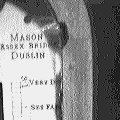
forgot to add them to CVS ;) Here's a nice one -- a ca. 19th century
hygrometer made in the Mason family's opticians shop in Essex Bridge,
Dublin, found in the museum at Collins Barracks:
U.N. Orders
Wonka To Submit To Chocolate Factory Inspections:
UNITED NATIONS -- Responding to pressure from the international community,
the U.N. ordered enigmatic candy maker William 'Willy' Wonka to submit to
chocolate-factory inspections Monday. 'For years, Wonka has hidden the
ominous doings of his research and development facility from the outside
world,' U.N. Secretary General Kofi Annan said. 'Given the reports of
child disappearances, technological advances in glass-elevator transport,
and Wonka-run Oompa-Loompa forced-labor camps, the time has come to put an
end to three decades of secrecy in the Wonka Empire.'
a memorable mistranslation found in a guesthouse at Annapurna Base Camp
:

Help! I'm being underclocked! ;) Perhaps that explained the shortness of
breath and dizziness...
(I did some scanning of the hundreds of photos from last year's trip about
a month ago, but haven't had a chance to fix 'em all up yet. And I'm
not uploading anything until I get to CA and some decent bandwidth.)
A
funny letter from New Scientist regarding the use of monkeys to
collect specimens in the field, which was pioneered by John Corner in
Singapore.
The botanist noticed that local fruit-pickers trained monkeys to collect
fruit, and reasoned that a monkey could similarly be trained to collect
flowers, leaves and nuts for his own work. The result was the collection
of hundreds of otherwise inaccessible specimens -- and this gem:
Travelling with mule and monkey on a narrow path in the uplands, he
spied a new and unrecognised flower on a liana hanging from the path,
down a near-vertical cliff face too steep for him to climb down. So he
instructed the monkey to descend and collect the flower. But the
monkey just looked at him questioningly with its head on one side.
'Go down!' repeated the eminent botanist. At which the monkey gave an
eloquent shrug, took hold of the liana and pulled it up hand over hand
to collect the flower. No human being, said Corner, had ever, before or
since, made him feel so much of a fool.
Boing Boing
notes that the SQL Slammer worm 'caused service outages at tens of
thousands of Bank of America ATMs and wreaked havoc at Continental
Airlines. Apparently, customers at most of the #3 American bank's 13,000
automatic teller machines were unable to process transactions for a period
of time.'
Does anyone else find it very scary to contemplate an ATM network
connected to the internet, with a sufficiently open set of firewalls
that a semi-documented Microsoftish SQL protocol can traverse as far
as the ATM servers? Sure, it probably took a few hops, compromising a
couple of SQL servers along the way, but each of the firewalls in question
must have had that MS-SQL port open for those servers. Yikes.
Someone should teach those guys about network compartmentalization for
security; something like an ATM network, where security is hugely
essential, should never have a direct IP-based connection to the internet,
no matter how many firewalls and gateways are in place.
Spam:
NACS: Spam Detection. Great, Catherine's new email system at UCI uses SpamAssassin. Nothing like
getting bug reports from your SO ;)
On the other side, though, they've written an
excellent set of pages on how to detect and act on the SpamAssassin
markup in various MUAs.
Kim Jong Il Unfolds Into Giant Robot (Onion). Met up with Paddy
Benson last night for a few drinks, and he let me into the secret
that The Onion is, once again, officially funny:
'If we add Kim Jong Il's transformation into a giant robot to his
already defiant isolationist stance and his country's known nuclear
capability, the diplomatic terrain definitely becomes more rocky,'
U.S. envoy James Kelly said. 'Kim has made it clear that, if
sufficiently threatened, he will not hesitate to use nuclear weapons
or his arm-mounted HyperBazooka.'
'We are also forced to consider the possibility that Kim may attempt
to robo-meld with other members of the Axis of Evil, forming a
MegaMecha-Optima-Robosoldier. Kim would make a powerful right arm --
or even a torso -- for such a mechanism.'
Wotcher Paddy!
Matt Blaze has posted a very neat exploit against
'weaknesses in most master-keyed lock systems, such as those used by
offices, schools, and businesses as well as by some residential facilities
(particularly apartment complexes, dormitories, and condominiums). These
weaknesses allow anyone with access to the key to a single lock to create
easily the master key that opens every lock in the entire system.
Creating such a key requires no special skill, leaves behind no evidence,
and does not require engaging in recognizably suspicious behavior. The
only materials required are a metal file and a small number of blank keys,
which are often easy to obtain.'
'The vulnerability was discovered by applying the techniques of
cryptanalysis, ordinarily used to break secret codes, to the analysis
of mechanical lock design.'
Paper here.
Daphne
Oram, one of the pioneers of electronic music, has died. (BBC)
Almost un-noticed by the wider world, one of the pioneers of electronic
music has died. Without Daphne Oram, we may never had known what the
Tardis sounded like. Electronic music - as much a part of today's life
as whistling a tune to yourself - grew up amid milk bottles, gravel,
keys, and yards of magnetic tape and wires. These were the sort of
tools typically scattered around the BBC's Radiophonic Workshop in the
1950s and 60s, when they were used to generate wonderful and ethereal
sounds for the airwaves. The mother of this great legacy was Daphne
Oram. Aged 18, and armed with a passionate interest in sound, music and
electronics, she started work at the BBC in 1943 as a sound engineer.
Another
good trip report, from 'babbage' at perl.org.
-
Again, and interestingly, quite a few folks agreed with one of SA's
core tenets; no single approach (stats, RBLs, rules, distributed
hashes) can filter effectively on its own, as spammers will soon
figure out a way to subvert that technique. However, if you combine
several techniques, they cannot all be subverted at once, so your
effectiveness in the face of active attacks is much better.
-
Also interesting to note how everyone working with learning-based
approaches commented on how hard it was to persuade 'normal people' to
keep a corpus. Let's hope SA's auto-training will work well enough to
avoid that problem.
-
in passing -- babbage
noted the old canard about Hotmail selling their user database to
spammers. That must really piss the Hotmail folks off ;) I think it's
much more likely that, with Moore's Law and the modern internet, a
dictionary attack *will* find your account eventually.
-
Good tip on the legal angle from John Praed of The Internet Law Group:
if a spam misuses the name of a trademarked product like 'Viagra', get
a copy to Pfizer pronto. Trademark holders have a particular desire
to follow up on infringements like this, as an undefended trademark
loses its TM status otherwise.
-
David Berlind, ZDNet executive editor: 'They don't want to be involved
(in developing an SMTPng)'. He might say that, but I bet their folks
working on sending out their bulk-mailed email newsletters might
disagree ;). Legit bulk mail senders have to be involved for
it to work, and they will want to be involved, too.
-
Brightmail have a patent on spam honeypots? Must take a look for this
sometime.
-
the plural of 'corpus' is 'corpora' ;)
Great report, overall.
It's interesting to see that
Infoworld notes that reps from AOL, Yahoo! and MS were all present.
Since the conf, Paul Graham
has a new paper up about 'Better Bayesian Filtering', and lists some
new tokenization techniques he's using:
-
keep dollar signs, exclamation and most punctuation intact (we do
that!)
-
prepend header names to header-mined tokens (us too!)
-
case is preserved (ditto!)
-
keep 'degenerate' tokens; 'Subject:FREE!!!' degenerates to
'Subject:free', to 'FREE!!!', and 'free'. (ditto! well, partly. We
use degeneration of tokens, but we keep the degenerate tokens in a
separate, prefixed namespace from the non-degenerate ones, as he
contemplates in footnote 7. It's worth noting that case-sensitivity
didn't work well compared to the database bloat it produced; each
token needs to be duplicated into the case-insensitive namespace, but
that doubled the database size, and the hit-rate didn't go up nearly
enough to make it worthwhile.)
Most of these were also discovered and verified experimentally by
SpamBayes, too, BTW.
When we were working on SpamAssassin's Bayesian-ish implementation,
we took a scientific approach, and used suggestions from the SpamBayes
folks and from the SpamAssassin community on tokenizer and stats-combining
techniques. We then tested these experimentally on a test corpus,
and posted the results. In almost all cases, our results matched
up with the SpamBayes folks' results, which is very nice, in a scientific
sense.
(PS: update on the Fly UI story -- 'apis' is not French, it's Latin. oops!
Thanks Craig...)
Kaitlin Duck Sherwood writes a trip report. Good tidbits:
-
many big players in the mail-sending side want to see an SMTPng;
a new protocol which is spam-resistant.
-
Jon Praed of the Internet Law Group said that 'better spam filters
make his job easier: the more contortions that a spammer goes through
to make sure that the messages go through, the easier it is to
convince a judge that the spammer knew it was wrong.' Excellent!
Andrew McGlinchey
writes about a Fly UI: 'I
have seen one of the finest instances of user interface design ever, and I
saw it in the men's room at Schipol airport in Amsterdam. In each of the
urinals, there is a little printed blue fly. It looks a lot like a real
fly, but it's definitely iconic - you're not supposed to believe it's a
real fly. It's printed near the drain, and slightly to the left.'
I've heard of this one before, and yes, it is an aiming-improvement UI.
It started in France around the turn of the century, if I recall
correctly. One important fact: it's not a fly -- it's a bee. You see,
it's also a visual pun -- the french for 'bee' is 'apis', geddit?
(I'd have commented on the blog, itself, but it's one of those 'create an
account to comment' places -- too much trouble!)
He's also spot-on about why
tea is big in Ireland: 'The climate is cool, grey and damp. Steady
doses of warm drink with a nice gentle caffeine push really keeps you
going.' Hey, works in the Himalayas too ;)
BoingBoing, back
in December, forwarded this snippet: 'A report issued by UK-based Infrastructure Forum ('TIF') says
spam-savvy thieves are using info from 'out of office' email
autoresponders and cross-referencing it with publicly available personal
data to target empty homes.'
Criminals are buying huge lists of email addresses over the internet and
sending mass-mailings in the hope of receiving 'out of office'
auto-responses from workers away on holiday.
By cross-reference such replies with publicly available information from
online directories such as 192.com or bt.com, the burglars can often
discover the name, address and telephone number of the person on
holiday. Tif is advising users to warn their staff to be careful of the
information they put in their 'out of office' messages.
"You wouldn't go on holiday with a note pinned to your door saying who
you were, how long you were away for and when you were coming back, so
why would you put this in an email?" said David Roberts, chief executive
at Tif. (via VNUNet)
My take on this? Bullshit.
I mean, how many house burglars (a) have the know-how to set up a fast
internet connection, get hold of an addresses CD, and send a spam; and
then (b) how often does a Reply-To address on a spam stay active once it's
sent -- assuming it ever worked in the first place -- before the ISP
whacks their account? I would guess 6 hours at the most, and most spam
runs wouldn't even be halfway through by that stage (from what I hear).
Self-promoting bullshit of the highest order I reckon.
Steppe by
Step (Guardian). "I started wondering if (the 'six degrees of
separation' theory) was true today. ... So 35 years on from the original
experiment, I decided to test out the urban myth on a world stage: how
many steps would it really take to get to someone on the other side of the
planet?"
The London-based "city girl" author, Lucy Leveugle, makes it in 9 steps
(hey, the world has expanded!) to Purev-Ochir Gungaa, a nomadic herdsman
in the middle of the steppes of Outer Mongolia. Amazing.
308
referrer hits from www.xxxstoryarchive.com, 282 from amateur-porn.us, 282
from nude-lesbians.us, etc. Somehow I doubt it. All the hits
are 404s, looking for e.g.
nn.nn.nn.nn - - [12/Jan/2003:18:52:13 +0000] GET /pics54754-96 HTTP/1.1 404 284 http://www.celebrity-nude-pics.com/ "Mozilla/4.0 (compatible; MSIE 6.0; Windows NT 5.1; .NET CLR 1.0.3705)"
Hits from hosts at AT&T WorldNet Services and an SBC PPPoX pool. They're
all MSIE 6 on Windows, and it's been going on for a month or so.
Theory: sounds like MSIE's download-to-'view'-offline functionality has bugs;
when it hits a 404, maybe it requeues that request but then sends it to
entirely the wrong IP.
Alternative theory: it's a pathetically underpowered DDoS. ouch!
Anyone else seen this?
Who knew relocating with a cat could be so tricky?
Well, actually, I did. He hates travel. I'm considering just putting him
in a crate and handing him off to a courier to do it.
Paul Graham's Spam Conference
seems to be doing great; they've moved to a bigger room, and are expecting
480 (!!) attendees.
I still can't make it due to all this movage, but thankfully there's a few
SpamAssassin folks going, so we'll still be able to snarf some good
tricks with any luck.
In other news, the public mass-check submission run for SpamAssassin 2.50
is about to start; with the new with-bayes and with-net-tests dimensions
in the matrix, it's going to be the biggest run yet. Should be fun.
Frequent drinking cuts heart attack risk (New Scientist). ' Half an
alcoholic drink every other day, be it wine, whisky or beer, can reduce
the risk of heart attacks by a third, a new study shows. The 12-year study
published in The New England Journal of Medicine found that the frequency
of drinking was the key to lowering the risk of heart disease, rather than
the amount, the type of alcohol, or whether or not it was drunk with
food.'
Well, looks like it's been announced; McAfee and NAI
are buying Deersoft. I wish I could comment properly, but I'm
in mid-packing right now and things are a total hectic mess :(
New Scientist: Turing tests filter spam email. "Simple tests
designed to distinguish computers from humans are increasingly being used
to clamp down on unsolicited, or 'spam', email advertising."
The article notes that Yahoo! has imposed such a test to block automated
account-signup-then-spam bots. (Thankfully -- that might discourage
some of the more automated 419 spammers.)
Sorry 'bout the lack of blogging -- very busy 'round here, what with
a new SpamAssassin release in the pipeline and a move to the US
in the offing...
|